Fifty for 150: Historic 1921 flood in Pueblo devastates downtown
Jul 13, 2026 | 6:00 am ET
Description
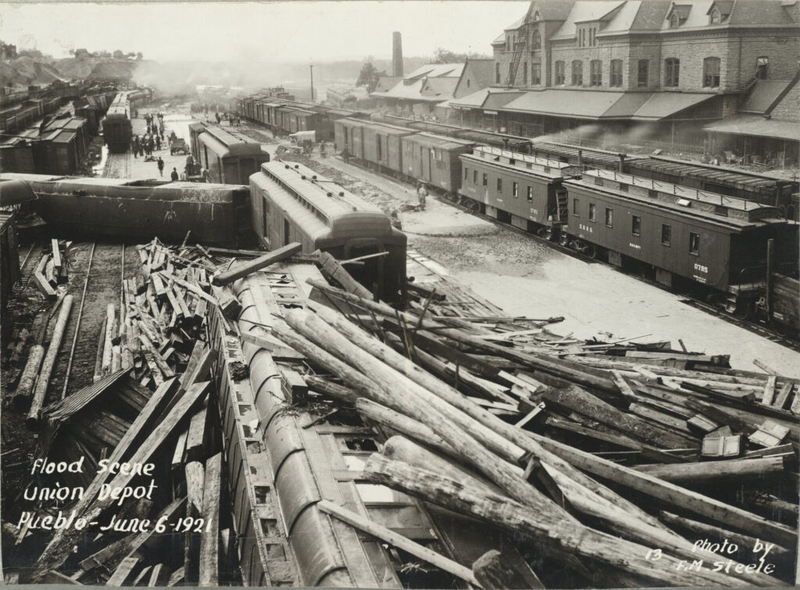
View of damage from the Arkansas River flood at the Union Depot rail yard in Pueblo in 1921. Denver and Rio Grande Western passenger cars are near the passenger platform. Damaged cars are turned over and logs and lumber are scattered across the rail yard. (Courtesy of Denver Public Library Special Collections, Z-5027)
During the evening of June 3, 1921, and into the next morning, the business district in Pueblo was engulfed in raging flood waters after significant rain, cloud bursts and snowmelt caused Fountain Creek to swell and ultimately break through the Arkansas River levees. The result was one of the most destructive and deadly floods in Colorado history, lasting three days and forever altering Pueblo’s infrastructure.
The high water mark at Union Depot was around 10 feet, and some downtown businesses reported being more than 13 feet underwater. At first, onlookers watched the rising waters as a spectacle on flood banks and bridges, but then they rushed to safety. Contemporary newspaper reports detail houses ripped from their foundations and trees barreling down the streets. There was a fire at a lumber yard, and Boy Scouts in a row boat rescued the business owner and his son. The waters derailed passenger trains from the Missouri Pacific and Denver and Rio Grande lines. Pueblo was a significant railroad center at the time.
“The largest flood visiting Pueblo since Decoration day 1894 gutted the business and wholesale business districts of the city last night and early this morning,” says a June 4, 1921, article from The Colorado Daily Chieftain, known today as the Pueblo Chieftain. “Scores of persons were caught as the rushing torrent in the lead of the flood swept around Fourth street and down Main. Most of them escaped by climbing to the second stories of the buildings.”
The display horse from R.T. Frazier’s Saddlery floated 15 miles down to Avondale, its papier-mâché construction somehow surviving the water. “Lucky” the horse now lives at the Pueblo Heritage Museum and has a mural dedicated to it.
By June 8, the Chieftain noted a “marked improvement” of flood conditions with several small rain showers.
“With clearing skies the stout hearted men and women of Pueblo set themselves more resolutely to the task of rehabilitation, even though the cessation of the storms and the clearing of the skies made more apparent the magnitude of the appalling disaster,” said one article.
It’s unknown how many people died and went missing because of the flood — reports vary between about 100 people to 10 times that. Bodies washed up downstream for years and many went unidentified. A contemporary report to the Pueblo City Council stated that 510 dwellings were washed away, and about 5,000 acres of agricultural land became unusable. A later report from the U.S. Department of the Interior noted that “the exact extent of losses to life and property will never be known.”
When the flooding ended, there was about $25 million in damage, about $418 million today. The National Guard, American Red Cross, Salvation Army and Knights of Columbus oversaw recovery and support efforts, and Colorado Sens. Samuel Nicholson and Lawrence Phipps appealed to Congress for $1 million in additional aid.
In the aftermath of the flood, the city, through the newly created Pueblo Conservancy District, rerouted the Arkansas River and built concrete levees to protect downtown. Those levees are now canvasses for the Pueblo Levee Mural Project. The creation of the conservancy district probably cost Pueblo part of its railroad industry. In order to convince Denver-area legislators to vote for the district at the Capitol, Pueblo lawmakers pledged their support for construction of the Moffat Tunnel, which provided the state with a rail connection through the Continental Divide.
The Pueblo Dam was constructed in the 1970s to help with flood control, creating the Pueblo Reservoir over the old town of Swallows. The Historic Arkansas Riverwalk of Pueblo restored the original path of the river and created opportunity for pedal boats, surrounding restaurants and grass space for picnics and city events.
Denver, CO