Fifty for 150: Fearsome East Troublesome Fire caps off 2020’s historic wildfire outbreak
May 29, 2026 | 6:00 am ET
Description
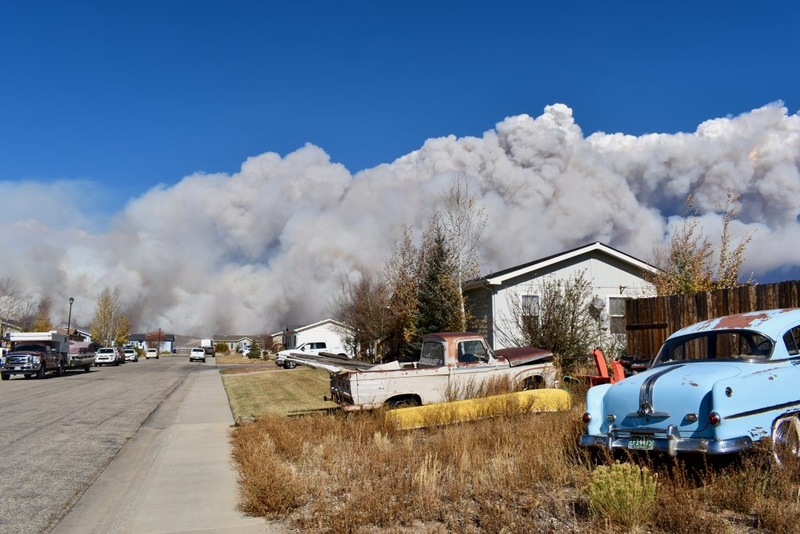
The East Troublesome Fire officials is seen on Oct. 22, 2020. (Chase Woodruff/Colorado Newsline)
In the fall of 2020, as Colorado was reeling from the effects of the COVID-19 pandemic, historic social justice protests and the run-up to a high-stakes presidential election, it suffered yet another blow in the form of an unprecedented outbreak of wildfires fueled by a warming climate.

This story is part of Colorado at 150. Each Fifty for 150 story focuses on an event that helped define Colorado over 150 years of statehood. Newsline is publishing one Fifty for 150 story every weekday in reverse chronological order until the sesquicentennial, Aug. 1, when the final of 50 stories, about the declaration of statehood, will appear.
At the beginning of that summer, 2002’s Hayman Fire ranked as Colorado’s largest wildfire in history, with a total burn area of 138,114 acres. By the end of the year, that mark had been surpassed three times.
The Pine Gulch Fire briefly took the top spot after burning 139,007 acres in remote areas of Mesa and Garfield counties in July 2020. The Cameron Peak Fire in Larimer County, ignited on Aug. 13, burned for the next 112 days, reaching a size of over 208,663 acres. It destroyed nearly 500 buildings, and post-fire flooding in its burn scar later resulted in the deaths of six people.
Other, smaller fires ignited across Colorado all summer long as the state experienced one of its warmest and driest years on record. The skies above the Front Range were regularly choked with wildfire smoke. Interstate 70 through Glenwood Canyon was closed for two weeks in August as crews battled the Grizzly Creek Fire in one of the Western Slope’s most rugged and fragile landscapes.
But it was the East Troublesome Fire, a 193,812-acre blaze that began in Grand County in October, that did the most to herald a harrowing new era of wildfires supercharged by Colorado’s increasingly hotter and drier climate.
After growing to about 20,000 acres in its first week, the East Troublesome Fire exploded amid red-flag conditions on Oct. 21, burning more acres over the next 48 hours than the record-breaking Pine Gulch Fire had burned in four weeks.
So-called pyrocumulonimbus clouds created by the fire’s blowup towered 40,000 feet into the air and were so massive and energetic that they generated their own lightning. At its most intense, it burned 6,000 acres an hour as high winds blew the flames east across Grand County, scorching the headwaters of the Colorado River, entering the boundaries of Rocky Mountain National Park, and even leaping the Continental Divide to raze several historic buildings and trailheads on the park’s eastern side. Smoke from the blaze cloaked much of western Larimer County in an apocalyptic dark-orange glow.
At a community briefing inside a Granby school gymnasium on Oct. 22, fire managers searched for words to describe the events that were unfolding: “Unprecedented.” “Unheard of.” “Amazing.” “Catastrophic.” Rarely, if ever, had they seen a fire make a run like the East Troublesome had — and certainly not high in the northern Rockies in late October.
“We’re supposed to have snow on the ground up here,” Christopher Joyner, a wildland firefighter with the U.S. Forest Service, told Newsline at the time. “It’s hard to even know what to say.”
Residents in Granby and Estes Park were evacuated as the fire raced eastward, filling up hotels and evacuation centers as far away as Black Hawk and Westminster. The community of Grand Lake, a popular summer tourist destination at the west entrance to the park, narrowly avoided catastrophe, but hundreds of homes on the outskirts of town and in other parts of Grand County were destroyed, and two people were killed.
Contributing factors to the fire’s intensity included the Colorado River Basin’s decades-long megadrought, fueled in large part by warmer temperatures and worse than any dry spell the region has experienced in at least 1,200 years. Large forested areas burned by the fire were full of dead timber caused by a bark beetle epidemic, which itself has been made worse by climate change. A weather station near Grand Lake had recorded less than an inch of precipitation between July 1 and Oct. 21, the Colorado Climate Center reported at the time — far less than the typical amount of more than 7 inches, and significantly worse than the next-driest total for such a period on record, the 2.34 inches recorded in 1915.
The East Troublesome Fire caused an estimated $543 million in insurance losses, more than the year’s other two historic blazes combined, briefly becoming the most destructive wildfire in Colorado history — before the Marshall Fire, which consumed more than 1,000 homes in suburban Boulder County, surpassed it the following year.
Denver, CO