Fifty for 150: The 2021 Marshall Fire was the most destructive in Colorado history
May 28, 2026 | 6:00 am ET
Description
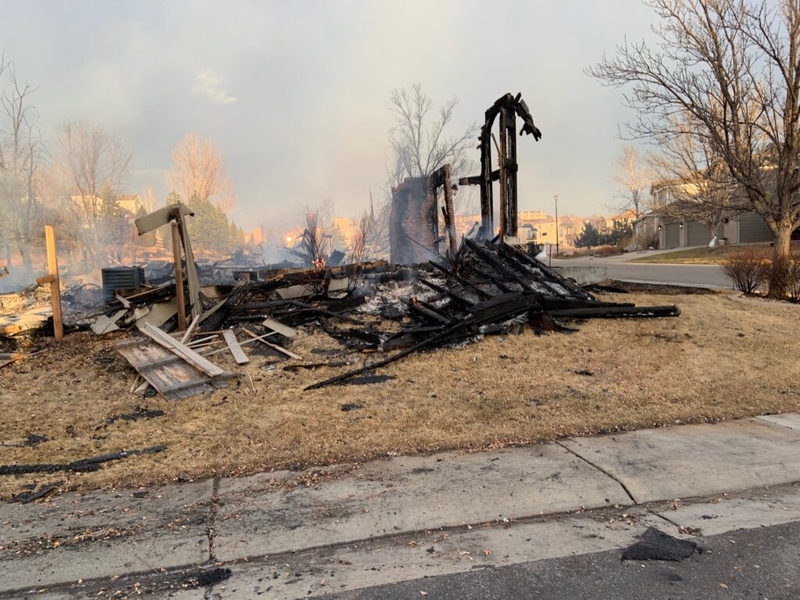
Homes are burned in the Marshall Fire in the Rock Creek neighborhood of Superior, as seen on Dec. 31, 2021. (Courtesy of Bill Wright)
On the morning of Dec. 30, 2021, a low-pressure zone developed just east of the mountains of Boulder, causing unusually high winds. On its own, the winds might have been a mere inconvenience, but the tinderbox environment they encountered created combustible conditions.

This story is part of Colorado at 150. Each Fifty for 150 story focuses on an event that helped define Colorado over 150 years of statehood. Newsline is publishing one Fifty for 150 story every weekday in reverse chronological order until the sesquicentennial, Aug. 1, when the final of 50 stories, about the declaration of statehood, will appear.
Heavy precipitation in the early part of the year was followed by extreme heat and dryness, creating abundant fine fuels. The Front Range in the seven months leading up to Dec. 30 had endured the warmest such period on record. Boulder County was experiencing extreme drought.
So, when a small fire ignited near the mountains, it quickly grew out of control and swept across the county. By the time it was extinguished it had killed two people and destroyed 1,084 homes in Louisville and Superior. Whole neighborhoods were flattened.
It was the most destructive wildfire in Colorado history.
More than a year later, investigators determined that the fire was caused by two distinct ignitions, one sparked by an unmoored Xcel Energy power line and another from embers of a trash fire at the nearby Twelve Tribes property. The two flames merged into a larger fire that advanced east with ferocious intensity.
Xcel Energy, the state’s largest utility, faced a public outcry over its role in the fire. Thousands of homeowners, businesses and insurers sued the utility seeking damages. Xcel settled the case for $640 million, and it instituted a program of preemptive power shutoffs in high-risk areas forecasted to experience high winds, which many annoyed power customers view as a disruptive way for Xcel to avoid liability.
Many factors contributed to the destructive power of the Marshall Fire. Increasing density in previously open spaces was a factor. But climate experts highlighted the unmistakable role of global warming. In fact, events like the Marshall Fire had been foreseen years earlier.
“Climate change, by altering weather patterns, is likely to affect fire extent, frequency, and severity” in the area that includes Colorado, predicted a 2011 study co-authored by conservation scientist David Theobald of Colorado State University.
Colorado House Speaker Alec Garnett acknowledged global warming’s role just days after the fire, when the Colorado Legislature convened for its 2022 session.
“There is no doubt that the severity and the devastation of the Marshall Fire were intensified by our changing climate,” he said in his opening-day address. “What began as a suburban grass fire that would have raised little concern a decade ago ended as a destructive inferno and a reminder that climate change is a clear and present danger.”
Colorado lawmakers have since made some progress in reducing greenhouse gas emissions, but they have done practically nothing to curb the extraction of fossil fuels in the state.
Denver, CO