Louisiana adds money to expand its fortified roof program by 60%
May 27, 2026 | 8:37 pm ET
Description
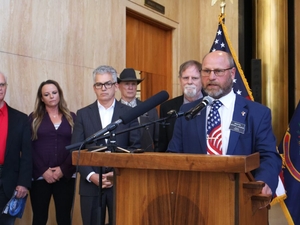
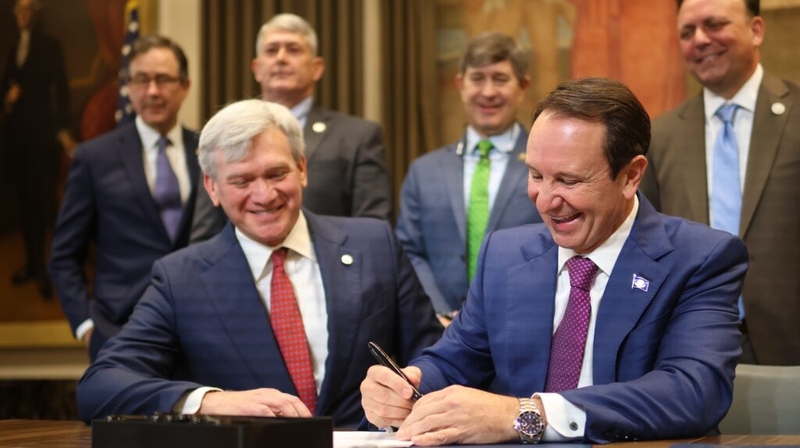
Louisiana Insurance Commissioner Tim Temple, left, and Gov. Jeff Landry sign legislation during a joint press conference May 26, 2026, on passing a one-time spending increase for the state’s popular fortified roof grant program. (Photo: Wes Muller/Louisiana Illuminator)
Another 5,000 Louisiana homeowners will gain access to a state fund to strengthen their roofs to a standard that will withstand hurricanes and eventually bring down their insurance costs.
State lawmakers already planned to put $30 million more into the Louisiana Fortify Homes Program in the state budget for 2026-27. A separate piece of legislation that Gov. Jeff Landry signed Wednesday will add another $50 million.
Landry and Insurance Commissioner Tim Temple announced the increase in a news conference and bill-signing ceremony. The cash influx paves the way for a 60% increase in the number of houses that are expected to add a fortified roof through the state grant program, which Temple said stands at around 4,900 roof upgrades completed since it began in 2023. Grants of up to $10,000 are available, though they may not cover the complete cost of upgrading a roof to hurricane-resistant standards.
The additional $50 million comes from the Louisiana Citizens Property Insurance program, which has a cash surplus after paying off bond debt. Rep. Paul Sawyer, R-Baton Rouge, sponsored House Bill 1187 that allows the Louisiana Department of Insurance to put the surplus toward more fortified roof grants, which are issued to eligible homeowners through a lottery system.
Temple said registration for the next grant lottery for an estimated 3,000 new grants will take place June 1-19 and is open to several more homeowners. Parishes now covered under the program are Acadia, Ascension, Assumption, Calcasieu, Cameron, Iberia, Jefferson, Jefferson Davis, Lafayette, Lafourche, Livingston, Orleans, Plaquemines, St. Bernard, St. Charles, St. James, St. John the Baptist, St. Martin, St. Mary, St. Tammany, Tangipahoa, Terrebonne and Vermilion.
In addition to the $30 million lawmakers already dedicated to the program, the new influx of cash will allow Temple’s office to fund another 5,000 fortified roof grants. Department of Insurance spokesman John Ford said that money is expected to be available in October.
Including the grants the state plans to award this year, the Louisiana Fortify Homes Program will have contributed to strengthening 12,900 residences in storm-prone areas of the state, according to Department of Insurance figures. Another 8,300 fortified roofs have been installed without the state subsidy.
The roof grant program has been wildly popular with Louisiana homeowners who have clamored to register for the program with each new lottery round. It was modeled after a similar program in Alabama, and Temple said Louisiana is closing the gap between the number of grants issued there and in North Carolina, which also has its own program.
At Wednesday’s news conference, the governor praised the fortified roof subsidy as a data-driven solution to Louisiana’s homeowner insurance crisis. The state has seen skyrocketing homeowner premiums over the past several years, with noticeable spikes after five named storms struck Louisiana in over 2020 and 2021.
Leaders in alignment
Last year, the state’s auto insurance crisis drove a political wedge between Landry and Temple, who publicly feuded for months over legislation on the matter. At the time, the governor accused Temple of deliberately keeping rates high, while Temple said the governor was seeking political cover and deflecting blame for the crisis.
On Wednesday, the two Republicans, who were elected on the same ballot in 2023, cordially stood beside each other and shook hands for the news cameras in the room. Landry minimized the rift when asked if their newfound cooperation signaled that they’ve “mended fences” in their relationship.
“I didn’t know we had broke any fences,” Landry said, turning to Temple who began laughing.
The governor attributed some of the escalation to news coverage but suggested the disagreement was a sign of functioning governance.
“If you don’t have tension in this building, nothing gets done,” Landry said, pointing out he and Temple had only disagreed on one bill within a larger package of insurance legislation.
Both officials said fortified roofs are effective at lowering homeowner insurance rates. But the relief has so far been limited to those who can afford to install them without a state subsidy.
An analysis last year from the Louisiana Legislative Auditor found the roof grants directly reduced insurance costs at a median rate of 22% but often come with out-of-pocket costs around $6,229 after accounting for the $10,000 grant.
In recent years, lawmakers have come up with additional ways to help homeowners install fortified roofs, including a $10,000 refundable tax credit that can with or separate from the grants.
Lawmakers passed a bill last year that requires insurers to adjust rates for homeowners who install fortified roofs, though it stops short of requiring a specific discount. Temple has sought to mandate rate discounts through a new agency rule that, in its current version, would require insurers to offer benchmark discounts ranging from 16% to 49% depending on the area of the state and the level of roof upgrade. The rule, which is currently under review, is scheduled to take effect Jan. 1.
To date, 4,900 fortified roofs have been installed with grants from the Department of Insurance, and an additional 8,300 have been installed without grants, Temple said.
Homeowner’s rates
Temple and Landry said the program is starting to work but acknowledged it could take many more roof upgrades in the state’s coastal zone to have a wider effect on insurance rates statewide.
“Insurance premiums as a whole, on property and auto, are coming down,” Landry said.
Temple’s office touted several rate decreases on homeowner’s coverage last year, though news in 2026 has so far been mixed.
From January through April, three insurers have filed homeowner rate decreases for nearly 34,000 policyholders in Louisiana. The biggest savings include a 10% drop for the 23,700 homeowners with Cajun Underwriters and a 7.7% rate drop for the 6,100 policyholders with Encompass Insurance, according to Department of Insurance data.
Four other underwriters are raising rates on more than 99,000 homeowners statewide. The biggest cost hikes are coming from USAA, which filed a 9.2% rate increase on its roughly 76,200 policyholders, and from Progressive’s 2.9% increase on 21,100 homeowners.
The new rates will apply to both new and existing policies up for renewal this year.
Auto rates
Louisiana’s private passenger auto insurance market has fared slightly better this year with eight insurers cutting rates for roughly 131,000 policyholders statewide, insurance department data show.
The largest savings include a 10.6% drop for the 39,300 drivers insured with Southern Farm Bureau, a 7.5% drop for Allstate’s 17,600 customers, and a 6% rate cut for Imperial Fire & Casualty’s 41,500 policyholders.
At the same time, six other companies are raising car insurance rates on roughly 50,000 policyholders. The worst of these includes Geico’s 7.9% rate hike on 36,500 Louisiana drivers and American National’s 5% hike affecting roughly 4,200 policyholders.
“Louisiana remains one of the most challenging insurance markets,” Temple said.
Baton Rouge, LA