Fifty for 150: Strike in Brighton becomes a key Chicano Movement moment in 1968
Jul 01, 2026 | 6:00 am ET
Description
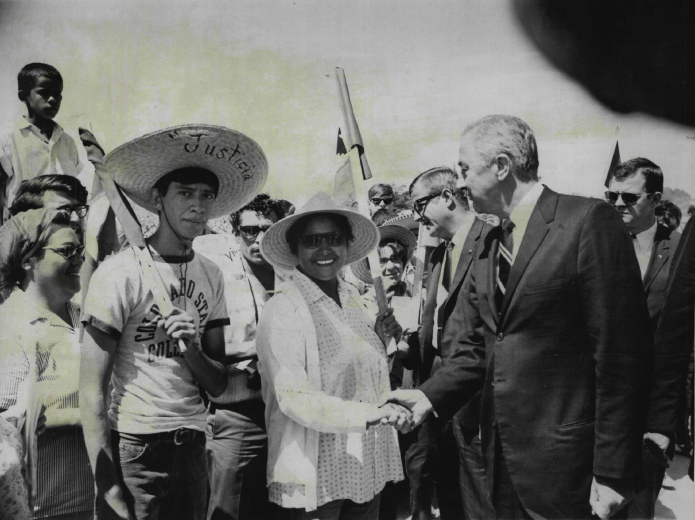
U.S. Sen. Eugene McCarthy meets with Lupe Briseño, center, and striking workers at the Kitayama flower plant in Brighton, in July 1968. (Courtesy of Denver Post via Denver Public Library)
In 1968, Lupe Briseño had four young kids in school when she decided to go to work to bring in some extra income for the family. She found a job at Kitayama Floral Corporation in Brighton. The pay was 98 cents an hour.

This story is part of Colorado at 150. Each Fifty for 150 story focuses on an event that helped define Colorado over 150 years of statehood. Newsline is publishing one Fifty for 150 story every weekday in reverse chronological order until the sesquicentennial, Aug. 1, when the final of 50 stories, about the declaration of statehood, will appear.
She soon discovered that conditions at the site, where she cut carnations with many older women from Mexico, were appalling.
“We didn’t have a lunch room,” she recalled years later. “The garbage was right here next to us where we eat. The rats are all over. The ground is wet because they water the carnations, and you’re walking in the mud.”
Illness was common, but sick time was not available. Refusing to tolerate such squalor, she began to organize the workers. When they gathered at a community center in Brighton, Ray Kitayama, the company’s owner, arrived and demanded they go home. Briseño said Kitayama likened the workers to “pigs.”
The next day, Weld County law enforcement officers were present at the plant, which intimidated many of the workers. At the end of her shift, Briseño noticed someone had snuck into her home. Kitayama and one of his deputies were waiting for her inside. He fired her.
“I said, ‘This is not the end. I will fight you, because what you’re doing is wrong,'” Briseño recalled. “It doesn’t matter what kind of work you’re doing, you work with pride and dignity and respect.”
And with that, the Kitayama Carnation Strike commenced.
The strike today is recognized as a pivotal event in the national Chicano Movement, as well as an inspiration for labor and women’s rights advocates. It helped establish Colorado as a wellspring of Chicano activism, which was led by figures such as Denver’s own Rodolfo “Corky” Gonzales, a boxer and poet whose poem “Yo soy Joaquin” was something of a founding document of the movement.
“Rich in courage/And/Wealthy in spirit and faith./My knees are caked with mud./My hands calloused from the hoe. I have made the Anglo rich …,” the poem says.
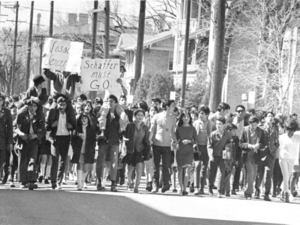
Gonzales provided support for the Kitayama strike, as did another movement leader, Cesar Chavez, and students from the University of Colorado Boulder. At one point Democratic U.S. Sen. Eugene McCarthy, who ran for president that year, showed up. Other women at the plant are credited with helping to organize the strike, including Martha del Rael, Mary Padilla, Mary Silas and Rachel Sandoval, who was pregnant at the time. With an eye to securing improvements beyond the Kitayama plant, they created the National Floral Workers Organization.
Briseño, who died in 2024, was inducted into the Colorado Women’s Hall of Fame in 2020. “She demonstrated the strength and power of Latina leadership in Colorado’s Labor Movement and set the stage for the Colorado Chicano Civil Rights Movement of the 1960s and 70s,” her dedication page says. “Her story is an essential chapter in the history of Colorado, the evolution of Latina feminist leadership, and the struggle for Chicano civil rights.”
The strikers started picketing in July 1968 and persisted for 221 days. They were asking for a minimum wage of $1.60 an hour, improved working conditions, and union recognition. Winter took a toll. As a “last-ditch effort,” they chained themselves to the Kitayama gate, drawing a violent response from Weld County law enforcement, which cut the chains and tear-gassed the women, according to History Colorado.
In some ways the strike fell short. The workers were never able to form a union. But Briseño said working conditions did improve at Kitayama, which soon closed. And her influence remains powerful. The story of the strike was dramatized in “War of the Flowers,” a play by Anthony J Garcia that was produced by Su Teatro in 2021.
“Whether or not Briseño viewed herself as part of a broader movement for Chicano/a justice at the time, it is clear that this small strike on the outskirts of Denver quickly became part of the larger narrative,” History Colorado says.
Denver, CO