Fifty for 150: Kerouac’s ‘On the Road’ immortalizes mid-century Denver with 1957 publication
Jul 03, 2026 | 5:55 am ET
Description
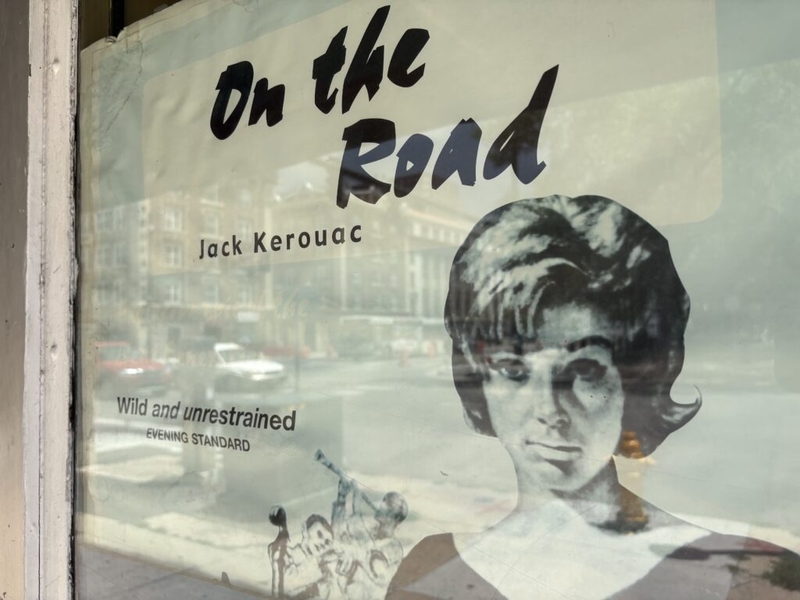
A poster for Jack Kerouac's "On the Road" hangs in a window of Capitol Hill Books in Denver. Colfax Avenue, which appears in the novel, is reflected in the window. (Photo by Quentin Young/Colorado Newsline)
Early in the semi-autobiographical novel “On the Road,” the young New York writer Sal Paradise decides to make a cross-country trip, and he dreams of the good times he’ll have in the “Promised Land” of Denver, home of the mythical character Dean Moriarty.
Paradise, a stand-in for author Jack Kerouac, buses and hitchhikes until he reaches Wyoming and heads south to Colorado, where he plans to see characters who were inspired by the real-life poet Allen Ginsberg, the archaeologist Haldon Chase, the architect Ed White, the architecture critic Allan Temko and other notables in Kerouac’s milieu.
A driver drops him off in Longmont. Kerouac writes, “And here I am in Colorado! I kept thinking gleefully. Damn! Damn! Damn! … I pictured myself in a Denver bar that night, with all the gang, and in their eyes I would be strange and ragged and like the Prophet who has walked across the land to bring the dark Word, and the only Word I had was ‘Wow!'”
Another driver takes him the rest of the way. “He let me off at Larimer Street. I stumbled along with the most wicked grin of joy in the world, among the old bums and beat cowboys of Larimer Street.”
Published in 1957, 10 years after Kerouac visited Denver, “On the Road” was a seminal work of freewheeling literary style that helped define the Beat Generation and launch the American counterculture of the following decade. Moriarty was inspired by larger-than-life Denver native Neal Cassady, a notorious car thief who in the 1960s became a hippie hero when he went out on the road with the Merry Pranksters as the driver of their bus, Furthur. Denver and Colorado play an outsize role in the novel.
Kerouac’s writing of the book is the stuff of legend. He is said to have typed it out in a frenetic 20 days in 1951, an apocryphal passage in a truly fascinating story of its publication. The draft was a 120-foot stretch of paper known as “the scroll,” which itself is something of a work of art. In 2007, The Denver Public Library exhibited the scroll during an exhibition that drew Beat pilgrims to gawk at the storied object as if it were a holy relic.
In a review of the exhibit at the time, John Wenzel of The Denver Post noted Denver symbolized for Kerouac “both youthful potential and the harsh, untamed landscape of the west,” adding, “Kerouac’s burning enthusiasm for Denver is part of the reason he so effectively crystallizes the hallmarks of our city.”
Many of the places frequented by Kerouac or his buddies still exist. They include Sonny Lawson Field on Welton Street, My Brother’s Bar and the nearby Confluence Park on the Platte River, the Colburn Hotel on Grant Street, and Civic Center Park. They also haunted the Five Points neighborhood and numerous bars on Colfax Avenue.
In “On the Road,” Kerouac describes going to see the Beethoven opera “Fidelio” in Central City, where Paradise and friends throw a party at “an old miner’s house at the edge of town.”
“It was a wonderful night,” Kerouac writes. “Central City is two miles high; at first you get drunk on the altitude, then you get tired, and there’s a fever in your soul.” Later he gazes up to pine trees silhouetted in the moon and ruminates on “the great Western Slope” and the desert beyond, “all in darkness now as we fumed and screamed in our mountain nook, mad drunken Americans in the mighty land. We were on the roof of America and all we could do was yell, I guess …”
Kerouac died in Florida at 47 in 1969, from complications of alcohol abuse. But his most famous work lives on. “On the Road” regularly shows up on lists of best American books. And his influence in Colorado persists, most visibly in the Jack Kerouac School of Disembodied Poetics at Naropa University in Boulder.
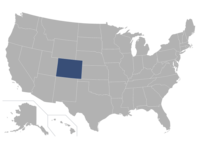
Denver, CO