Fifty for 150: First cadets graduate from U.S. Air Force Academy in 1959
Jul 02, 2026 | 6:00 am ET
Description
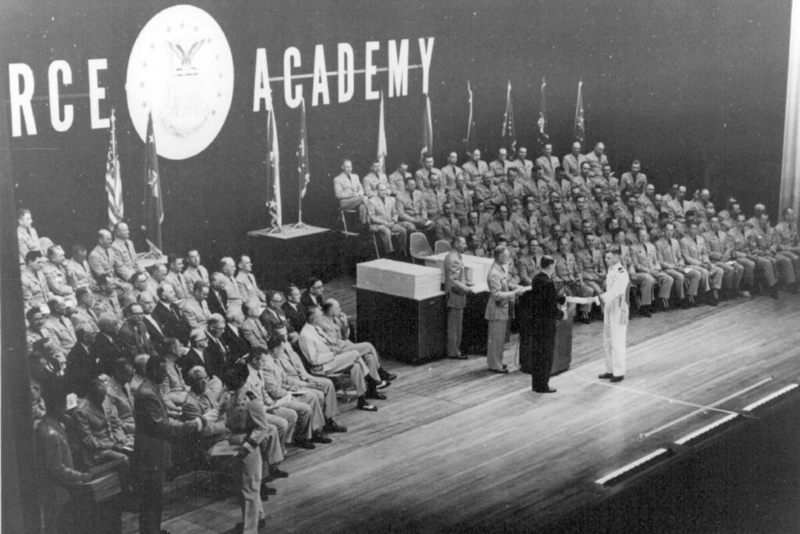
The first U.S. Air Force Academy graduation was on June 3, 1959 in Colorado Springs. (Photo courtesy of U.S. Air Force Academy)
Over 200 cadets made up the first graduating class at the U.S. Air Force Academy in Colorado Springs and completed their work on June 3, 1959.
“With a thundering shout, the 207 cadets hurled their white caps into the air as Brig. Gen. Henry R. Sullivan, academy commandant, stepped to the microphone onstage in the cadet theater at 10:45 am. and announced: ‘Gentlemen of the graduating class—you are dismissed,'” reported The Rocky Mountain News the following morning.
Of those 207 male cadets, 205 became lieutenants, one took a Marine Corps commission and one person did not meet the physical requirements for a commission. The top scholar in the class, Bradley Hosmer, went on to become the first graduate to serve as the academy’s superintendent in 1991.
At that first graduation held indoors at Arnold Hall, the academy superintendent read a message from President Dwight Eisenhower and the chairman of the Joint Chiefs of Staff.
Congress authorized the creation of the academy in 1954, and that first class was sworn in at a temporary site at Lowry Air Force Base in Denver the next year. Active-duty Air Force second lieutenants served the role as “upperclassmen,” known then as Air Training Officers. The academy in Colorado Springs was finally ready for occupancy in 1958.
Three cities were in consideration for the academy site: Alton, Illinois; Lake Geneva, Wisconsin; and Colorado Springs. Officials were concerned if the Rocky Mountains and its wind patterns would be suitable for flight training, but after famous aviator Charles Lindbergh flew over the area and said it was suitable, the Air Force secretary chose Colorado Springs. The state contributed over $1 million to purchase the property.
Denver, CO