WPRI debate showcases a crowded, but not contentious, Democratic primary for lieutenant governor
Jul 31, 2026 | 6:14 pm ET
Description
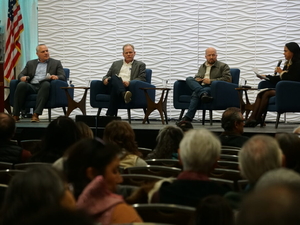
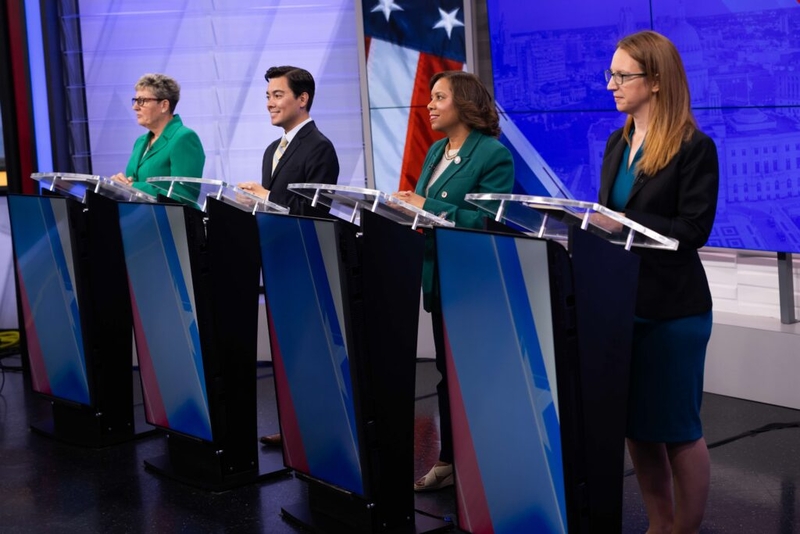
Democratic candidates for lieutenant governor, from left, former state Sen. Cindy Coyne, Newport City Councilor Xay Khamsyvoravong, Lt. Gov. Sabina Matos and Providence City Councilor Sue AnderBois stand behind WPRI 12’s new podiums during a debate taped in East Providence on Friday, July 31, 2026. (Photo by James Bartone/WPRI 12)
By Rhode Island standards, the Democratic primary for the lieutenant governor’s job is a packed one.
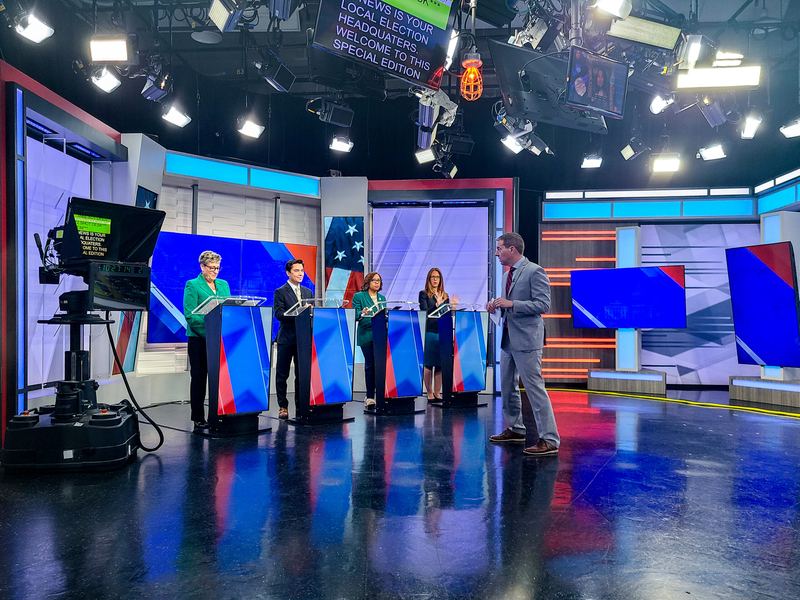
Yet the five-candidate contest for the seat currently occupied by Lt. Gov. Sabina Matos has received somewhat scant attention, WPRI 12 politics editor Ted Nesi remarked to four of the candidates shortly before the cameras rolled on a debate taped Friday morning at WPRI’s studios in East Providence.
As if to commemorate the occasion of their first televised debate, the TV station had recently purchased a new set of podiums with animated monitors on the front. Xay Khamsyvoravong, a Newport city councilor and former mayor of the City by the Sea, joked that the podiums were “custom designed for our respective heights.”
From behind those new podiums, the candidates — Matos, Khamsyvoravong, Providence City Councilor Sue AnderBois and former state Sen. Cindy Coyne — mostly stood on common ground.
The four Democrats unanimously supported the state’s new millionaires’ tax. All four said they preferred Rhode Island’s 2033 deadline for achieving 100% renewable electricity, rather than set a new deadline of 2050 as Gov. Dan McKee has suggested.
None offered an endorsement in the Providence mayoral race when asked.
And the quartet agreed McKee was right to sign the charter school moratorium.
The sharpest disagreement may have jutted out from the candidates’ different ideas about what a good relationship between governor and lieutenant governor should look like in a state where the two officeholders are elected separately.
Who wants to be a ‘shadow governor’?
Early in the McKee administration, Nesi noted, press releases shared news from the “McKee-Matos administration,” a label that fell into disuse “a long time ago.”
“Do you still consider yourself Gov. McKee’s partner today?” Nesi asked Matos.
Matos acknowledged that this previously united front was mostly due to how she obtained the office, having applied for the position when McKee opened it to contenders in 2021.
But Matos said the state must “change the way we elect the lieutenant governor.”
Her solution, which she said she’d work on instituting if elected, would adopt a model closer to that of Massachusetts, in which the governor and lieutenant governor run separately in the primary but on a combined ticket in the general election.
“It’s a challenge for a governor, lieutenant governor, to be able to have that relationship because they’re not elected together,” Matos said. “There’s always going to be people around the governor that only want one governor. The governor doesn’t want a shadow governor, nor (do) the people around him want a shadow governor.”
She also said that a lieutenant governor who completes the remainder of a governor’s term should not be permitted to run immediately for a full term.
Nesi pivoted to Khamsyvoravong next about the office’s needs, which the Newporter described as “clear scope, clear support, a clear plan for what you’re doing.”
He offered as an example the relationship between former Gov. Gina Raimondo and then-General Treasurer Seth Magaziner, calling it “the best relationship between a governor and a general officer that I have seen in my lifetime.”
Raimondo defined a mission for Magaziner to find school construction funding, and that led to billions for the state, Khamsyvoravong said.
“That is the type of relationship that should exist between the lieutenant governor and the governor,” he added.
Matos chimed in briefly, citing that example as an unequivalent one.
“A lot of the work that the governor does depends on also having a good relationship with the investment that the state is making with the treasurer,” Matos said. “So there’s always going to be a better relationship between the treasurer and the governor than with the lieutenant governor and the governor.”
Four Democrats paint their views for the ‘entrepreneurial’ lieutenant governor’s office
Coyne said eight years in the state Senate taught her the path to get legislation from “a piece of paper to the governor’s office” is knowledge that’s “not in a book anywhere,” and it’s knowledge she’d share with the governor’s team.
Nesi countered that McKee wanted a similar rapport when he was lieutenant governor, but that “it wasn’t on offer from Governor Raimondo.”
“Well, we try to collaborate as best as we can,” Coyne said, adding one can still use the office as a “bully pulpit” or reroute legislative priorities through teamwork with the General Assembly.
AnderBois described herself as “radically collaborative,” pointing to her experience coordinating work across state agencies as Rhode Island’s first director of food strategy.
Still, AnderBois warned: “I’m very collaborative and very friendly, but you can’t push me around.”
Seven successions in state history
Rhode Island’s lieutenant governor has fewer constitutional duties than those in other states.
But one big responsibility remains, as prescribed in the state constitution: If the governor should “die, remove from the state, refuse to serve; become insane, or be otherwise incapacitated,” the lieutenant governor steps up to the plate.
“The importance of this office is not lost on anyone,” WPRI investigative reporter Tim White said at the start of the debate. He noted that McKee became governor after his boss Gina Raimondo left for a job in Joe Biden’s administration.
A 2021 analysis in the Boston Globe showed that a lieutenant governor taking over for the governor of Rhode Island has only happened seven times since the Constitution’s ratification in 1842.
Still, it does happen. And it can bring an unwelcome inheritance, White noted. In McKee’s case, it would be the Washington Bridge debacle, he posited.
“If you suddenly found yourself in that chair, name one specific thing you would have done differently at the start of the bridge crisis,” White asked the four candidates.
All agreed McKee was wise to close the bridge’s westbound span. They differed on the details.
Khamsyvoravong said the state should have concentrated its resources on repairing the bridge, comparing McKee’s response to Pennsylvania Gov. Josh Shapiro’s response to the 2023 collapse of an Interstate 95 overpass.
Matos said she would have routed financial assistance to affected businesses faster.
AnderBois said she would have accepted responsibility from the outset rather than blaming previous administrations, and pondered “more creative solutions to get people from one side of our state to the other, not just ‘how many cars can we pack on that bridge?’”
East Bay resident Coyne said the administration’s communication needed improvement.
“I’m still waiting for the day of reckoning,” Coyne said, recalling McKee’s March 2024 promise to hold accountable those responsible for the bridge’s failure.
There was almost unanimity again on the question of whether former Rhode Island Department of Transportation (RIDOT) Director Peter Alviti Jr. should have been removed sooner.
Coyne, Khamsyvoravong and AnderBois said they would have removed him from his role.
Matos, meanwhile, said she would not have replaced Alviti “in the middle of the crisis.”
“I think we needed his expertise and the knowledge that he had in order to get through the crisis,” Matos offered. “It’s very difficult when we just shut down a bridge [and] make changes in an organization like DOT that touches so many other projects that are happening right now.”
The candidates also debated abolishing ICE (Matos and AnderBois supported the idea, while Khamsyvoravong and Coyne favored reform), clean energy guidelines (all four agreed to keep the renewable energy deadline at 2033, with Matos noting this was one of her diversions from McKee), and the charter school moratorium’s legal aftershocks. AnderBois and Khamsyvoravong were broadly curious about how the legislation came to affect De La Comunidad, the school which was prevented from opening and is now suing McKee. But all four candidates echoed one after the other that it’s now a matter for the courts.
The fifth candidate for LG, Ross McCurdy, did not participate in the debate. Per the rules of WPRI’s parent company Nexstar Media, candidates for statewide office must have reported at least $100,000 in campaign contributions, with at least 25% raised in-state, to participate in televised debates.
McCurdy’s most recent campaign account filing shows he had a total of $632.83 in contributions during the quarter that ended June 30. McCurdy, who also did not attend the candidates’ previous debate at WPRO 630 AM, could not immediately be reached for comment Friday.
The Democratic primary is scheduled for Sept. 9, and early voting begins Aug. 20.
The winner of the primary will go on to face Republican John Loughlin II in November’s general election.
Providence, RI