Colorado inspection law unfairly singles out ICE detention center, operator’s lawyers say
Jul 31, 2026 | 6:20 pm ET
Description
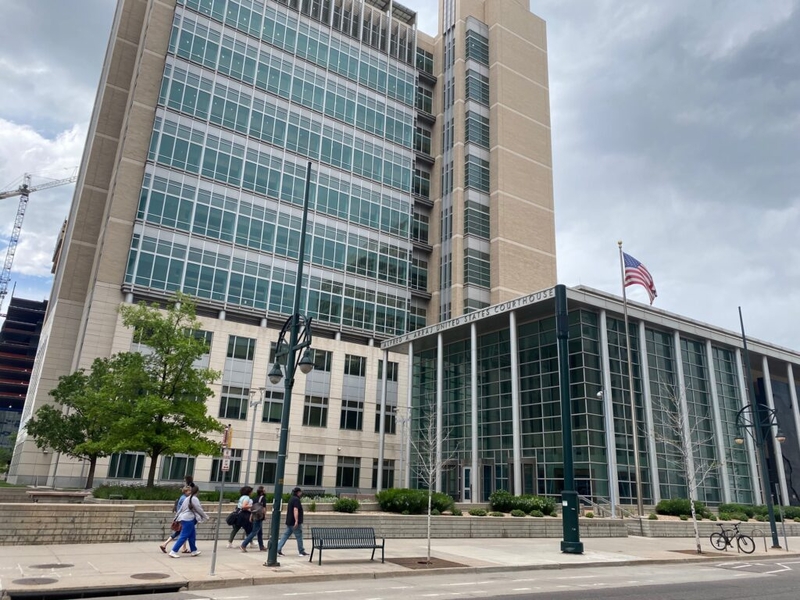
A view of the Alfred A. Arraj U.S. Courthouse in downtown Denver on May 30, 2023. (Quentin Young/Colorado Newsline)
Lawyers for the private company that runs Colorado’s only immigration detention center told a judge Friday that a new state law is unfairly discriminatory and should be struck down.
The GEO Group sued the state over House Bill 26-1276, a new law that requires more frequent health and safety inspections inside immigration detention centers and allows the state to impose civil penalties for noncompliance. GEO operates the facility in Aurora under a contract from U.S. Immigration and Customs Enforcement.
“This (case) isn’t about the general background of public health laws. This isn’t about creating a new inspection authority. This is about a state’s attempt to directly and specifically regulate, through targeted legislation, a single facility in the state,” Fred Yarger, one of GEO’s lawyers, told U.S. District Court Judge Daniel Domenico during a hearing Monday morning.
Yarger said that because there is only one facility in the state subject to the “bespoke” new law, it is discriminatory. The new regulations, he said, present an additional burden outside of existing public health inspection laws.
“It’s not simply the same (inspection) regime as before. If it was, the General Assembly would not have passed (the law),” he said.
GEO Group sues over new Colorado law requiring immigration detention center safety inspections
The state cannot regulate the federal government, Yarger said, but it is circumventing that restriction by regulating the government’s contractor instead. The law specifically carves out facilities directly operated by the federal government and it instead applies to contractor-operated facilities that “house or detain individuals who are noncitizens for purposes of civil immigration proceedings.”
That can only apply to the GEO site in Aurora.
GEO is asking the court to issue a preliminary injunction against the new law, which Democrats in the Legislature passed this year. It sets a minimum number of yearly health and safety inspections at the facility, requires GEO to pay for those inspections and lets the attorney general bring civil penalties against the company for noncompliance. Its provisions also cover how minors can be detained, mental health worker staffing minimums and annual reporting requirements.
Yarger argued that the law directly conflicts with the detention center contract GEO has with ICE. That contract requires that medical workers, including mental health professionals, are available at all times, but the new law states that someone must be physically on site. The contract also requires that GEO abide by ICE’s determination about access. Domenico questioned why he shouldn’t assume those contractual provisions with ICE include the expectation that GEO will comply with state and local laws.
Yarger said “the notion that through this contract, the (U.S. Secretary of Homeland Security) consented to any state law … it’s not a fair reading of the contract.”
Concerns are speculative
Talia Kraemer, representing the state, contended that there are no current or imminent threats to GEO, because the parts of the law that impose new requirements, such as around medical workers, have not undergone the rulemaking process through the Colorado Department of Public Health and Environment. That could take many months and would include an opportunity for input from GEO. The company’s concerns are speculative, she said.
Kraemer said the state only views the section related to inspections as in effect. In fact, state lawyers said, GEO has had favorable treatment historically because it has faced fewer required inspections than other penal facilities like state prisons and county jails.
“The fact the General Assembly has imposed a minimum inspections … does not indicate that Aurora has been singled out,” state lawyer Gabriel Podesta said.
Domenico asked the state’s lawyers where the constitutional line is when it comes to regulations of federal contractors.
“What if the regulations the state wanted to impose were so onerous that, maybe it didn’t make it impossible, but … that would make it effectively that nobody could profitably operate one of these?” he said. “Does it make sense to say ‘Well, the federal government contracts, and they’re allowed to comply with their contractural provisions, and anything beyond that is interfering with the federal government’s chosen methods?”
Domenico said he will issue a written order on the matter “as soon as possible.”
Tuberculosis case
The litigation coincides with GEO and ICE refusing to comply with a public health order issued by the Adams County Health Department around a confirmed tuberculosis case at the detention center. Federal officials are refusing access to local public health inspectors to complete an investigation that’s required by law.
“Adams County’s legal counsel, alongside the Colorado Attorney General’s Office, is actively working to preserve public health authority and ensure ACHD can continue fulfilling its statutory responsibilities in litigation arising from challenges brought by The GEO Group,” ACHD Executive Director Kelly Weidenbach said in a statement. “While that legal process moves forward, ACHD’s responsibility remains unchanged. We will continue to follow the science, apply Colorado’s public health laws consistently, and work with our partners to protect the health of every person and every community we serve.”
Denver, CO