Federal judge dismisses legal challenges to South Dakota drug discount law
Aug 10, 2026 | 6:06 pm ET
Description
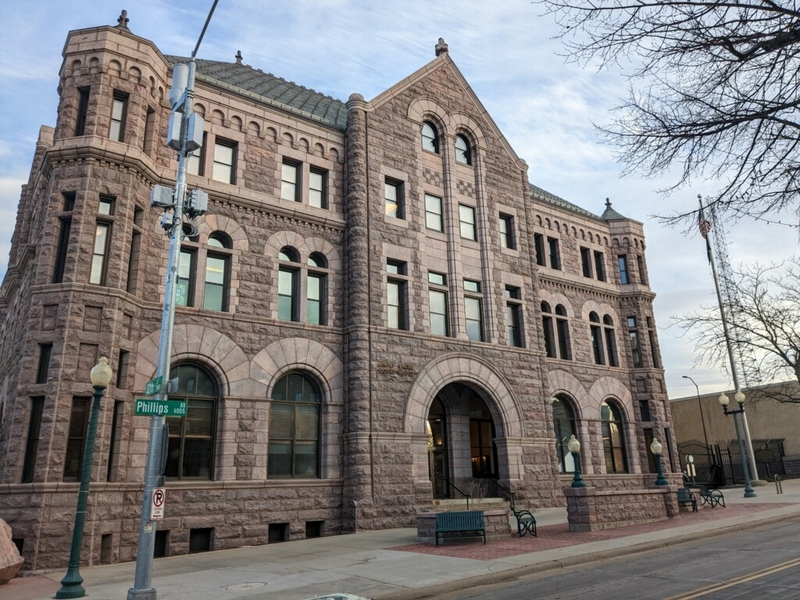
The federal courthouse in Sioux Falls is pictured in November 2022. A federal judge recently ruled in favor of a South Dakota law that helps rural healthcare providers buy discounted drugs and mark up their sale price to fill budget holes created by low Medicare and Medicaid reimbursement rates. (John Hult/South Dakota Searchlight)
A judge has ruled in favor of a South Dakota law that helps rural healthcare providers buy discounted drugs and mark up their sale price to fill budget holes created by low Medicare and Medicaid reimbursement rates.
AbbVie, maker of the arthritis drug Humira, among other medications, sued the state in April 2025. The Chicago-based company argued that South Dakota lawmakers unconstitutionally regulated interstate commerce with Senate Bill 154, which they passed and Gov. Larry Rhoden signed into law earlier that year.
The drug company AstraZeneca filed a similar lawsuit last August, and the trade group Pharmaceutical Research and Manufacturers of America filed one in September.
The law, which took effect last year, blocks drug companies from restricting which pharmacies health care providers can use to access discounts through the federal 340B program. It requires drugmakers who want to participate in Medicare and Medicaid to offer steep discounts to hospitals and clinics that deliver care to underserved or vulnerable populations. Providers who qualify for 340B can then upcharge patients for the drugs, which helps them pay their bills when federal reimbursement rates are too low to cover the cost of providing service.
South Dakota among states to restrict drug company contracting
The 340B program initially required discounts for providers that serve mostly Medicaid clients. It was expanded to “sole providers” under the Affordable Care Act in 2010, which opened it up to rural healthcare providers in places like South Dakota. Federal guidance issued that same year also allowed participating providers to contract with an unlimited number of pharmacies. Until then, providers had to use one.
In response to the expanding 340B usage that followed, drug companies have moved to restrict the pharmacies through which providers can purchase discounted drugs.
Supporters of Senate Bill 154 argued that such restrictions can put 340B discounts out of reach for rural hospitals that need the financial boost of participation to stay open and serve their rural clientele.
Other states have passed similar laws, and faced similar lawsuits.
The laws amount to an unconstitutional “taking” of drug company property through forced discounts, the lawsuits have argued, as well as to state-level regulations on interstate commerce. They also argue that because 340B is a federal program, states can’t regulate it.
Judge: South Dakota law is constitutional, protects ‘legitimate interest’
The ruling from U.S. District Judge Roberto Lange dismissed all three lawsuits against South Dakota. Lange relied in part on appeals court rulings supporting similar laws in states including Arkansas and Missouri.
Lange noted that 340B participation is optional. Other courts, and now Lange, have ruled that drug companies cannot opt into a voluntary program and then argue that their products have been taken without just compensation.
Drugmaker sues SD over law preserving broad access to discounts for hospitals, pharmacies
The judge also ruled that South Dakota’s law does not unfairly burden interstate commerce, in part because the state has a “legitimate interest in regulating the delivery of 340B drugs ultimately dispensed to its citizens.”
To the argument that the state cannot change the setup of a federal program, Lange ruled that South Dakota’s law deals with the delivery of drugs. It doesn’t make any changes to the federal law, he wrote, because the federal law deals with drug pricing.
South Dakota Attorney General Marty Jackley praised Lange’s decision in a press release.
“This ruling guarantees that our healthcare providers will continue to access these discounted medications and use them in ways that best serve their communities,” Jackley wrote.
AbbVie appealed Lange’s decision to the Eighth Circuit on Monday morning. AstraZeneca and Pharmaceutical Research and Manufacturers of America had not appealed as of Monday afternoon. Lawyers for the latter two did not immediately respond to emails requesting comment.

Pierre, SD