For WA GOP, a tough primary delivers alarming results
Aug 10, 2026 | 6:37 pm ET
Description
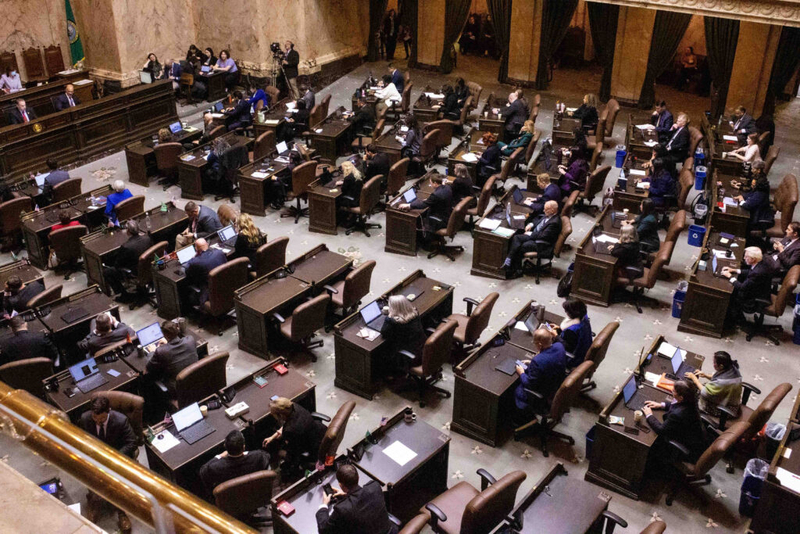
Washington state lawmakers in the House chamber on the first day of the 2026 legislative session. With several incumbent House Republicans trailing in the Aug. 4 primary, Democrats are positioned to add to their majority in the chamber for 2027. (Photo by Jacquelyn Jimenez Romero/Washington State Standard)
David Stuebe gets a lot of phone calls from constituents, more than usual these days as he campaigns for reelection to the Washington Legislature.
Ahead of this month’s primary, the first-term House Republican received a particularly jarring call. The person didn’t ask about his vote against a new state income tax on higher earners or his opposition to a gas tax increase that Democrats pushed through a year ago.
They wanted to know his stance on the war with Iran, which is unfolding 7,000 miles from Stuebe’s district. That’s when it hit home. For many voters, Tuesday’s primary wasn’t about what state lawmakers were doing in Olympia. They were paying attention to Washington, D.C.
“I honestly think people are so mad with Trump that they say, if you’re an R, then you’re a Trumpster and you’re evil,” Stuebe said. “Why aren’t people in tune? Why aren’t they looking at what’s happening with the state?”
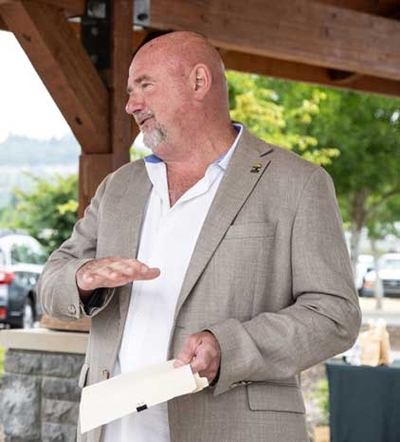
Primary results suggest that for GOP candidates in Washington, there’s no escaping headwinds created by President Donald Trump. If Republicans appeared unified with the national party, they were out of sync with the state’s electorate.
That sentiment was especially strong in southwest Washington, where Stuebe, who also serves as mayor of Washougal, trails Diana Perez, a Democrat, by more than 4,000 votes. Stuebe’s seatmate, Kevin Waters, and two other Republican lawmakers in a neighboring district, Stephanie McClintock and John Ley are also trailing.
“It’s absolutely nationalized,” said House Majority Leader Joe Fitzgibbon, D-West Seattle. “You have a historically unpopular president and his party is not interested in differentiating themselves from him.”
House Minority Leader Drew Stokesbary, R-Auburn, said it is “no secret” that Trump’s favorability “is underwater” in Washington. Polling also shows disenchantment with Democratic Gov. Bob Ferguson and some policies pushed through by the majority Democrats in the state Legislature, he asserted.
“I do think there is some dissatisfaction with everybody in charge,” he said. “People are hungry for change. Our goal is to get out the message. Based on our polling and modeling, our message is winning over voters who go into this election with an open mind.”
‘A really big wave year’
Democrats hold 59 of the 98 seats in the state House of Representatives. With 66, they’d have a supermajority, giving them the ability to bypass Republicans to try to advance goals such as constitutional amendments protecting abortion and lowering the voter approval threshold for passing school bonds.
Following Tuesday’s primary, Democrats are abuzz about the prospect of reaching that rarified level of political dominance. They last gained seven seats in one election cycle in 2018, the midterm election of Trump’s first term.
Fitzgibbon tamped down expectations. Conditions are ripe for a “really big wave year,” he said, but it is probably “more likely than not that we are under 66.”
Democrats are confident they’ll flip all four Republican-held seats in the 17th District, where Stuebe and Waters are running, and the 18th District, represented by McClintock and Ley.
They also are eyeing the 26th District, where Republican Katy Cornell is looking to succeed Rep. Michelle Valdez, R-Gig Harbor. Cornell’s 43.4% total is less than the combined tallies of Democrats in the primary race.
Other possible pick-ups could come in the 25th district where Republican Rep. Cyndy Jacobsen is ahead with a total under 50% and her GOP seatmate, Rep. Michael Keaton, is leading with a tally just above 50%. There are Republican-held seats in the 12th and 14th districts that could be at risk if Democrat turnout surges in the fall.
Big picture
In a state like Washington where Democrats have long held power, Republicans already have a structural disadvantage, said Ben Gaskins, a political science professor at Lewis and Clark College.
That’s only part of the story. Over the past half-century, American political parties have become far more nationalized, Gaskins said, making it harder for Republicans to separate themselves from the national party, and by extension, from Trump.
Trump “sucks the oxygen out of all the other Republican institutions,” Gaskins said. Trump’s strong media presence coupled with his demand for unrelenting loyalty in the party make it hard for even sitting Republicans to win back power, he said.
While Republicans need to focus on November’s general election, they shouldn’t lose sight of the long term, said Mark Stephan, an associate professor of political science at Washington State University Vancouver.
“Is their party willing to be the permanent minority party in the state of Washington?” Stephan said. “If you actually want to win elections and you actually want to maybe even have some power in the state overall, then you have to change. You have to moderate.”
The party should lean into independent voters and away from Trump, and accept candidates that do so, he said.
“Be principled, but be willing to compromise and be willing to have a bigger tent,” Stephan said.
Joe Fain, Bellevue Chamber president and a former state senator, said that both Republicans and Democrats will face challenges due to the direction the national parties are heading.
At a time when two-thirds of Washingtonians disapprove of Trump, “voters are steering clear of the Republican brand,” Fain wrote in an email. “Even the most talented local Republican candidates, of which there are several, are finding it difficult to swim against that tide.”
As for Democrats, some may conclude from the primary that the electorate is veering to the left, Fain said.
But “the rejection of high-profile Democratic-Socialist aligned candidates, including three prominent races in downtown Seattle, show Democratic voters are right alongside Independents and many Republicans in tiring of the political side-show,” Fain said.
‘We can save these seats’
Rep. Jim Walsh, chair of the Washington State Republican Party, called the nationalization of the election a “Democrat talking point.”
Walsh attributed the low GOP turnout to the timing of the Aug. 4 primary, stating many folks are on vacation, but he’s hopeful for the general election.
“There are more persuadable voters in November,” Walsh said. “There are more moderate and conservative voters in November.”
GOP leaders cautioned against drawing conclusions from the primary because, they said, there was no concerted effort to turn out the base. Rather, they focused on zeroing in on voters who hadn’t made up their minds, and messaging about the records of Republicans and Democrats.
Attention will broaden to energizing the base to show up in the general election. Without Trump on the ballot, it will be tough. Republican lawmakers are counting on the presence of three ballot measures, including one to ditch the new income tax, to motivate GOP and independent voters.
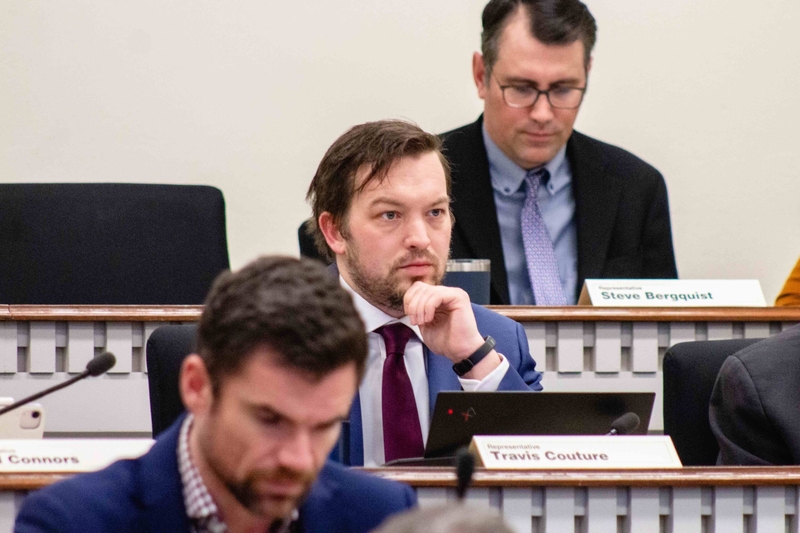
“There is a lot of work to do,” said Rep. Travis Couture, R-Allyn, assistant floor leader for the caucus. “We can save these seats. These are Republican districts.”
In southwest Washington specifically, where Stuebe and the three other Republican incumbents trail, Couture expressed confidence that they will turn things around in November because “they know how to win down there.”
“There is absolutely a pathway to come back,” he said. “We just have to make sure our voters turn out.”
Olympia, WA