Four UNC Chapel Hill degree programs paused amid academic review
Jul 30, 2026 | 2:29 pm ET
Description
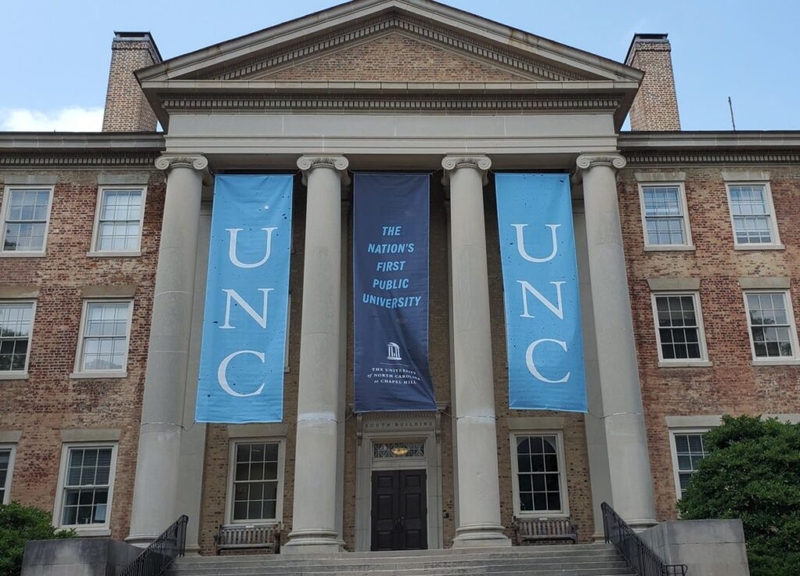
UNC Chapel Hill. (Photo: Clayton Henkel/NCNewsline)
“Publish or perish” is a well-known saying among university professors, reflecting the pressure to have their research published to continue advancing in their field.
Academic programs face a similar mandate: Attract students or perish.
That was the case this week, when University of North Carolina Provost Magnus Egerstedt told the UNC-Chapel Hill Board of Trustees that four degree programs had been placed on pause.
Addressing the University Affairs committee Wednesday, Egerstedt said after reviewing UNC-Chapel Hill’s 275 degree programs, 28 stood out for low enrollment or low rates of degree completion.
Programs were judged in part by UNC system office thresholds for the number of degrees awarded over a five-year period. Programs were flagged if they experienced a 20% or greater decline. In the second phase of the review, the provost said broader quantitative metrics were used to assess the programs, including enrollment, admissions, student credit hours, and the time-to-completion of a degree.
A deeper dive into the 28 flagged programs identified programs that were sustainable based on their importance, programs with low enrollment where active restructuring was underway, programs where the drop in enrollment was temporary or the result of a data anomaly, and programs that should be paused and admissions halted.
Egerstedt said four graduate programs fell into the category of degrees “on pause” to allow time to substantially revamp or consolidate the degrees. In some cases, the programs may be formally discontinued once all enrolled students have completed.
Programs currently on pause include:
- Digital Curation and Management in the School of Information and Library Science – According to a report, faculty voted to eliminate this program because of low enrollment, and will repackage it as a concentration for existing master’s degrees, rather than a free-standing degree. Two students involved will be allowed to complete their coursework as the program winds down.
- Curriculum and Instruction in the School of Education – All doctoral students have finished this program, and zero students are enrolled for the coming year.
- Environmental Sciences and Engineering in the Gillings School of Public Health – All students have completed classwork and no new students have enrolled. The school is rethinking this Master of Science in Public Health degree “given a larger context of engineering at UNC.”
- Health Policy and Management in the Gillings School of Public Health – This Master of Science in public health has two students enrolled who will be able to complete their coursework. One student is expected to graduate in Dec. 2026, and the other is a dual MSPH/MBA candidate expected to graduate in May 2027. UNC is considering a pathway to allow undergraduate students to earn a Bachelor of Science in Public Health (BSPH) and a Master of Science in Public Health (MSPH).
Among the four graduate-level programs that could be discontinued, only four students are currently enrolled.
Egerstedt said he was surprised that the review only turned up four programs out of 275 at UNC-Chapel Hill that needed to be paused.
“We are actually in a rather unusual situation as a university. We’re growing our enrollment, which means there are more students on campus, which means a lot of our degrees are growing,” said Egerstedt. Other programs such as clinical specialties were intended to be small, explained the provost.
Trustee Marty Kotis said the academic program review did not go far enough and should have included the cost for degrees conferred.
“We’ve got to do a better job of considering the dollars involved,” Kotis told the committee.
At Thursday’s full Board of Trustees’ meeting, Kotis reiterated the need for UNC-Chapel Hill leadership to look at student outcomes to make sure that degrees offer “meaningful value.”
The academic review process is ongoing.
“I just want to make sure we’re doing everything we can to invest in the areas where it’s going to make the most difference in people’s lives,” said Kotis.
Raleigh, NC