Spanberger restores voting rights to more than 60,000 Virginians
Jul 31, 2026 | 10:36 am ET
Description
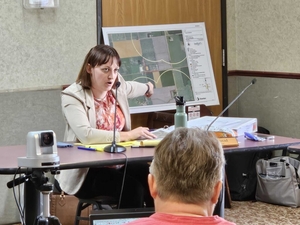
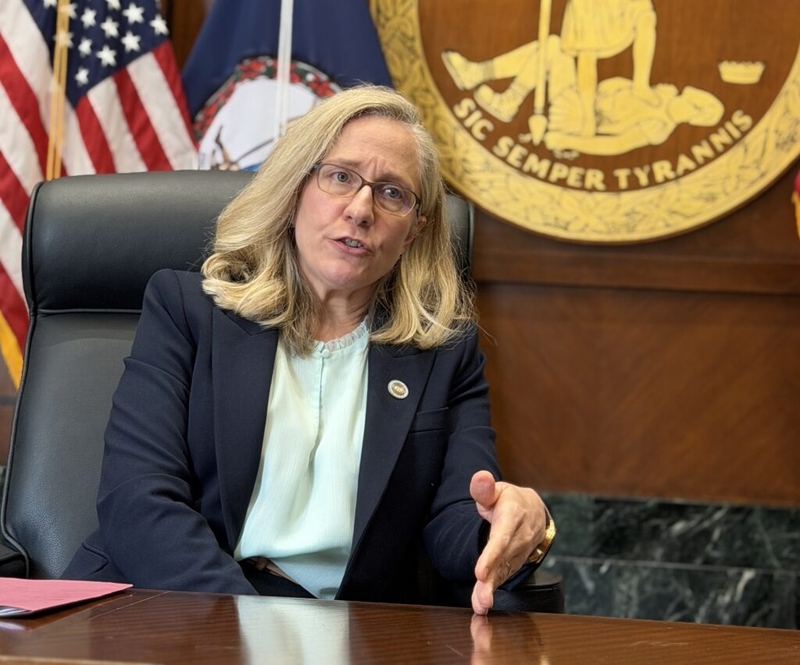
Gov. Abigail Spanberger speaks to reporters in Richmond. Spanberger announced Friday that her administration has restored voting and other civil rights to more than 66,000 Virginians since she took office in January. (Photo by Markus Schmidt/Virginia Mercury)
Gov. Abigail Spanberger has restored voting and other civil rights to more than 60,000 Virginians since taking office in January, reversing the more restrictive restoration process adopted by her predecessor and reopening voting access for thousands of people with past felony convictions, her administration said Friday.
The 66,085 Virginians whose rights have been restored may now vote, serve on juries, run for public office and become notaries public. The announcement comes about seven weeks before early voting begins for the 2026 midterm elections, which include a constitutional referendum that could largely remove Virginia governors from the restoration process.
“The right to vote is foundational to who we are as Americans. As a member of Congress, as a candidate for governor, and in the months since I took office, I have heard from many Virginians who have shared their personal stories of redemption with me — and heartfelt reflections of the moment their voting rights were restored by previous governors,” Spanberger said in a statement.
Virginia is one of just three states whose constitutions permanently disenfranchise people convicted of felonies unless the governor restores their rights. The state constitution gives governors broad discretion over both eligibility and the restoration process.
Governors of both parties streamlined the process over the decade before former Gov. Glenn Youngkin took office in 2022.
Republican Gov. Bob McDonnell began expanding restorations, a policy later accelerated by Democratic Govs. Terry McAuliffe and Ralph Northam. McAuliffe restored the rights to more than 173,000 people during his term, while Northam restored the rights to more than 126,000.
But in 2016, the Supreme Court of Virginia struck down executive orders from McAuliffe that sought to broadly restore civil rights to approximately 206,000 people who had completed their prison sentences and supervised release. The court ruled that governors must consider each case individually rather than issue blanket restorations.
Youngkin later eliminated the state’s streamlined process, requiring people with felony convictions to apply individually to regain their rights.
Although his administration said every application would receive an individualized review, Democrats and voting rights advocates criticized the pace of restorations and the lack of publicly disclosed criteria.
Spanberger’s administration said it has restored both the application review process and proactive outreach to identify eligible Virginians. Officials also removed questions added during the Youngkin era that they described as “unnecessary.”
Secretary of the Commonwealth Candi Mundon King said her office reviews every restoration individually while working with law enforcement agencies to verify eligibility.
“Today is an important day for the commonwealth and the more than 66,000 Virginians who now have their voting rights restored — in many cases, after waiting multiple years for a fair review,” Mundon King said in a statement.
“Over the past six months, our work has been guided by Governor Spanberger’s deep belief that Virginians who served their time deserve their civil rights. That is why our team reviews every individual who has their voting rights restored, working with our law enforcement partners to make sure we get it right.”
Meanwhile, thousands of voter registration applications from Virginians with certain past felony convictions remained pending as of June while the state worked to comply with a federal court order changing its registration process.
It was not immediately clear how many of those applicants, if any, are included in the 66,085 rights restorations announced Friday.
The referendum set to go before voters Nov. 3 would amend the state Constitution to automatically restore voting rights to people convicted of felonies once they are released from incarceration, largely removing governors from the restoration process.
The amendment cleared the General Assembly in two consecutive sessions, separated by the 2025 legislative election as required for constitutional changes. Lawmakers approved it for a second time during the 2026 legislative session, and Spanberger signed legislation in February, placing it and other proposed amendments on the November ballot.
Similar proposals have surfaced repeatedly over the decades, although Virginia voters rejected one in 1982 by 63% to 37%. That measure would have allowed for civil rights to be restored under new rules established in state law.
But more recent polling has shown greater support for a more sweeping change. A 2025 Christopher Newport University survey found that 63% of registered voters supported or strongly supported automatically restoring voting rights to people who have completed their prison sentences.
Civil rights advocates have also emphasized the origin of Virginia’s felony disenfranchisement provision, which dates back to the state’s 1901-02 constitutional convention, where white political leaders adopted voting rights restrictions intended to suppress Black political participation.
“This fall, voters can cast their ballots for Virginia to no longer strip so many of our neighbors of their fundamental rights — a shameful relic of our Jim Crow past,” Spanberger said Friday. “I hope Virginians will join me in voting yes.”
House Speaker Don Scott, D-Portsmouth, whose civil rights were restored by McDonnell after a federal drug conviction, thanked Spanberger for ending what he called “the restoration of rights gridlock” of the last four years.
“Today’s action is an important step forward, but it cannot be the final step,” Scott said. “A future governor should never be able to reverse a fundamental right with the stroke of a pen.”
He urged Virginians to support the proposed constitutional amendment in November, saying voting rights should no longer be subject to changing governors or political administrations.
Early voting begins Sept. 18, with Election Day set for Nov. 3.
Richmond, VA