A favorite finishes third, big money loses and policy pays off: lessons from a wild campaign
Jul 30, 2026 | 6:16 pm ET
Description
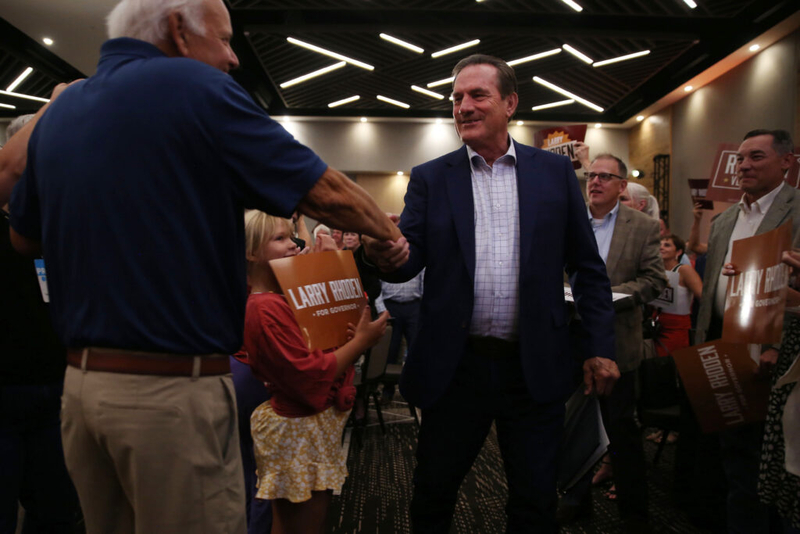
South Dakota Gov. Larry Rhoden greets supporters at his election night watch party in Sioux Falls on July 28, 2026. Rhoden won the Republican nomination for governor after a runoff election with political newcomer Toby Doeden. (Photo by Makenzie Huber/South Dakota Searchlight)
Rarely has there been a campaign in this state offering more novelty, surprises and intrigue than this year’s race for the Republican nomination for governor, which ended Tuesday with South Dakota’s first statewide runoff election.
The campaign got an early jolt when Gov. Kristi Noem resigned a year and a half ago to accept a job in President Donald Trump’s administration. Her lieutenant governor, Larry Rhoden, automatically became governor for the rest of what would have been her term.
U.S. Rep. Dusty Johnson emerged as the frontrunner to win the next full term, but he ended up finishing third in the June 2 primary, bringing his two-decade run at the highest heights of South Dakota politics to a halt.
Podcast: Rhoden’s victory, a quote that doomed Doeden, and a Democrat’s ‘uphill battle’
Rhoden had never won a statewide election outside of being Noem’s running mate, and he initially appeared powerless to stop Johnson, who was elected twice to the state Public Utilities Commission before winning four terms as South Dakota’s sole member of the U.S. House. But Rhoden beat Johnson in the primary, while coming in second to a guy nobody in politics had ever heard of a few years ago: Aberdeen businessman Toby Doeden.
Doeden, a first-time candidate, shocked everybody by finishing first in the four-way primary race. Then he slid backward during the top-two runoff, while Rhoden rocketed to 71% and won the nomination.
What a ride.
Thanks, Kristi
It’s difficult to imagine Rhoden winning the nomination if Noem hadn’t resigned.
If Noem had stuck around through the end of her term, Rhoden would not have had full use of the state’s resources to spend much of his first year in office traveling the state on his Open for Opportunity tour, which was really a publicly funded get-to-know-Larry tour for voters.
He also would not have had a chance to build a record as governor, including his signature on a bill banning the use of a legal process known as eminent domain to gain land access for carbon capture pipelines, a bill devoting $650 million to the construction of a men’s prison, and bills using sales tax increases and other mechanisms to reduce property taxes for homeowners.
‘Good policy makes good politics’
Rhoden said in his campaign announcement that “good policy makes good politics,” and he helped himself politically by tackling the three aforementioned issues — pipelines, prisons and property taxes — after Noem failed to deal with them effectively while she pursued a national political role.
What a concept: Focus on your job, get some things done, and voters might reward you.
Money doesn’t always buy victory
Johnson came into the race with around $6 million of built-up campaign funds from his many years of running for statewide offices. Doeden spent $4 million of his own money on his campaign before the primary (and possibly more since then, though we won’t know until his next campaign finance report, due in October).
Rhoden was no slouch, raising and spending more than $1 million and counting, but he had far less money to work with than Johnson and Doeden. That didn’t stop Rhoden from beating them both, mostly with his focus on policy.
The importance of the 35% threshold
Back in 1985, South Dakota lawmakers approved legislation requiring top-two runoffs in statewide primaries when no candidate reaches 35%. The law collected dust for 41 years and then suddenly became important this year, the first time it was triggered.
Doeden called the runoff law a “silly rule.” Imagine how silly it would be if the law didn’t exist, and the Republican Party was saddled with a nominee opposed by more than two-thirds of its voters — or a selection process tossed to a state convention, as was the practice before 1985. Any candidate, including the primary’s fourth-place finisher, state House Speaker Jon Hansen, could have won in that scenario.
Calling polls ‘fake’ doesn’t change the result
Doeden fashioned himself as a Trump clone in many ways, even adopting the president’s penchant for labeling news he doesn’t like as fake.
When KELO-TV released survey results two weeks ago from Emerson College Polling that showed Doeden trailing Rhoden in the runoff by 30 points, Doeden wrote on social media that “the paid-off media is attempting to influence the outcome of this election with a very fake poll.”
The poll’s only flaw turned out to be its inflated estimation of support for Doeden, who lost by 42 points, not 30.
It ain’t over yet
In South Dakota, where it’s been 52 years since the last win by a Democratic candidate for governor, it’s easy to forget there’s another election Nov. 3. The Democrats have a candidate, former legislator Dan Ahlers of Dell Rapids, who knows his way around politics and state government.
Rhoden’s supporters probably think he has an easy path to victory, and maybe he does.
But if there’s any final lesson to take from all the twists and turns in the campaign for the Republican nomination, it’s don’t take anything for granted in politics.

Pierre, SD