Tahoe’s next state legislative battle: Public safety or tourism development
Jul 30, 2026 | 7:58 am ET
Description
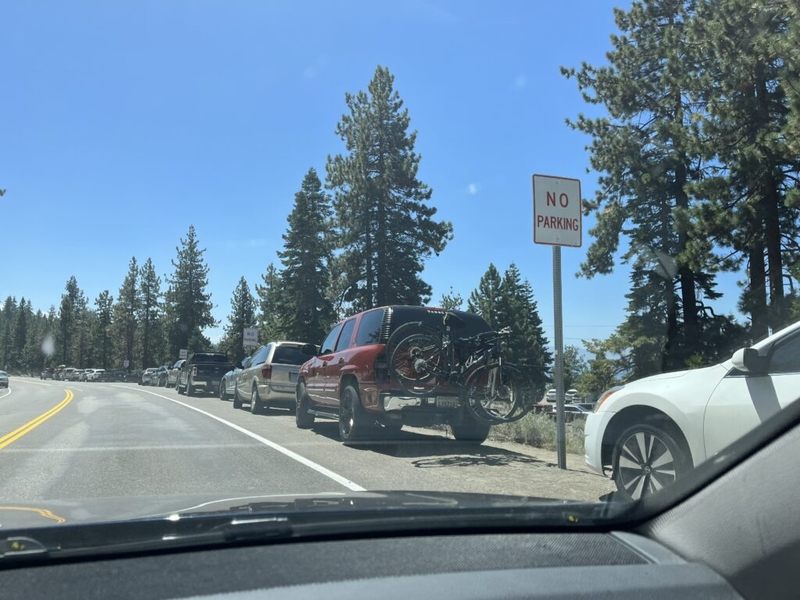
You can almost hear Nevada’s travel industry and its private-public partners gleefully hum Joni Mitchell’s Big Yellow Taxi as they seek state and federal funding to pave over more paradise and put up more parking lots in both Washoe and Douglas Tahoe. (Photo courtesy Pamela Mahoney Tsigdinos)
What was once one of the most beautiful, isolated drives in Nevada is now among the most harrowing due to an endless stream of visitors and unfettered tourism development. Highway 28 winds along the east shore of Lake Tahoe. This narrow road rises to 50 feet above the Lake’s surface of 6,225 feet. State Route 28 is also a main evacuation route in an area prone to fast-moving wildfires. Wildland fire is a known hazard as the state faces emergency planning resource challenges.
And yet Nevada’s local and state tourism and planning agencies continue to casually collaborate with Trip Advisor and other online travel sites to beckon more visitors to venture into the rapidly depleting unspoiled wildness as vast swaths of terrain in France, Spain, Canada, Oregon and Yosemite’s gateway go up in flames. Earlier this month the North Lake Tahoe Fire Protection District’s Strike 4425C was mobilized out of the Lake Tahoe Basin to the Elephant Fire.
Also ongoing is a lawsuit filed in federal court challenging TRPA ordinances that will add density that could worsen traffic congestion and create dangerous bottlenecks during a wildfire evacuation – particularly along State Route 28.
There are no clear markings along SR28 to signify this road’s evacuation importance. There’s little to no enforcement to dissuade visitors from crowding, parking recklessly or unloading large paddle boards, floaties, dogs and children. But these same agencies are responsible for Ray Bradbury-like signs that proclaim ‘Restoring Tahoe’ as construction crews clear-cut mature trees and destroy the natural habitats of Stellar’s Jays, White-headed Woodpeckers, Grosbeaks and Chickadees to make room for asphalt.
You can almost hear Nevada’s travel industry and its private-public partners gleefully hum Joni Mitchell’s Big Yellow Taxi as they seek state and federal funding to pave over more paradise and put up more parking lots in both Washoe and Douglas Tahoe.
Miles south along the Tahoe watershed, glyphosate use (an herbicide the World Health Organization deems a probable human carcinogen) has recently been confirmed. According to the Tahoe Regional Planning Agency (TRPA) “regulations discourage the use of terrestrial herbicides, but do not prohibit it if the herbicide application meets requirements.”
Such comforting words from the federally designated planning agency responsible for the Tahoe basin’s environment.
One might hope that a governor’s race pitting a former sheriff, Governor Joe Lombardo, with the state’s top law enforcement officer, Attorney General Aaron Ford, might move either of their campaign staff to take a closer look at a crime scene in the making. You can bet one or both will be at the August 19 Tahoe Summit, a tourism promotion politician-filled grip and grin with lip service paid to protecting the Lake. It will be held this year at Nevada’s Sand Harbor state park.
Damaging natural habitats
Lake Tahoe is the ancestral home of the Washoe Tribe. In Nevada during the mid-1800s the silver rush, soon after California’s gold rush, is when robber barons first clear-cut Tahoe’s towering Sugar and Jeffrey pines. John Muir’s efforts in the early 1900s to make Tahoe a national park failed due to commercial interests. Small mountain communities sprung up the past century that still hold locally owned hardware stores and schools that play in Class 2A designated sports. Second and third growth forests now shade the twisting roads that encircle Lake Tahoe.
Fueled by steady tourism promotion and social media, the Tahoe basin now has more recreation visitors than some of the nation’s largest national parks. If modern-day commercial interests have their way in Nevada’s next legislative session, they will usher in more destruction of Tahoe’s fragile ecosystems and further congest and pollute the already overcrowded shoreline of America’s turquoise lake, which in 1968 measured 102.4 feet in clarity.
The most recent reading was a combined winter and summer of 69.2 feet disclosed in a carefully managed announcement so as not to ruffle the feathers of corporate tourism interests. One had to dig into the appendix for the more revealing 2025 Lake Tahoe summer reading, which declined to 53.4 feet clarity. This troubling data aligns with rising temperatures and a growing human footprint. Worse, since 1959 the rate of algae growth has quadrupled, increasing at a rate of five to six percent a year.
Public feedback to Nevada leaders
Conserving Tahoe’s natural beauty lies in the hands of those now seeking to lead Nevada, and more immediately, the state’s interim legislative committee charged with the oversight of Tahoe and the TRPA.
Committee Chair Heather Goulding invited “all interested parties to provide recommendations” for possible consideration using a recommendation form ahead of the Committee’s working session. Several Nevada citizens met the July 10 submission deadline.
At the committee’s July 17 meeting residents lined up to offer public comment. They respectfully pleaded with legislators to exercise their authority and prioritize public safety and the Lake’s health over commercial interests run amok.
There was a lay botanist and trained master gardener, Paula Chung, who addressed Tahoe’s complex soil environment and microbe network. She explained how spraying glyphosate “will create a massive dead zone above and below the soil that affects all future plants and animals, including us.”
Nevada resident Lisa Hokholt, a career soil scientist with the USDA Natural Resources Conservation Service, stated categorically that “soil out of place is pollution and is a contaminant transport that can
seriously affect riparian and lake ecosystems” and strongly urged the committee to direct TRPA “back to its environmental roots rather than supporting more development for tourism.”
Lisa Foley, another long-time resident of Zephyr Cove, NV, summed it up: “No marketing budget will be able to buy back Tahoe’s pristine reputation once it’s lost.”
Tuning in you might think you were watching an episode of The Twilight Zone or the makings of a disaster film.
Brett Tibbetts, head of the Tahoe East Shore Alliance, used his two minutes to request that the committee open the bill draft recommendation process further. Others joined in pressing for more transparency.
As of July 28, the committee staff responded:
“The Committee Chair is currently reviewing the bill draft requests that were submitted for the Committee’s consideration. Once that review is complete, we will post the submitted recommendations on the Committee’s webpage so they are available to the public in advance of the Committee’s work session on August 20th.
Once the BDRs have been selected for consideration by the Committee, they will be included on the work session document, which will be posted to the Committee’s webpage at least four working days before the meeting.
We appreciate your interest in the Committee’s work and your comments regarding transparency throughout the BDR process.”
Upon hearing this one member of the public noted, “Not quite clear to me if they will post all submitted BDRs or just those selected. But we shall see soon enough.”
The committee’s final meeting of this interim session will take place in Carson City. The previous four committee meetings were held at TRPA’s headquarters. As in the previous interim session, prior to the public portion of the meetings TRPA’s chief lobbyist organized tours and lunches with select individuals. Those pre-meetings were closed to public. What’s unknown is how much legislative jockeying has been unfolding behind closed doors.
Las Vegas, NV