Oregon researchers journey into Pacific for clues about disappearance of old, female rockfish
Jul 30, 2026 | 7:05 pm ET
Description
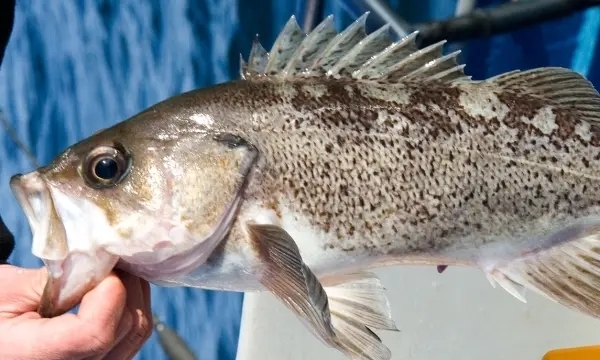
A black rockfish. Though females can live up to 60 years, few older than 30 years are found off the Oregon Coast today. (Photo courtesy of the Oregon Department of Fish and Wildlife)
Off the coasts of California, Oregon, Washington, Canada and Alaska, three species of female rockfish have largely disappeared in the last 40 years.
Oregon Department of Fish and Wildlife scientists hope to learn why when they board an Oregon State University trawler Aug. 1 for two weeks — including a two-day journey westward across 322 miles of ocean — to the Cobb Seamount and the edge of the North Pacific Gyre to search for the old females.
The seamount is an inactive underwater volcano that has created a solid ocean shelf where marine ecosystems thrive, and the gyre is one of Earth’s five large, rotating ocean currents. It spans from North America to Asia and stops at the equator, where the currents of the South Pacific Gyre pick up.
Some records from federal scientists and fishing crews in the 1960s detail sightings of larger, perhaps old, female black, canary and yellowtail rockfish that have largely today disappeared from Oregon’s Coast.
They are three of 86 species of rockfish found in Oregon, and both male and female black and yellowtails can live up to 60 years, while canary rockfish can live even a decade longer.
But commercial and recreational fishing crews and fisheries managers up and down the West Coast of the U.S. and Canada for the last few decades have caught very few females over 30 years old. Most of the female population begins to decline after 12 years, leaving almost exclusively males, explained Leif Rasmuson, who leads the rockfish research at ODFW’s Marine Fisheries Research Program.
For the department, knowing whether the old females exist, and whether they still reproduce, is helpful for managing fisheries and catch limits to balance ocean fish stocks. The rockfish are sexually mature at 6 years old, so the disappearance of the elder females off the Coast has not yet been detrimental to stocks managed by the state.
But Rasmuson said the research is also about alleviating concerns over unanswered, “disconcerting” questions about the future of the species and whether they are dying of causes set off by a toppling domino wall of human effects. If they find the older females, he and the crew will study whether they are genetically related to nearshore populations of rockfish, and whether their diet differs from other populations and will tag and release some to learn about any migration patterns.
Hypotheses
Among the lesser possible explanations, according to Rasmuson, is that the older females are out in the ocean, clustered in spots along the West Coast from California to Alaska, but just in places that all researchers, commercial and recreational fishing crews and fisheries managers have just completely overlooked for the last four decades.
“That seems highly improbable to me,” he said. “Fishermen are really good at catching fish, and I just struggle to envision a way where females get this magical ability to avoid every type of fishing gear ever known to man on the entire West Coast.”
Another hypothesis is that fishing crews are catching and killing more young black, canary and yellowtail female rockfish than males, keeping the females from growing old. But, Rasmuson said, only those three rockfish species lack evidence of older females. The other 83 species of rockfish that live off the Oregon Coast don’t have the same problem, indicating fishing is not cutting into the overall ratio of females in the overwhelming majority of species.
Another option is that aging females are swimming very far north or south somewhere. Researchers in Alaska have tagged some females that have gone as far as the Bering Sea, but they weren’t very old when they were found there, Rasmuson explained.
Still another possibility is that the females swim from shore and go out into the middle of the North Pacific Gyre as they age. He said that articles from the 1960s and later research from the National Oceanic and Atmospheric Administration detail black rockfish in the gyre that were larger than most of their species, indicating perhaps advanced age.
If it is the case that the females go out to age in the gyre, it opens up even more questions for Rasmuson and the other researchers.
“The thing is, if it’s just old females that go out into the middle of the gyre and there aren’t a bunch of males, what does that mean? Is it just like a retirement home for old females?” he asked. “It’s hard to wrap your mind around. Why is this evolutionarily stable? What’s the point? Is it: ‘Hey, we just go out there and hang out for the last 40 years of our lives?’”
To him, the most probable hypothesis is that the females are dying at younger ages of some sort of natural cause, which could still be human-influenced, such as the loss during the last century of an important food source they need.
Dicey international waters
It was not easy to get permission to go to the seamount to catch fish for research, according to Rasmuson. It’s located in international waters and regulated by an international intergovernmental group called the North Pacific Fisheries Commission that includes representatives from the United States, Russia, Korea, Japan, China and Canada, among others.
In those waters there is effectively a moratorium on commercial fishing, and growing international skepticism of the motivations of the U.S. government led other member nations to scrutinize the research and researchers more heavily, Rasmuson said.
Some commission officials shared concerns about the research boat possibly scouting deep sea mining areas, and representatives from Japan and Korea threatened to come aboard the ship to ensure the researchers are not doing any illegal fishing, he explained. When he proposed the team be allowed to catch and take with them 50 fish, commission officials were shocked, he said, believing it was a proposal for 50 tons of fish.
He said representatives from the U.S. did not help to make the process smoother, but the Canadian delegation stepped in to vouch for the researchers.
“The United States kind of dropped the ball. We’ve just had to lean on Canada,” he said. “It’s still been an ongoing adventure on the policy side.”

Salem, OR