Faced with crippling housing crisis, Beacon Hill nibbles at the edges
Jul 02, 2026 | 8:58 am ET
Description
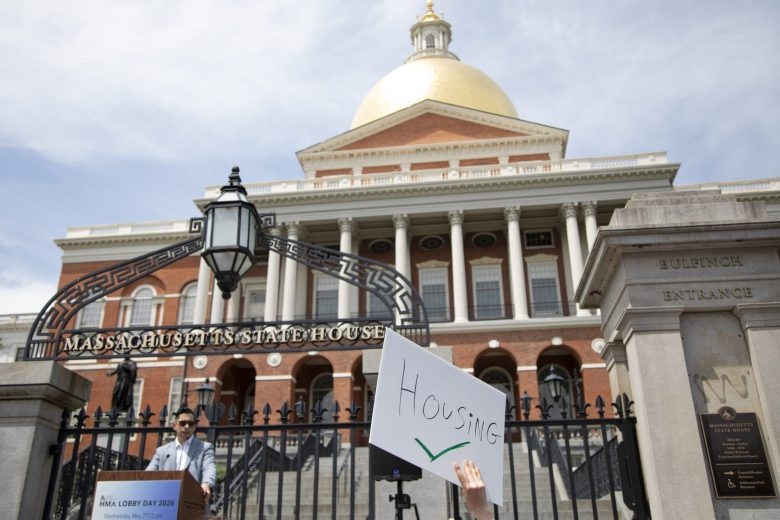
Rallygoers call for more housing development at an event Abundant Housing Massachusetts hosted outside the State House on May 27, 2026.
POLICY WATCHERS TRYING to figure how lawmakers have spent the current legislative session tackling the housing crisis could be forgiven for having a sense of déja vu.
The moves getting the most attention from Beacon Hill as it hurtles into its busiest month of the two-year session are a housing bond bill passed two years ago and lauding the zoning changes introduced by the controversial MBTA Communities multi-family zoning law, signed back in 2021.
“This isn’t the monumental session for housing, for a variety of reasons,” said Jesse Kanson-Benanav, executive director of the pro-housing group Abundant Housing Massachusetts.
Instead, much of the housing energy is being channeled piecemeal into various things moving through the State House: the state budget, a supplemental budget, an economic development bill, an environmental bond bill.
There is no disagreement over the stakes. Amid fears about stemming the tide of out-migration for cheaper pastures, polling finds that affordable housing remains a chief anxiety for young residents.
“Affordability is at the center of nearly every major conversation we’re having in the Senate today – and has been for quite some time,” Senate President Karen Spilka said at the Greater Boston Chamber of Commerce in June. “That’s because you cannot get the most out of Massachusetts if you cannot afford to live here, start a business here, or raise a family here.”
But Beacon Hill has so far steered clear of the type of ambitious proposal that would seem to meet the moment.
A new state housing tracker, launched last week, offers some bright spots and plenty of question marks. Massachusetts added 34,561 homes in 2025, just over 15 percent of the way toward Healey’s goal of 222,000 new units by 2035. But officials said that also reflects a surge of backlogged pandemic-era projects, and low permitting numbers plus national economic headwinds make it hard to predict the actual flow of new units in the next decade.
Here’s a rundown of recent actions, pending proposals, and rulings at the Supreme Judicial Court influencing housing policy more aggressively than any single piece of legislation.
About last session
The Affordable Homes Act, signed in August 2024, remains the largest housing bond bill in state history. It paired $5.1 billion in capital authorizations with dozens of policy changes, notably a mandate that cities and towns allow accessory dwelling units, or ADUs, by right in single-family districts.
Opening the door to so-called “granny flats” was pitched as low-hanging fruit at the bill’s signing. In the new law’s first year, municipalities issued just over 1,200 ADU permits in the past year, but that was short of the administration’s own target of 1,600 to 2,000 annually, according to a Boston Indicators report on the policy’s rollout. Amy Dain, the report’s author, said legalizing ADUs was only a first step, since local wetlands, septic and building-code rules still vary town to town and can add tens of thousands of dollars to a single project.
Capital investment in housing doubled as a result of the bond bill, Housing Secretary Juana Matias said this month. Housing advocates point to significant boosts in fair housing funding authorized through the bond bill — ever more critical during period of federal step-backs —and more money going to an array of affordable and market-rate housing initiatives.
The message from the Healey administration with the bond bill spending has been to build “more, faster,” said Matt Noyes, director of state and federal advocacy at the Citizens’ Housing and Planning Association. Still, he said, “we’re continuing to nudge the Legislature. It has the tendency to pass one big bill and take a session off to focus on other things.”
A piecemeal approach
With no major follow-up housing bill this term, lawmakers have instead worked permitting and site plan language into whatever bill is already moving.
Both the House and Senate reached an accord on the Fiscal Year 2027 state budget this week, which includes provisions to streamline local permitting, support development on nonconforming properties, provide “reasonable” timelines for projects to move forward under existing zoning rules, and modernize variances.
Meanwhile, the House is finalizing its version of the Mass Wins Act, Healey’s economic development bill, after which the Senate will take its turn. The governor’s proposal would codify a statewide site plan review process, with local boards required to give projects an up-or-down within 90 days or the project is deemed approved. It would also let municipalities opt into commercial-to-residential conversion rules and let mayors formally initiate zoning changes in cities, which they are not currently authorized to do.
Both chambers have cleared versions of an environmental bond bill, the Mass Ready Act, but now need to reconcile the two versions. The final bill is likely to include streamlined environmental and wetlands permitting for priority housing projects, which responds to recommendations from the governor’s Unlocking Housing Production Commission.
Significant policy changes can be tucked into faster-moving omnibus bills, as was the case with the MBTA Communities law, which required that cities and towns served by the MBTA system zone for a multi-family district or reasonable size.
But it can make for an inconsistent system, Kanson-Benanav noted, if there isn’t appetite to wade into the political quagmire of local zoning reform so soon after MBTA Communities pushback found its way, twice, to the state’s highest court.
“If some of the changes that are working their way through are implemented, I am hopeful they would be impactful,” he said of the permitting proposals. “Expedited permitting is important to make sure that homes that are legal to build can be built at lower cost and occupied by residents sooner. But you also need zoning reform to legalize the types of homes you need to get through that permitting process.”
Other changes have squeaked through already, like a Fair Share supplemental budget amendment offering sales tax relief on construction materials for multi-family projects serving low-, moderate- and middle-income residents.
The sales tax change is the kind of shift that rarely “generates headlines,” Spilka said at the recent chamber of commerce event, but “that reform alone has the potential to help create 35,000 additional housing units over the coming decade.”
For his part, House Speaker Ron Mariano has not weighed in on most targeted housing proposals, but continues to beat the drum for one specific initiative: expanding Massachusetts Water Resources Authority service into Weymouth to facilitate housing development at a former Naval Air Base. In an April speech, Mariano said 6,000 homes could be built there, but construction can’t begin until there is an agreement on water supply.
Maybe in someone’s backyard
The most ambitious pending bill sweeps a package of housing reforms into what advocates call “YIMBY 2.0.” The Senate combined an earlier “Yes In My Back Yard” pro-housing production bill— which would generally allow denser housing, eliminate parking minimums near transit, and make it easier to split larger lots and build on smaller lots — and provisions of a “Yes in God’s Back Yard” bill that would make it easier for religiously owned parcels to be used for taxable housing.
But the new Senate version has sat in Senate Ways and Means since a December committee vote, and the House version hasn’t moved out of the Joint Committee on Housing since a September hearing.
Sen. Brendan Crighton of Lynn, the bill’s cosponsor with Haverhill Rep. Andy Vargas, has said the economic development bill could become a vehicle for individual pieces of the package.
Noyes, the Citizens’ Housing and Planning Association official, said dozens of faith groups and a handful of business groups submitted testimony to the committee considering the bill in support of incorporating YIGBY. As more communities seek Proposition 2 1/2 overrides to address budget shortfalls, Noyes said, bringing new properties onto tax rolls could be, well, a godsend.
“At a time when dozens of municipalities are facing significant local budget challenges, YIGBY represents a lifeline,” the business groups said in their written testimony. “Because homes developed under this policy would be subject to local property taxes, YIGBY could generate tens of millions of dollars in property tax revenue for cities and towns.”
By the wayside
Doug Howgate, president of the Massachusetts Taxpayers Foundation, said the housing crisis has been growing more serious while policymakers largely took a “30-year holiday” on the subject.
“The challenge over the last several decades has not been that we moved too recklessly,” Howgate said. Housing policy has leaned into local control over zoning and permitting, which pro-housing advocates decry as a surefire way to slow production. “An aggregation of policies, many well-intended, have had the practical impact of paralyzing the housing that people need and people can afford,” Howgate said.
The amount of housing language worked into faster legislative vehicles, and the scale of the bond bill still playing out is a “positive sign” that Beacon Hill is at least attentive to the crisis, Howgate said.
But the action this term has appeared more dramatically in the courts and in the ballot measure campaign season. The November ballot will almost certainly feature one question that backers say will help ease the housing crunch.
A question dubbed the Legalize Starter Homes initiative would reduce the minimum lot sizes required for single-family homes if they have water and sewer access. An analysis from Tufts’ Center for State Policy Analysis predicted modest gains if the zoning policy took effect — about 750 new homes a year on average.
Another potential ballot question — imposing statewide rent control — was ruled ineligible to go before voters by the Supreme Judicial Court because it included an impermissible reference to religion by excluding from rent limits any housing used for religious purposes.
Prospects remain shaky for a real-estate transfer fee on high value property transfers, first put forward by the governor and initially embraced by the Senate in the earlier version of the housing bond bill. The money collected would fund new affordable construction. The House looked askance at the proposal, the Senate ultimately axed it from the chamber’s bond bill before the two bills needed to be reconciled, and Healey hasn’t touched the subject since.
Sometimes the outcome advocates want is, in fact, no movement at all. Legislative leadership chose not to act on an array of bills and amendments that would have pared back the ambitious MBTA Communities housing law, which has put about 6,000 units in the permitting pipeline.
Housing advocates would love, in fact, to see multi-family zoning expand across the Commonwealth, and Cyr filed a bill currently in limbo that would create an MBTA Communities-like rezoning obligation for any city and town larger than 2,000 residents.
Meanwhile, a major Supreme Judicial Court decision is still looming, which could resolve or upend the years of forceful advocacy from the governor and the attorney general to wrangle the vast majority of MBTA Communities into compliance with the law. The state’s high court is expected to drop a ruling within the next few weeks on a challenge alleging that the law is an illegal “unfunded mandate.”
Boston