Even wealthy Oakland County can’t dodge Michigan’s economic woes
May 25, 2026 | 8:00 am ET
Description
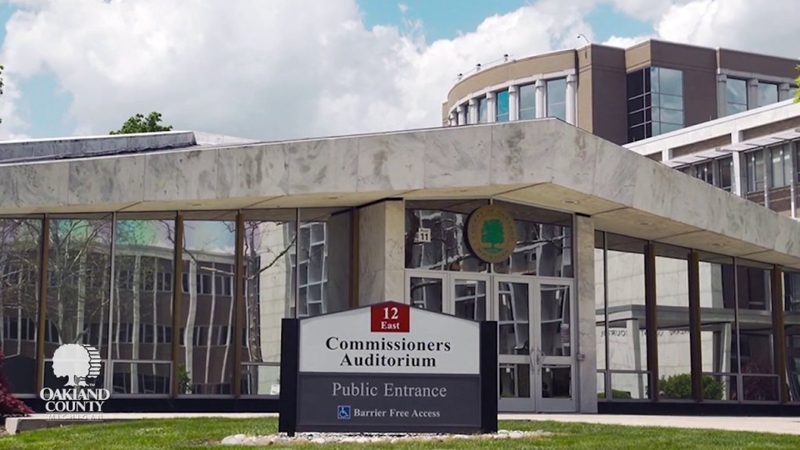
Oakland County Commissioners' Auditorium | Oakland County
Oakland County, long a superstar economic performer and among the wealthiest big counties in the nation, is slipping, another worrisome indicator of Michigan’s sinking competitiveness.
The suburban Detroit county’s economic fundamentals are still enviable. Oakland boasts a highly educated workforce, good schools, hundreds of thousands of high-paying jobs and low child poverty. It annually churns out nearly a quarter of Michigan’s goods and services.
But the county has recently been struggling to hang on to its prized professional, technical and scientific services jobs. And it has fallen from sixth in 2019 to 11th this year among 27 similar-sized suburban counties nationwide in a measure that includes educational attainment, income, child poverty and the percentage of managerial and professional jobs.
Real wages in Oakland, adjusted for the cost of living, were roughly 19% above the national average in the early 2000s. But the spread had narrowed to just 2.8% by 2024.
“It’s not just Oakland. It’s a problem with the region overall,” said University of Michigan economist Don Grimes, co-author of U-M’s annual Oakland County economic forecast.
Michigan’s biggest job-producing counties have fallen dramatically in the ranking of all U.S. counties in per capita income, according to data compiled by Michigan Future Inc., an Ann Arbor-based think tank.
Among them, Oakland has dropped from the 21st wealthiest county in the country in 1999 to 122nd in 2024. Kent County has slid from 237th to 425th. Wayne County has fallen from 560th to 1601st. Macomb County has plunged from 179th to 1095th during the past 15 years.
Michigan has plummeted from 16th in per capita income in 1999 to 40th in 2025.
“This is a statewide collapse of unprecedented scale,” Michigan Future President Lou Glazer said.
Glazer and Grimes have long maintained that Michigan’s economic decline is due to the state’s failure to shift from a factory-based to a knowledge-based economy.
Most of those high-paying knowledge jobs are counted in the professional, technical and scientific jobs category. They include lawyers, accountants, engineers, designers, researchers and other occupations that require high levels of education and training.
Oakland and Michigan have been losing those jobs, likely because many of them are tied to the state’s struggling auto industry, Grimes said.
Oakland lost 4,600 professional jobs last year and is expected to lose another 1,000 jobs between this year and 2028, according to the U-M forecast.
Michigan has shed 2,000 professional and business services jobs over the past 12 months, according to the latest jobs report.
“Our hunch is that these jobs are subcontractors to the auto industry,” Grimes said. “We don’t know that. We can’t prove that. But it’s always been our suspicion.”
Michigan has lost 10,000 manufacturing jobs, including in the auto industry, over the past 12 months.
Oakland and Michigan’s economies are also being hurt by forces outside their control. Tariffs, stubbornly high inflation and the war in Iran that has sent gas prices spiraling, are harming job growth.
“We believe those difficulties reflect the tough external environment Oakland has faced recently, including high interest rates and uncertain trade policy,” the U-M forecast said.
But the biggest threat the county and state face into the future is Michigan’s aging population and its lack of success in retaining and attracting young talent.
Michigan’s labor force fell by 19,000 workers in April and has shrunk by 103,000 people, or 2%, over the past 12 months, according to the state’s latest jobs report. Much of that decline is a result of an increase in retiring workers, according to the Michigan Center for Data and Analytics, a state agency.
Unless the state can replenish and grow that talent pipeline, Michigan faces a future of anemic job growth, at best. The state no longer will have the ability to create 20,000-to-30,000 jobs a year, as it has in the past, Grimes told me.
“The bottom line going forward is we’re going to reach the point where we don’t expect employment gains,” he said. “It’s a fact of life for the rest of our futures. A normal year might be job losses.”
As scary as that sounds, Glazer and others say they’ve been frustrated that these population and economic competitiveness issues have failed to light a fire under policymakers.
“The thing that has surprised me is that there have been no alarm bells by anybody,” Glazer told me. “We’ve become one of the poorest states in the country and nobody cares about it.”
But that could begin to change this week when the state’s top business leaders, policymakers and gubernatorial candidates meet on Mackinac Island for the Detroit Regional Chamber’s annual policy conference.
Chamber President Sandy Baruah and conference chair Bob Riney, the CEO of Henry Ford Health, are scheduled to kick off the conference on May 26 with a session entitled, “Michigan’s House Is on Fire.”
Baruah is expected outline how Michigan is falling behind competing states in income, job growth, K-12 test scores, population growth and educational attainment.
Business leaders and policymakers “are going to hear all this horrible population, income and education data,” Glazer said. “They’re not going to be able to ignore it.”
If Michigan is to again become a wealthy state, they’d better not.
Lansing, MI