Memorial Day and the women who mourn
May 25, 2026 | 6:49 am ET
Description
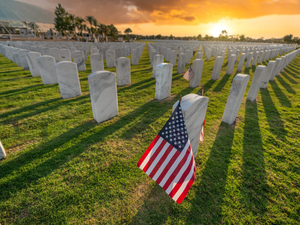
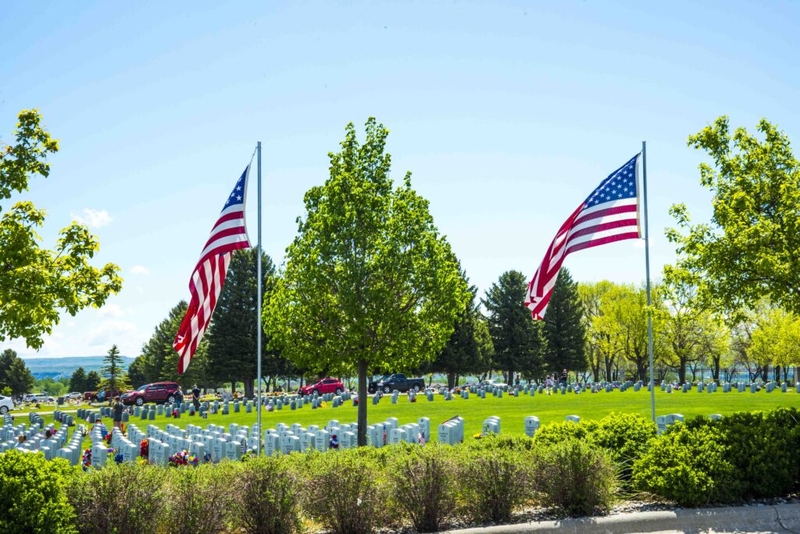
The Yellowstone National Cemetery in Laurel, Montana on Memorial Day 2020 (Photo by Ed Saunders, used with permission).
Years ago in late May, the calendar showed Memorial Day would soon come to Yellowstone National Cemetery in southcentral Montana. Many people would then visit graves, watch ceremonies, and listen to patriotic speeches. A rifle salute would crack, and the mournful bugle call of Taps would finish the day.
But not today. Today she walked alone with her thoughts and memories; no one else was in the cemetery.
She was a past middle-aged woman with hair turned white from age and perhaps unspoken sorrow. A woman of dignity, of quiet elegance and of modest dress, she walked among the hundreds of upright gray-granite headstones.
The headstones were all identical except for names and dates showing birth and death. The many engraved emblems-of-belief beneath the headstones’ rounded tops showed how that person, buried beneath, prayed or did not pray.
The headstones were granite, not to honor anyone with nobility but to withstand Montana’s prevailing winds, lashing blizzards, and dry searing heat. This is unrelenting land. A fierce land. A land that does not yield.
In this cemetery of precision-set headstones, rank after rank as if in final military parade, she walked a few steps and stopped. She looked to the horizon and then down, perhaps to say a silent prayer or two. The Montana wind slackened to a breeze that tousled her groomed hair.
I arrived after she did and watched her from afar. She appeared uncertain. I thought perhaps I could help. I walked to her. She looked at me and said she was looking for a grave and could I help? She said the name she searched for.
The woman, reserved in manner, did not wait for my answer but said, “He always wanted to be buried here. Here among the western sky, the deer, the eagles, and looking west toward the mountains. He really liked it here.”
I nodded.
Yellowstone National Cemetery is on a ridge one mile north of Laurel, Yellowstone County, Montana. The cemetery overlooks scenic Yellowstone River Valley. Distant mountains and vast prairies surround the cemetery. Nothing on that ridge impedes relentless western winds, winds that stretch the cemetery’s massive American flag flying over the cemetery and straining the 60-foot-tall flagpole holding the flag aloft.
Commissioned in 2014, the ten-acre U.S. national cemetery is America’s first national cemetery designed for sparsely populated rural areas in America. Presently, America has 208 national cemeteries and soldiers’ burial lots, the majority operated by the U.S. Department of Veterans Affairs, National Cemetery Administration.
America now cares for the mortal remains of over four million honorably served military veterans. Even today America reflects on how best to pay tribute to, and remember in death, those who served this nation honorably in military uniform.
Drew Gilpin Faust in her 2008 award-winning book, “This Republic of Suffering,” writes about the Civil War, when the upheaval of tens of thousands of military battle deaths challenged America physically, culturally, and spiritually. She writes about the character of a people, and how it shows in the way they treat their dead in body and in memory. In America these are the foundations of our Memorial Day.
Gilpin Faust explores the “Good Death” where America sought to ameliorate war deaths with notions of honor, purpose, and somehow being in the right. With fine words and ceremonies, America struggles even today to alleviate the hard bitter truths of deaths in war and in military service, especially in wars or armed conflicts that twisted wrong.
Women of the defeated Civil War Confederacy were the first to organize, find, and decorate the graves of their fallen brothers, husbands, and sons. Wearing black, these women were first in American history to collectively mourn their fallen men.
In World War I Grace Seibold’s son was killed-in-action.
Seibold resolved that mourning alone was not proper or emotionally healthy. In 1928 she began Gold Star Mothers, a Congressionally chartered organization for women to honor and remember their family members who died in military service to America. Gold Star Mothers exist today to ensure no one mourns alone at the grave of the fallen who died in military service.
In 1948 the Arlington Ladies organization began when Air Force chief of staff, Gen. Hoyt Vandenberg and his wife, Gladys, observed burials of servicemen at Arlington National Cemetery where no family or friends came to honor the deceased. Vandenberg then began group of women who would attend the burials of these forgotten servicemen to ensure someone honors them. The Arlington Ladies continue today.
These women knew that the greatest tragedy facing an American in military uniform is not that they may die in battle or in service. That is the greatest sacrifice. The greatest tragedy is these servicemen and servicewomen may be forgotten; forgotten in life and forgotten in death by the same nation they swore an oath to defend, even at the cost of their lives.
Abraham Lincoln’s heart-rendering Civil War letter to Lydia Bixby is among the highest examples of honoring a mother and remembering her sons who died in battle. In November 1864 Lincoln wrote to her, “I pray that our Heavenly Father may assuage the anguish of your bereavement and leave you only the cherished memory of the loved and lost, and the solemn pride that must be yours to have laid so costly a sacrifice upon the altar of freedom.”
The American poet and Civil War veteran, Walt Whitman, wrote in “Dirge for Two Veterans,” “The moon gives you light, and the bugles and the drums give you music. And my heart, O my soldiers, my veterans, my heart gives you love.”
In ceremonies honoring the dead, including Memorial Day, we search for illusive closure, if closure can be found. Gilpin Faust summarizes the hard cold truth of death when she writes, “Yet for those who remain alive to mourn, death provides no full stop.”
At Yellowstone National cemetery that day, the lady and I walked together searching for a grave. She said, “I won’t be here for Memorial Day. I no longer live here, so I came today. The cemetery has so many graves alike that I can’t find his grave.”
We soon found the grave. She thanked me and I departed, leaving her with her thoughts. At a respectful distance I watched as she put her hand on the granite headstone. She patted the headstone as if she were patting his hand.
Watching her I remembered the poignant Civil War letter of U.S. Army major Sullivan Ballou, written to his wife shortly before a battle in which he was killed. He wrote, “O Sarah, if the dead can come back to this earth, and flit unseen around those they loved, I shall always be near you…and, if the soft breeze fans your cheek, it shall be my breath; or the cool air cools your throbbing temples, it shall be my spirit passing by.”
On that day at Yellowstone National Cemetery long ago, the breeze caressed the headstones and carried memories aloft. A quiet day of honor for two people under Montana’s big sky.
Helena, MT