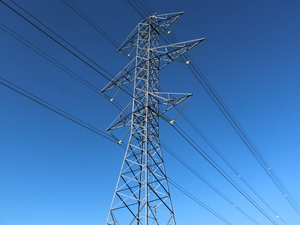
Energy Department unveils project to squeeze more juice through existing power lines
Sep 24, 2026 | 4:29 pm ET
Description
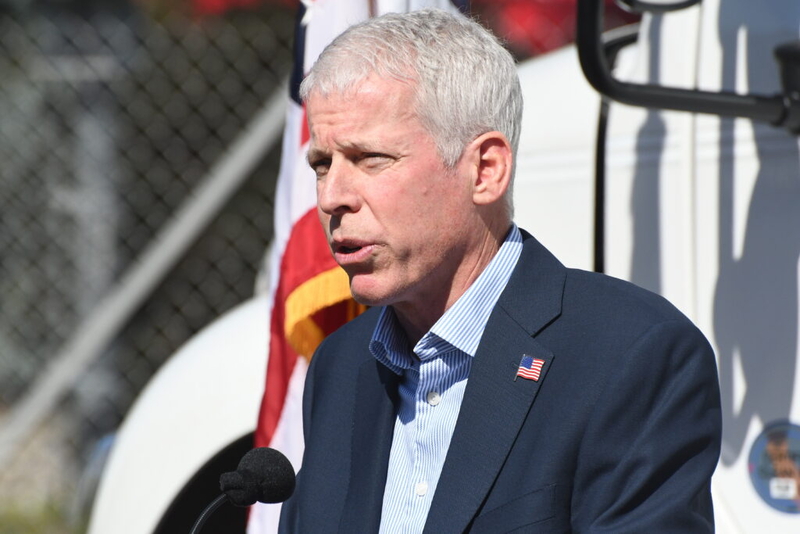
U.S. Energy Secretary Chris Wright speaks at a news conference where he announced a $71.5 million Department of Energy grant for PPL Electric Utilities to rebuild a Pennsylvania transmission line. (Photo by Peter Hall/Pennsylvania Capital-Star)
A project to wring more capacity out of existing power lines will help suppliers like PPL Electric Utilities improve reliability and affordability for customers, U.S. Energy Secretary Chris Wright said Thursday.
As the energy industry scrambles to meet surging electricity demand, largely from AI data centers, the U.S. Department of Energy (DOE) is poised to spend nearly $2 billion to help fund 31 grid improvement projects in 26 states.
“Energy is life,” Wright said in a news conference near Allentown, where he met with Lehigh Valley leaders. “Get energy policy right, and you create a community with tremendous opportunity, affordability. You attract businesses, which bid up wages. You create a stronger, more thriving community.”
That philosophy guides the DOE in the Trump administration, he said.
“Every project is evaluated in economics — Is that going to increase energy supply, drive down energy prices, and increase energy security? Because that’s how America thrives,” Wright said.
The program, in partnership with utilities that will contribute $3.4 billion, will rebuild or modernize 1,500 miles of transmission lines and deploy grid-enhancing technologies over 21,000 miles, increasing capacity nationally by 23 gigawatts.

Allentown-based PPL is slated to get up to $71.5 million to rebuild about 30 miles of high-voltage transmission lines to improve resilience, increase capacity and replace aging support structures. It will benefit the company’s customers in the Susquehanna Valley, Greater Lehigh Valley and Northeast Pennsylvania, the company said in a news release.
“By modernizing critical infrastructure with advanced technologies, we’re strengthening a key transmission corridor and nearly tripling its grid capacity while improving our ability to monitor system performance,” PPL President Christine Martin said at the event with Wright.
The technologies employed in PPL’s Montour Grid project will include advanced conductors that can carry more electricity and a fiber optic system that will allow the company to monitor strain in the wires and other environmental conditions.
Earlier this year, Gov. Josh Shapiro signed legislation as part of the state budget that would require utilities to assess whether the technologies could save ratepayers money before applying for approval to build new power lines.
Facing voters in the midterm elections this fall, elected leaders and candidates across the country have been straining to answer concerns about soaring electricity prices, as data center proposals drive demand forecasts to unprecedented levels.
Wright said the recipients of grants under the DOE’s SPARK Initiative were chosen because of their willingness to invest their own money in the technology.
“PPL won an award two months ago because they focus on their ratepayers, they focus on their communities to build smart, thriving communities,” Wright said, adding that the project is in line with the Trump administration’s prioritization of the economy in its energy policy.
Since taking office in his second term, President Donald Trump has ended support for renewable energy resources such as wind and solar in favor of fossil fuels and nuclear energy. The DOE has also ordered owners of coal, oil and natural gas fired power plants that were slated to close to keep them on standby for spikes in electricity use.
“We lost our way, and we started to spend money only based on decarbonization goals, forgetting American people, forgetting taxpayers, forgetting jobs and opportunity,” Wright said.
The funds for the SPARK initiative come from the bipartisan infrastructure law that former President Joe Biden signed into law.
“We are reallocating funds that were already dedicated towards the United States electricity grid, but just driving them towards reliability and affordability instead of making things more expensive for political posturing,” Wright said.
Wright added that new demand for electricity can result in lower costs for retail ratepayers but it depends on suppliers negotiating the right deal with large users. In March, the Trump administration announced it had reached an accord with hyperscale data center and AI companies to carry the costs of their energy consumption.
Under the pledge, AI and data center developers would be required to, “build, bring, or buy all of the energy needed for building and operating data centers, paying the full cost of their energy and infrastructure, no matter what.”
A bill with similar intentions passed the U.S. House in August. The Ratepayer Protection Act would require state utility regulators to explore strategies to make data centers pay their own way.
Martin, PPL’s president, said the commonwealth has seen “a lot of data center interest” particularly in the utility’s service area. A major data center campus is under construction in Salem Township, Luzerne County, adjacent to the Susquehanna Steam Electric Station nuclear plant.
PPL also announced last year it had formed a joint venture with Blackstone Infrastructure to build, own and operate new gas-fired power plants to supply AI data centers under long-term energy service contracts.
“As we see this new large load entering our system over the next few years, those customers will be paying for a much more significant portion of our transmission system,” Martin said, noting that it expects its service agreements to grow from 11 gigawatts to 30 gigawatts.
“That is a huge amount of load over which to spread the cost of a fixed asset. So we will see costs for all other customers coming down,” she said, adding that PPL is the only utility in the commonwealth to have a large-load rate structure that requires those customers to pay for growth.
Harrisburg, PA