DOC begins on-site correctional officer training
May 26, 2026 | 7:48 pm ET
Description
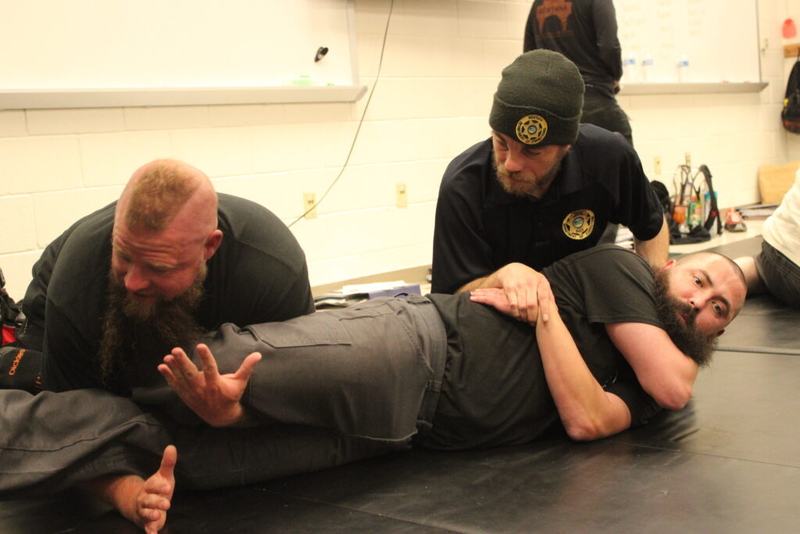
Montana Department of Corrections officers take part in a training at Montana State Prison on Thursday, May 21, 2026. (Jordan Hansen / Daily Montanan)
DEER LODGE — Facing a backlog of a required course for all state correctional officers, the Montana Department of Corrections now has the ability to host the classes on site at Montana State Prison.
It’s the first time the training, which covers the basics for corrections and detention officers, has been hosted at Montana State Prison.
A correctional officer said the training is critical for staff safety in an environment that can be volatile, and the department director said it will help the agency with retention and protect its recently reduced vacancy rate.
“There was just a need for us, just because the numbers we have and the capacity of what the Montana Law Enforcement Academy provides,” DOC Director Eric Strauss said in an interview last week. “We weren’t getting caught up with demand.”
All correctional officers in Montana, within one year of hire, must go through what’s called the Correctional/Detention Officer Basic class, which is usually hosted at a facility north of Helena.
When DOC brought its backlog and request to do on site training to the Public Safety Officer Standards and Training Council in February, the state had 107 correctional officers that needed the training. DOC is not the only agency that needs its employees to go through that training — county and local law enforcement officers also utilize the class.
Prior to the training change, DOC was averaging about 60 graduates through the class per year. The three-week course is mirrored after the class the Montana Law Enforcement Academy provides and will end on May 29, Strauss said. The class, while open to anyone who might need it, was intended to gather together correctional officers from all of Montana’s secure facilities and have them train together.
The class is 160 hours of in-person training.
The POST Council had to approve training at MSP, and if the class hosted by the Department of Corrections continues, it will be open to other agencies — including county law enforcement — to take at the corrections facility. The POST Council, with the Department of Justice, oversees all law enforcement training in Montana and helps oversee the class.
The state has worked to address staffing shortages in Corrections over the past four years. In a DOC newsletter earlier this year, the agency said it reduced the vacancy rate of correctional positions from 45% to 5% under former DOC Director Brian Gootkin, who is now the U.S. Marshal for the state of Montana.
Retention of those officers is key too, Strauss said. He added that he believes investing in staff skill development, along with anything that makes them feel more confident in their jobs, is key to retention efforts.
“One of the things that I believe, that we owe our staff, is making sure that they have the right training, the right skills, the right resources to do their job, and that’s part of our initiative. Our interest in performing this training out here is to make sure that people do have those skills to perform the duties,” Strauss said. “This is a hard job, and I think everyone admits that, and everyone agrees to that.”
Corrections opened part of the training to media members on May 21, and during that time officers were practicing different holds and disarming techniques for inmate restraints. In law enforcement and mental health settings, trainers place significant attention on different types of body holds, or restraints, which generally look to alleviate as much risk as possible for the person doing the restraining, as well as the person being put in a hold.
Winston Ferryman, a correctional officer at the prison, said the training had been beneficial, which included crisis intervention. It’s also centered on escalation, Ferryman added.
“The crisis intervention training has been actually very, very good in my opinion,” Ferryman said. “It’s something that we will use every day. We are very fortunate here at MSP we don’t have a hands-on altercation every day. We do have at least one person who is going to go through a crisis every day.”
The class also pushes communication, which among correctional officers is extremely important, he added.
“Being that we are outnumbered so much, our biggest tool that we use is our radio,” Ferryman said. “It’s our voice, it’s our body language, it’s the way that we communicate with our other (correctional officers) and with other inmates. The way that we communicate is everything. Just standing the wrong way around somebody who is having a real bad day can put them in a worse mood.”

Helena, MT