RTD board overhaul signed by Gov. Polis on a Denver bus
May 26, 2026 | 7:15 pm ET
Description
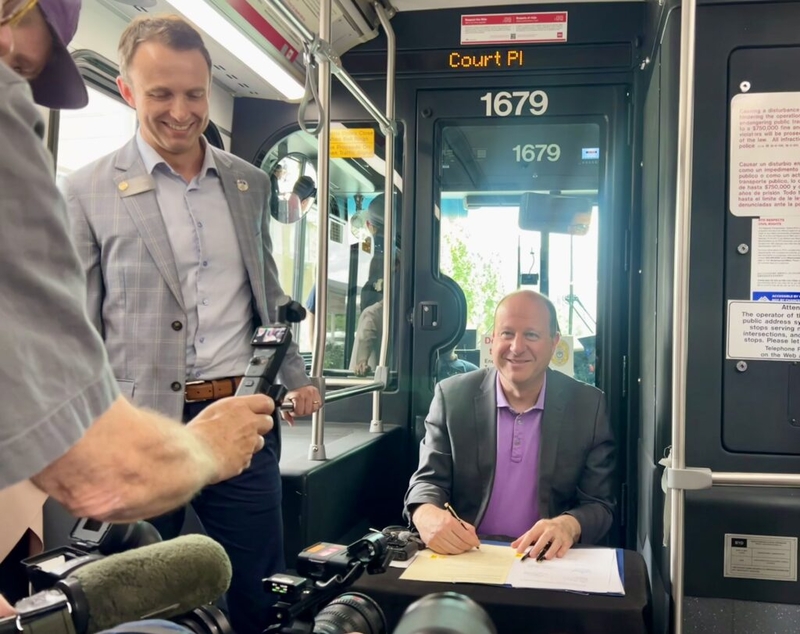
Colorado Gov. Jared Polis signs Senate Bill 26-150 into law aboard a shuttle bus in Denver on Tuesday. Next to him is Sen. Matt Ball, a Denver Democrat. (Photo by Sara Wilson/Colorado Newsline)
In a packed 16th Street FreeRide bus Tuesday, Colorado Gov. Jared Polis signed into law a bill that shrinks the Denver-area transit agency’s board and gives the governor appointing authority for some members.
“The Denver metropolitan area deserves an A-plus transit agency, and I think we all know through our own ridership, through stories from our constituents, and many others, that we are not there. We really need to energize and improve the efficiency of RTD,” Polis said, referring to the Regional Transportation District that oversees the rail and bus services in Denver and surrounding suburbs.
He signed Senate Bill 26-150 aboard the bus, a free shuttle operated by RTD that runs down 16th Street from Civic Center Station near the Capitol to Union Station. The bus was trailed by two RTD security cars, and Polis disembarked after three stops and got into an awaiting SUV.
The bill would overhaul RTD’s governance structure by decreasing the board from 15 all-elected members to nine members, five of whom would be elected to represent specific districts. The remaining four members would be appointed by the governor, with one on a recommendation from the Denver Regional Council of Governments and another from the Amalgamated Transit Union. The appointed seats serve to ensure expertise in areas like finance, transportation planning and land use. Supporters say that a smaller board with more professional qualifications can act more effectively and ultimately steer RTD onto the right track.
The bill also triples board member pay from $12,000 to $36,000. The changes would start in the 2028 election.
“At the end of the day, the average, everyday person — they don’t care about what the board makeup is,” bill sponsor Rep. Jamie Jackson, an Aurora Democrat, said. “All they care about is being able to get from Point A to Point B effectively and safely. I think this bill is a step in the right direction to doing that and being able to better serve our communities.”
In 2024, three of the eight seats on the RTD Board up for election were uncontested, and another saw a write-in candidate garner a few hundred votes against the candidate on the ballot.
The new structure was born out of the RTD Accountability Committee, created through 2025 legislation, which studied the board in comparison with other transit districts in the country and offered recommendations to the Legislature that closely resemble what is in the new law. Some bill opponents worry that a smaller board will make the agency less responsive to residents who live in the eight counties that make up RTD.
In that accountability report, the committee found that unreliable service, declining fare revenue, stagnant ridership and a perception of poor ride safety are challenges for RTD to overcome, warranting some level of governance reform.
Polis has prioritized policy to expand transit and decrease car dependence during his eight years as governor. That goes hand in hand with encouraging denser, more flexible housing development along the Front Range.
“Colorado, a few years ago, made a commitment to transit-oriented communities, and this is the perfect complementary bill to that, to make sure that people can age, live and work in the communities that they want because they have reliable rail and fixed transit,” bill sponsor Sen. Iman Jodeh, an Aurora Democrat, said. Jodeh was referring to another bill she sponsored, and Polis signed into law, in 2024 that encourages denser development along transit lines.
SB-150 was also sponsored by Sen. Matt Ball, a Denver Democrat, and Rep. Meg Froelich, an Englewood Democrat.
On Tuesday, Polis also signed into law a bill to update the Front Range Passenger Rail District boundaries to include only cities that would be directly served by the eventual rail line from Fort Collins to Pueblo.
Denver, CO