DNR to hold public meetings on solutions for dangerous Palisades-Kepler dam
Jul 18, 2026 | 10:00 am ET
Description
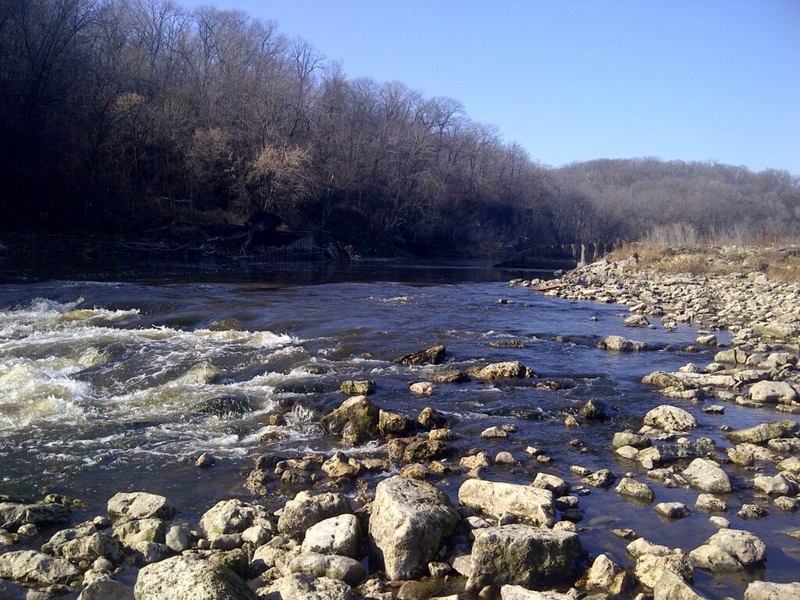
Downstream of the low-head dam along the Cedar River at Palisades-Kepler State Park. (Photo courtesy of Nate Hoogeveen/DNR)
The Iowa Department of Natural Resources is seeking public input as it explores remediation of a low-head dam in Linn County’s Palisades-Kepler State Park.
Decisions to remove or modify the dam will have to take into account a significant sturgeon spawning site nearby and recreation habits along the river.
Nate Hoogeveen, the river programs coordinator with DNR, said the dam has been the site of many incidents with swimmers and fishing boats who were caught in powerful flows or recirculating currents caused by the dam.
“It’s sitting in a very beautiful spot right between Cedar Rapids and Iowa City, it gets a lot of traffic,” Hoogeveen said. “But we do believe that there are some things that we can do to make the whole area inherently safer.”
Low-head dams were installed to operate mills, as early power generators or to supply water. They act as a short wall across a river and, unlike larger dams, allow water to flow over the top of the dam.
Hoogeveen said all low-head dams have some “inherent danger” because as the water flows over the top, it can create recirculating hydraulics which pushes objects — including swimmers and paddlers — in the water down and toward the dam.
According to the low-head dam fatalities database, Iowa, with more than 100, is the state with the second highest number of low-head dam fatalities. The database reports four deaths at the Palisades-Kepler dam.
Hoogeveen said the dam has been breached for many years, meaning water flows through the broken portion of the dam. This also creates swift currents that can sometimes catch swimmers unaware.
As the department considers removing the dam, or other solutions, Hoogeveen said it’s important to preserve the things that are working in that area: a “massive” fish spawning site and a sandbar in the river that’s a popular recreation site.
Near the dam is a spot of very fast, deep water that sturgeon and paddlefish use to spawn, which is the process of releasing their eggs and sperm. Hoogeveen said the conditions at the site are uncommon on the rest of the Cedar River and it is one of the largest congregations of sturgeon in North America.
“There’s seriously a lot of sturgeon breeding happening right there, and it’s important for the whole Cedar River system, not just that one spot.”
Hoogeveen said the department is waiting on hydraulic modeling to better understand the impacts of the dam on the river and the effect that removing the dam would have.
“But at the same time, we want to reach out to the public and confirm that what we think are their values, are their values,” Hoogeveen said. “And that can help us steer the project in a direction that citizens actually want.”
DNR previously scheduled virtual public meetings for July 16 but had to postpone the meetings. A new date has not yet been set but will be posted online.
In the meantime, Hoogeveen said DNR is not encouraging people to swim or wade out in the area near the dam. Generally, Hoogeveen said river recreators should take precaution anytime they see a “horizon” along a river and hear rushing water as that’s usually an indicator of a low-head dam.
Dam mitigation projects are part of the Iowa Water Trails and Low-Head Dam Public Hazard Program, which has an annual budget of $1.5 million.
To date, Hoogeveen said the department has removed or thoroughly modified 38 low-head dams on Iowa rivers, and there are about 160 remaining structures.
Des Moines, IA