Democrats, Republicans alike focus on states’ rights as a way out of America’s political woes
Jul 02, 2026 | 5:00 am ET
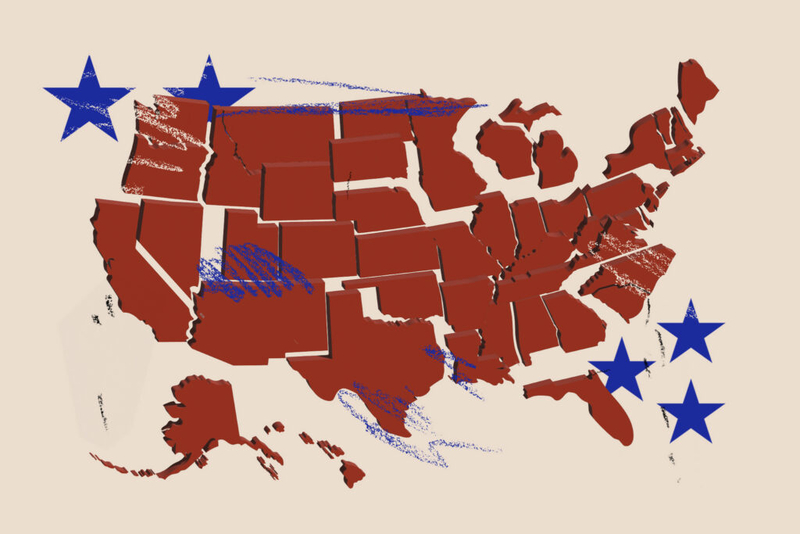
Description
(Illustration by Alex Cochran for Stateline)
Democrats are seizing the mantle of states’ rights to oppose the agenda of President Donald Trump, who has sought to reset Washington’s relationship with the states.
While the party out of federal power has always pushed its agenda in statehouses, Democrats across the country have recently demanded more autonomy for governors and state lawmakers. Liberals, longtime proponents of a stronger central government, are now championing an ideology that evokes odious memories of slavery and segregation.
Many state leaders hope that a renewed focus on federalism could help lower the national political temperature. By shifting more political decisions to the states, they envision a nation less subject to blue-red swings that change the entire course of federal law enforcement, environmental policy and business regulation.

“Otherwise we just end up fighting every four years over red king-blue king,” said Utah state Rep. Ken Ivory, a Republican. “And our entire nation goes entirely one way, and then 180 degrees the other way.”
Ivory said the pendulum swinging is “ripping our nation apart” politically and costing untold dollars as national policy reverses depending on who is in power. He leads Utah’s Federalism Commission, a bipartisan legislative group assessing state-federal boundaries and working to educate leaders across the country on federalism issues.
While he’s been pushing for a smaller federal government and heightened role for the states for years, he said the fiery policy debates in Trump’s second term have given the effort unprecedented momentum.
Last June, California Democratic Gov. Gavin Newsom said the White House had violated his state’s sovereignty in deploying the National Guard to Los Angeles without the governor’s consent. In a lawsuit the state ultimately won, California cited arguments made by founding father James Madison in the Federalist Papers calling for ratification of the Constitution more than 200 years ago.
And this winter in Minnesota, Democrats pushed for more state oversight of the federal government after immigration officers killed Renee Good and Alex Pretti in Minneapolis.
How Trump’s expansion of federal power threatens states’ authority
“This is a matter of states’ rights,” said Democratic state Senate leader Erin Murphy. “And while we can’t impact — except for next November – the makeup of Congress, we can impact and bring relief for the people of Minnesota.”
Many of the most high-profile conversations surrounding states rights’ have proven predictably partisan. Yet Democrats and Republicans behind the scenes have been quietly building momentum for a rebalancing of state-federal authority.
Conservative state lawmakers who have long pushed for a smaller federal government are welcoming liberal counterparts to a growing movement underscoring the importance of federalism, the uniquely American system created by the framers of the Constitution to share power between Washington, D.C., and the states.
As the United States celebrates its 250th anniversary, Stateline is exploring how the Trump era is transforming the relationship between the states and the federal government. This article is the third in an occasional series examining the fraught moment and what evolving — and often deteriorating — state-federal ties mean for the country, now and in the future.
In Utah, the Republican House speaker called Rep. Ivory several days after Trump’s 2024 election, noting that even California’s liberal governor was talking about federalism.
“He says, ‘We have the opportunity of our lifetime. … We need to get out and work with other states, get them together,’” Ivory recalled.
“I said, Mr. Speaker, I agree with you. But if Gavin Newsom does something that we believe is state jurisdiction, even if we don’t like the policy, we’ve got to stand with him. And he said, ‘I know,’ and that had never happened before.”

‘An inflection point’
The debate over how much power states should wield is as old as the nation itself: Alexander Hamilton and Thomas Jefferson, the forebears of our two-party system, famously argued for larger and smaller federal roles, respectively.
In Trump’s second term, Democrats have leaned on federalism principles as a means of checking federal power, said Troy Smith, a professor of constitutional federalism and director of the Constitutional Federalism Initiative at Utah Valley University in Orem.
The American federalist system is always evolving as states and the federal government tussle over authority and the two parties come in and out of national power. Smith said state governments, namely governors, have grown increasingly partisan since the 1990s. But that may be changing as Republicans and Democrats embrace states’ rights.
“I think we’re in an inflection point now that looks like it has the potential to go in that direction as the states start recognizing they have many things in common that transcends party and cooperation could be to their benefit,” Smith said.
Federalism scholars took note of December’s inaugural meeting of the Assembly of State Legislative Leaders, a bipartisan gathering of lawmakers from 30 states. Though not highly publicized, that group signed off on a 449-word declaration on the importance of states’ ability to legislate independently.
As Trump looks to punish foes, Democratic states find ways to push back
“I think that’s pretty unique and telling in this moment that Republican and Democratic leaders came together and unanimously approved that resolution,” Smith said.
The group of lawmakers has yet to publicize any more meetings and its leader, Ohio’s Republican House Speaker Matt Huffman, declined an interview request.
But New Hampshire House Speaker Sherman Packard, who attended that gathering, said it was clear that concerns over the size and scope of the federal government transcend parties.
“It’s strictly a bipartisan issue,” said Packard, a Republican. “It isn’t an issue that’s dominated by one blue state or one red state. It’s an issue that I think almost every state legislature is dealing with, and red or blue, it’s worth telling the federal government, ‘enough is enough.’”
Tennessee Democratic state Rep. Karen Camper, though, is skeptical that the states will mark meaningful progress during Trump’s term.
“Bipartisan has become a nasty word for this president,” she said. “So it’s going to have to be after he’s gone, because he will kill it. That’s what I’ve seen from this president.”
Camper, the Tennessee state House minority leader, pointed to May’s special legislative session in which the GOP pushed through a controversial congressional redistricting plan. It splits the state’s only majority-Black congressional district in Memphis across three districts, diluting that area’s vote as Republicans attempt to flip the state’s only Democratic-held district.
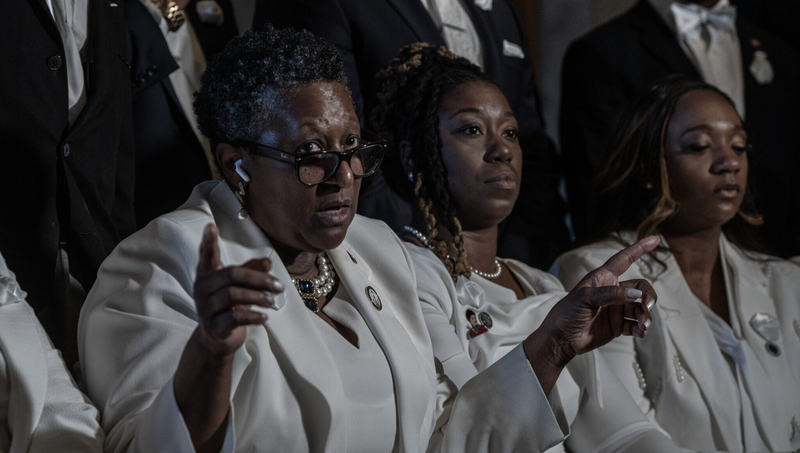
“Look at what just happened in our state,” Camper said, highlighting Trump’s push for redistricting. “That was a chance for our Republican supermajority to say, ‘We’re not going down this road.’”
Camper is also the chair of the Black Legislative Leaders Network, a national group of Black lawmakers who lead state chambers, caucuses and committees. She said she worries that too much focus on state autonomy could jeopardize important freedoms that were won at the federal level, including civil rights and voting rights.
“So we’re going to be fighting, refighting some of the same stuff, some of the same things that we fought for,” she said. “…We should be protected by these rights, regardless of where we go in this country, but in states’ rights, there’s a chance that you won’t.”
A complicated history
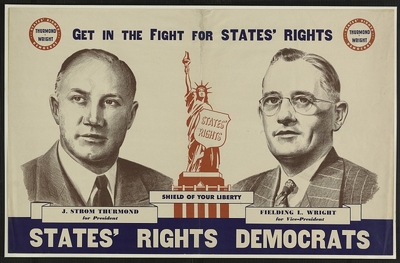
The debate over states’ rights is inextricably tied to race, equality and segregation.
And some Southerners continue to argue that conflicts over states’ rights — rather than slavery — drove secession ahead of the Civil War. Historians, though, note the only significant right under debate at that time was the right to enslave people.
In the Jim Crow era, Southern states continued the siren call of states’ rights as they defended racial segregation and fought civil rights movements.
While the concept can still evoke those deeply divisive times, liberals in recent years have found political value in embracing states’ rights, said Paul Nolette, professor and director of the Les Aspin Center for Government at Marquette University and co-editor of a national academic journal on federalism.
That’s particularly true of Democratic attorneys general, who have been aggressively challenging the White House in the past year with scores of lawsuits over its immigration enforcement efforts, environmental policies and the withholding of federal funds from states.
“If states were just this weak link, then they would be able to do nothing,” Nolette said. “You know, it would just be the federal government getting whatever it wants. But in fact, the states have a lot of tools themselves to push back on the federal government.”
Though the federal government has grown in scope over the decades, Nolette noted, state bureaucracies have also expanded influence. Many federal programs, including the national food stamp program and safety net health insurance, are administered by state governments.
“So the nature of federal policy over the last few decades has actually given states additional powers to have a say in national policy,” he said.
Nick Brown, Washington state’s Democratic attorney general, acknowledged his view of states’ rights has evolved over the years.
Like many others, the phrase to him frequently evoked the Southerners who championed states’ rights in their efforts to oppose racial integration. The state’s first Black attorney general, Brown previously spent years working in the U.S. Department of Justice, a federal agency he admired for its role in pursuing civil rights cases.
But he said the Trump era demands a different role for states as the president continues to flout congressional appropriations and punish political opponents.
“I think certainly we have to look differently at what states’ authorities are in this moment,” he said.
Brown said a heightened focus on states is welcome after years of outsized attention on national politics. That’s because the issues most important to most people — taxes, schools and public safety — are most affected by local policy decisions, he said.
Changing the structure
In Utah, state officials are looking to lead a national movement to bring more authority back to the states.
While fears over the Trump administration’s overreach have fueled Democratic interest, Ivory, the Republican representative leading that effort, said the initiative is more focused on governmental structure than politics.
Ivory likened the current federal-state dynamic to a bicycle with a bloated front tire threatening to bust and a back tire so flat it’s about to chew the rubber off the rim.
“Well, the answer is not to get a different rider or a stronger rider or to steer the bike to the left or to the right. It’s to fix the balance in the tires,” he said. “Our structure, our vehicle of government was two spheres with very specific balance, and we haven’t been paying attention to that for a long time.”
This discussion comes naturally in Western states that have for generations feuded with Washington over the proper use and ownership of federal lands. Over 90% of federal lands are located in the West, according to the Congressional Western Caucus, with the federal government owning 1 of every 2 acres.
States are oftentimes too wrapped up in whether we're blue states or red states to really have each other's back.
Utah’s commission aims at connecting state lawmakers and agency staff from across the country to better adjudicate federal and state jurisdiction on everything from land management to law enforcement. Ivory said the group would also like to help fill the void left after the 1996 disbandment of the Advisory Commission on Intergovernmental Relations, an entity that put state and local governments in direct contact with federal agencies.
Utah Democratic state Rep. Jennifer Dailey-Provost acknowledged her initial skepticism of the GOP’s federalism push there because of its historic ties to slavery and segregation.
“I’m pretty liberal,” she said. “Federalism is something that was always viewed, I think for not unjustified reasons, as something that was hostile to equality and equitable outcomes and fairness.”
But after a 90-minute conversation with her Republican colleague, she began to see the value — especially now — of pushing for an expanded role for states. Now a member of the state’s federalism commission, she said she envisions a better structure where states stand together, regardless of party affiliation, to counterbalance the federal government.
“States are oftentimes too wrapped up in whether we’re blue states or red states to really have each other’s back,” she said. “And it’s been hard, politically, to convince a red state like Utah to vocally say blue-state California wants to do things its way, we have to have their back and say that they have the right to do things that way, even if it’s not how we would do things.”
As a member of the political minority in Utah, she acknowledged how difficult that can be. Utah’s Republican party holds all statewide offices and enjoys supermajorities in both legislative chambers. And Dailey-Provost said the state’s LGBTQ+ population has been subjected to “constant attacks” from the GOP there.
Still, she said, she would rather have that debate locally than rely on the federal government to protect those residents.
“So, I don’t like the current policy outcomes, but I see more opportunity to continue to work with communities and try to fix it over time here at the state level,” Dailey-Provost said. “… At least I feel like there’s a path forward at the local level.”
Stateline reporter Kevin Hardy can be reached at [email protected]. States Newsroom reporter Jonathan Shorman can be reached at [email protected].