Court ruling clears path for Shekarchi to continue his pursuit to join RI Supreme Court
Jul 27, 2026 | 4:19 pm ET
Description
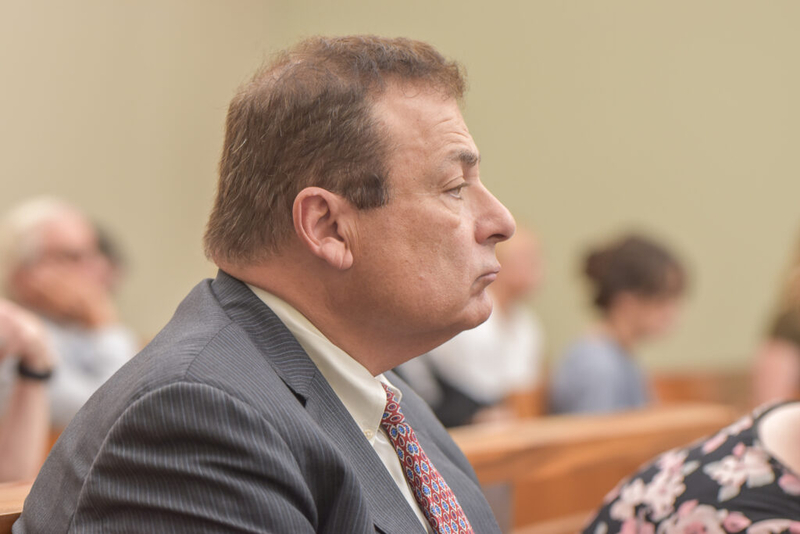
Former House Speaker K. Joseph Shekarchi listens as attorneys present oral arguments in Kent County Superior Court for his lawsuit seeking to halt a state ethics investigation on July 20, 2026. (Photo by Christopher Shea/Rhode Island Current)
One day before the state’s Judicial Nominating Commission is scheduled to interview former House Speaker K. Joseph Shekarchi and other candidates to fill a vacancy on the state’s high court, a Superior Court judge declared there’s no constitutional reason preventing a sitting lawmaker from taking the job.
Judge Richard Licht on Monday ruled that Shekarchi’s application to join the Rhode Island Supreme Court does not violate the state’s revolving door law, which bars lawmakers from accepting certain state appointments within a year of leaving office.
“Mr. Shekarchi, as an elected member of the House of Representatives, was permitted to apply to the JNC,” Licht wrote in his 29-page ruling. “If nominated and confirmed, he may serve in the position.”
Licht himself sought and received an Ethics Commission advisory opinion before joining the Superior Court in 2014.
Shekarchi is among five candidates scheduled to be interviewed by the Judicial Nominating Commission on Tuesday afternoon. The other four are: Luis Matos, a Rhode Island Superior Court judge; Christopher Bush, an assistant attorney general; Laureen D’Ambra, a Family Court judge; and John E. Roberts, an attorney who is a partner with the Boston firm Proskauer Rose LLC.
Shekarchi, a Warwick Democrat, stepped down as House speaker on May 7, three days after applying to fill the seat left vacant after Justice Maureen McKenna Goldberg retired in March.
That same day, Roger Williams University School of Law Professor Michael Yelnosky filed a complaint to the state’s Ethics Commission arguing that the leap from one branch of government directly to another would violate the revolving door rule written into state law in 1992.
“The clear and unambiguous rule of law won today,” Shekarchi said in a statement Monday. “As a practicing attorney for more than 30 years, I always had full confidence in the judicial system and am grateful for today’s court decision reaffirming that elected officials may be considered for appointment to the Rhode Island Supreme Court.”
The law prohibits sitting legislators from seeking or accepting employment with any state government agency for at least one year after leaving elected office. But it exempts lawmakers who seek or accept election to a constitutional office.
“Nothing contained herein shall prohibit a state elected official from seeking or being elected for any other constitutional office,” the law states.
The Ethics Commission voted to authorize a full investigation on June 2. After the Ethics Commission twice rejected petitions to end its investigation, Shekarchi’s legal team filed a Superior Court lawsuit seeking to halt the probe and have a judge declare that Shekarchi did not violate the state ethics code.
Shekarchi and his attorneys have repeatedly argued his application is eligible under the law, arguing that the Supreme Court is a constitutional office.
Jason Gramitt, executive director for the Ethics Commission, had argued that the exemption applies to those who seek elected constitutional offices, such as governor or attorney general — not appointments to the judiciary.
“This court is not convinced,” Licht responded to the Ethics Commission’s arguments.
Were the Supreme Court not exempt from the revolving door rule, Licht wrote, the General Assembly would have omitted the words “seeking or” in the law.
Licht also pointed to a 2020 commission decision allowing Associate Justice Erin Lynch Prata to join the Supreme Court, despite the panel’s legal staff voicing support for upholding the revolving door prohibition. At the time, Lynch Prata had applied to the bench while still a state senator from Warwick.
“This court cannot close its eyes to the fact that RIEC rejected an opinion which would have prohibited her from reaching the Court, and that RIEC has done nothing to seek a change in the law,” Licht wrote.
Licht’s decision does not formally toss the Ethics Commission’s investigation. The parties must still work with the court to prepare the final order and judgment.
Grammitt said in an email to Rhode Island Current that Ethics Commission staff “will carefully review the Superior Court’s decision” before making a determination on its next steps.
During oral arguments on July 20, Licht acknowledged any ruling would likely be appealed to the state’s Supreme Court.
“It’s not that uncommon for their decisions to get appealed,” John Marion, executive director for Common Cause Rhode Island, said in an interview. “What’s uncommon is for it to get removed to Superior Court at this stage.”
Should Shekarchi’s case go to the state’s highest court, Marion assumes Justice Lynch Prata would recuse since it’s so similar to her path joining the bench.
“I can’t imagine a world where she wouldn’t recuse,” he said.
Marion called Licht’s decision disappointing. He added that Common Cause may push for a constitutional amendment to strengthen the state’s revolving door rule.

Providence, RI