Democratic state officials urge US Supreme Court to affirm pause on Trump vote-by-mail order
Aug 03, 2026 | 6:18 pm ET
Description
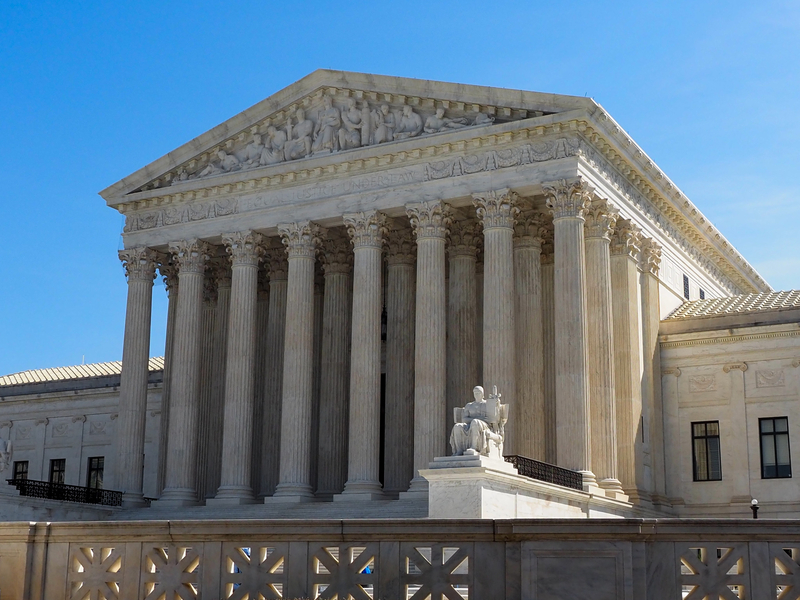
The U.S. Supreme Court on April 9, 2026. (Photo by Ashley Murray/States Newsroom)
WASHINGTON — States do not have time before November’s midterm elections to comply with President Donald Trump’s executive order mandating overhauls of their mail-in-voting systems, two dozen Democratic state officials told the U.S. Supreme Court on Monday.
Justices should keep a stay pausing the order in place through Election Day, the Democrats, led by California Attorney General Rob Bonta, wrote. The court is compelled to keep voting rules in place this close to an election, but the executive order would force massive changes on state administrators, they wrote.
Neither the president nor the U.S. Postal Service has authority to administer elections under the U.S. Constitution, which assigns that responsibility to state governments, the Democrats wrote.
Trump’s March 31 order directs USPS to collect lists of registered voters from each state and only mail ballots to registered voters, and the Department of Homeland Security to compile lists of voting-age citizens in each state.
That would insert the executive branch directly into elections administration and the administration has not defended the legality of that move, the Democrats wrote.
Worse, the officials said, the order would create mass confusion at this point in the election cycle, meaning that the court should delay considering whether it is legal until after the midterms.
“Because of the high risk of errors and the limited window for correcting mistakes, many of the millions of voters who rely on mail voting—especially voters with disabilities and those in rural areas—would likely be denied mail ballots and, as a result, disenfranchised,” the state officials said. “Many more voters would be confused—either because they wouldn’t receive their mail ballots or would fear that USPS would fail to deliver their voted ballots to state officials for tabulation.”
Bonta signed the brief along with the attorneys general of Massachusetts, Washington, Nevada, Arizona, Connecticut, Colorado, the District of Columbia, Delaware, Hawaii, Illinois, Maine, Maryland, Michigan, Minnesota, New Jersey, New Mexico, New York, North Carolina, Oregon, Rhode Island, Vermont, Virginia and Wisconsin. Pennsylvania Gov. Josh Shapiro also signed on.
Their filing was the Democrats’ response to the Justice Department request that the Supreme Court overturn an appeals court decision against lifting a district court stay of the executive order. The court is considering the issue on its emergency docket that allows for speedy decisions.
Spokespeople for the Justice Department did not return a message seeking comment Monday.
No final rule
The administration argued that the states’ challenge was premature because the Postal Service and DHS had not yet written the rules the executive order directed.
While a three-judge panel of the U.S. 1st Circuit Court of Appeals sided with the Democratic states, a separate case at the D.C. Circuit Court of Appeals agreed with the administration that the states could not yet challenge the policy because there was no final rule. The case under consideration at the Supreme Court is from the 1st Circuit.
In an amicus brief supporting the federal government, a coalition of conservative groups led by attorney William Olson said Monday that the district court stay was possibly the first time a judge has blocked a notice of proposed rulemaking, which “is the very definition of an agency action which is not a final agency action.”
Sowing voter confusion
The states said Monday the order itself, even without final rules from the affected agencies, would impose significant burdens on their election administrators. And the administration has detailed in court the steps the agencies must take to finalize the order’s mandates.
Forcing the states to wait until there is an actual rule in place, especially when the steps agencies have taken “do not materially differ” from the order, would mean state election officials could face an untenable situation of needing to prepare for the new requirements.
“If litigation challenging final implementation of the EO does not even begin for several more weeks, it would be extremely difficult—if not impossible—to obtain a definitive judicial resolution with enough time remaining for States to redesign and reorder their ballot mail, train elections officials, and adequately educate the public before the November midterms,” the state officials wrote.
That would drain significant resources from overworked election offices at a busy campaign time, and leave voters “confused about which rules govern,” they added.
Support for states
Several friend-of-the-court briefs weighed in on the states’ side.
Scores of state and local election officials and the nonprofit voting rights group Center for Election Innovation wrote in one amicus brief that if the executive order is allowed to proceed, it would put them in the “untenable position” of updating their mail-voting procedures in the midst of primaries and just weeks before a general election.
And Democratic campaign groups said the order was plainly unconstitutional and rejected the administration’s argument, saying it “makes little sense.”
In part, the administration argued the district court injunction caused irreparable harm because the administration was running out of time to implement the policy before the midterms, attorney Marc Elias wrote for the Democratic National Committee, three campaign groups and the Democratic leaders of each chamber of Congress.
“When the President launches an unconstitutional seizure of sensitive election powers during an election year, he may not avoid an injunction by insisting he is in a rush,” Elias wrote.
All States Newsroom content is free to republish. Read our republishing policy for more information.