Tax on millionaires, rainy day fund anchor new budget plan
Apr 01, 2026 | 12:46 am ET
Description
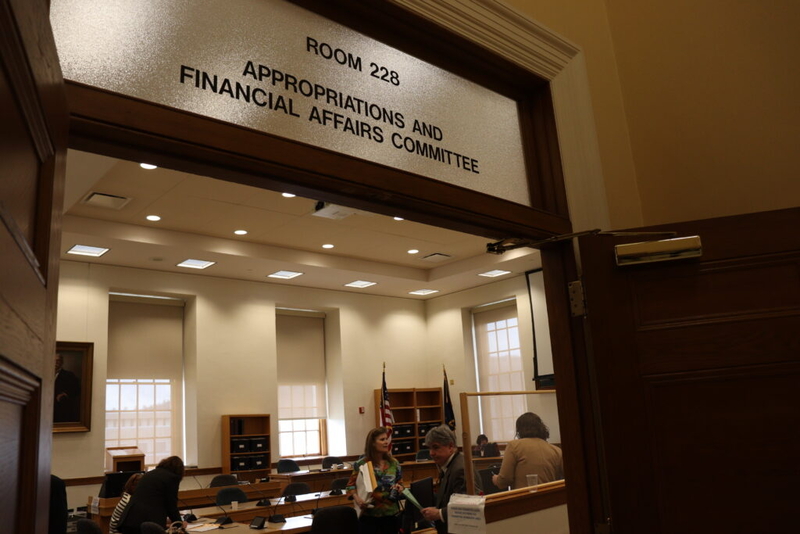
Legislative staff prepares for Appropriations and Financial Affairs Committee work in Augusta. (By Emma Davis/ Maine Morning Star)
Maine’s budget committee set a plan early Thursday that doubled down on the Democratic majority’s reliance on the state’s rainy day fund to provide short-term boosts for priorities such as addressing the high cost of living.
The supplemental budget is anchored by a decision made Tuesday night to add a tax on millionaires, which Gov. Janet Mills announced she’ll support after she’s long opposed calls to increase income taxes.
The Maine Legislature’s Appropriations and Financial Affairs Committee passed the spending package around 12:40 a.m. Thursday along party lines, sending it to the Maine House of Representatives and Senate. It adds to the current $11.65 billion biennium budget passed last year, though it’s still unclear yet how the plan will alter that total.
The Democratic-led Legislature is likely to continue its streak of passing partisan budgets, with the committee preemptively removing from the plan the emergency clause that would have required two-thirds support and allowed for a sooner enactment.
Over the past several weeks of individual line votes, the majority of the committee agreed with many of Mills’ initiatives, including continuing the state’s free community college program. However, lawmakers opted to fund several of her proposals at lesser amounts, including “affordability checks” to some Mainers, a ban on cell phones in schools and Artificial Intelligence training for state employees.
The committee-backed plan also includes funding Mills proposed to help offset changes made by President Donald Trump’s spending law signed last summer, which significantly shifted tens of millions of dollars in costs for health care and assistance programs to the state. However, the committee opted to conform with even fewer of the federal tax changes than the governor had recommended.
Several initiatives lawmakers originally debated in separate bills — expanding free meals to all children enrolled in public preschool and energy cost assistance for low-income Mainers — also made their way into the plan.
It’s unclear how much money will be left for bills not funded in the budget. The committee will reconvene in the coming days to make those decisions, however committee co-chair Rep. Drew Gattine (D-Westbrook) requested Thursday morning that any amount over $8 million left be transferred to MaineCare Stabilization and Education Stabilization funds to help with the next budget cycle.
The minority party is opposed to the package for much of its policy. Rep. Ken Fredette (R-Newport) called the millionaire tax, among other provisions, “poison pills” for Republicans. But GOP lawmakers also objected to Democrats’ use of the Budget Stabilization Fund, otherwise called the rainy day fund, for even more measures than Mills had recommended.
The fund, which is meant to cover revenue shortfalls, has grown to its statutory maximum under Mills, who had previously refrained from touching it.
Democrats on the committee paid for their final series of funding decisions into the early hours of Thursday by transferring $38.4 million from the roughly $1 billion rainy day fund to the general fund to then put toward initiatives, including the state’s eviction prevention program, emergency shelters, public defender system, stabilizing school budgets, improving access to affordable prescription drugs, victims’ services, and services for older Mainers such as meal programs, among others.
Taxing the wealthy
The budget plan now includes a “millionaire’s tax.”
It’s an income tax surcharge of 2% on wealthy Mainers, specifically on the portion of a resident’s taxable income beyond $1 million for single filers, $1.5 million for heads of households and $1.5 million for people filing jointly. The tax is expected to impact 2,631 tax returns and generate $150 million in the next biennium.
This idea was originally proposed in a separate bill, LD 1089, which is currently tabled in the House.
Notably, the Mills administration testified against that bill, following a pattern of the governor consistently opposing income tax increases throughout her two terms.
However, unlike that bill, which would have revenue generated to public K-12 education, revenue would now go to the state’s general fund without a specific dedicated use.
In a statement after the vote, the governor said she supported the plan, explaining that she believes it is “crucial” that the state maintain investments in health care, education, and local communities, “especially as we face such economic uncertainty because of actions of the Trump Administration.”
“So,” Mills continued, “when the Senate President and the House Speaker asked me whether I would support a surcharge on the very wealthiest in the supplemental budget in order to continue funding these investments, I agreed, and I requested that that revenue be used in part to provide property tax relief for hardworking Maine people who are feeling the pinch.”
When the amendment was introduced around 9 p.m. Tuesday, committee co-chair Rep. Drew Gattine (D-Westbrook) said, “I believe it’s a fundamental issue of tax fairness that we ask people with the very highest incomes in Maine to contribute a little bit more.”
The addition of this tax follows the recommendation of the majority of the Taxation Committee, although that body had also suggested a tax on corporations and an overall restructure of the state’s tax brackets to provide relief for the middle class.
With a vote of 8-5 along party lines, Republicans objected to the tax on millionaires, both to the policy and the fact that the initial bill hasn’t yet passed the House.
“We’re doing things that we couldn’t get done in the chamber,” Rep. Jack Ducharme (R-Madison) said.
Republicans also raised concern about driving high earners out of the state, though studies on the outcomes of such policies have been mixed.
Pushing back on their arguments, Rep. Michael Brennan (D-Portland) pointed out the extreme levels of inequality that persist in Maine and the rest of the country.
“Sixty percent of people in this country live paycheck to paycheck, cannot afford a medical bill, and if their car breaks down, they can’t fix it,” he said. “Thousands of people lost their insurance because they couldn’t pay premiums.”
“And yet,” Brennan said, “we’re going to sit here and defend millionaires?”
“Affordability checks”
The Democratic majority of the committee went ahead with Mills’ plan to send “affordability checks” to a subset of Mainers, though to fewer people with a smaller pot of money.
Instead of allocating $218.5 million, the committee allocated $155.2 million.
Mentioning the recent spikes in gas prices, Gattine said, “This is an effort in order to provide a very small level of relief, but a meaningful level of relief to the people that would receive these checks.”
However, a key sticking point throughout the discussion was Democrats’ plan to use the rainy day fund to pay for the checks and several other items. The fund hovers at the current statutory maximum of roughly $1 billion, an increase of more than $820 million since Mills took office in 2019.
State savings weaken as budget pressures increase, analysis warns
Republicans sharply criticized the use of the fund, which as outlined in state law “may be expended only to offset a General Fund revenue shortfall,” with few exceptions.
Rep. Amy Arata (R-New Gloucester) said that if the state depletes its rainy day fund and there’s a recession, “we’ll have property taxes going up, services going down, and people losing their jobs.”
She added, “I’m so glad Democrats are very confident in Trump’s economy.”
Several Republicans also criticized the “affordability checks” as a political ploy, given Mills’ bid for Republican U.S. Sen. Susan Collins’ seat.
“I want to know if the governor’s campaign is going to declare these checks as a campaign expense on her ethics report,” Ducharme said.
Separately, the Democratic majority changed where some of the interest on the rainy day fund goes to provide a steady source of revenue to support the Land for Maine’s Future Program, the state’s primary funding vehicle for land conservation.
The use of the rainy day fund came up again on Wednesday, when the committee debated how to fill a budget gap in the state’s highway fund. The Democratic majority ultimately decided to use the rainy day fund, after Republicans first attempted to use revenue from general obligation bonds.
Responding to federal cuts
The Democratic majority of the committee included Mills’ proposals to add more staff and make technology adjustments to handle forthcoming changes to Medicaid rules passed in congressional Republicans’ reconciliation package.
“I wish we had not been in a position of having to do this,” said Gattine. “But I think if we want to make sure that people who would otherwise be eligible don’t lose their health insurance, I think we want to give the department the resources that it needs to do this work correctly and accurately.”
That includes determining who meets new work requirements. During last year’s budget negotiations in Maine, Senate Republicans held out support to fill a Medicaid funding gap unless work requirements and other structural changes were made to the program.
“Now we’re being told by the feds that we have to do this, and so I’m just pontificating that if we’d done it 12 months ago when we talked about it, maybe we’d be in better shape,” Ducharme said during a committee meeting Monday night.
Gattine argued that waiting to see how the federal government acted first was ultimately more efficient, as opposed to “possibly have a federal requirement come to us that’s very different and cause us to have wasted a bunch of money or had to course correct.”
Among the new positions are also dozens of specialists to improve the Supplemental Nutrition Assistance Program payment error rate, or how much the state over or underpays recipients’ benefit amounts.
Under the “One Big Beautiful Bill,” states will be penalized from 5%-15% of their SNAP benefit costs if their error rates are over 6%. Maine’s error rate is currently 10.26%, which is below the national average but still puts the state at risk of potentially losing $50 million in federal funding.
Over Republican objections, Democrats on the committee also opted to pull from the general fund to pay reproductive health care providers to offset federal funding reductions.
On the other hand, the committee unanimously voted to adheare to Mills’ request to make permanent what she initially intended to be $6 million in one-time funding to address federal funding shortfalls from the Victims of Crime Act, which funds local services such as centers for sexual assault support, children’s advocacy and domestic violence resources.
On Wednesday, Democrats also backed measures to plan for possible future federal cuts or other unanticipated changes that disrupt programs and services, including giving the governor more authority over providing emergency funding for the Supplemental Nutrition Assistance Program and reproductive rights services.
Tax conformity
States can choose whether to align their tax codes with the federal one, which is called tax conformity. After Trump and congressional Republicans passed significant federal changes, Mills recommended the state reject the provisions on not taxing tips, overtime pay, certain car loan interest and deductions for seniors, which had already drawn the ire of the Republican minority.
To conform or not to conform? Maine debates changes to tax code
Democrats on the budget committee went a step further, deciding not to conform with added deductions for charitable donations, an expansion of a business stock exemption, and making permanent something called the opportunity zone tax incentive program.
Republicans opposed the plan, “not for what it does but for what it fails to do,” as Ducharme put it.
Created by the 2017 Tax Cuts and Jobs Act, the opportunity zone program allows businesses and individuals to defer paying taxes on capital gains by reinvesting the proceeds into “qualified opportunity zones,” which are supposed to be economically-distressed communities. However, the program has faced criticism for helping wealthy investors while doing little to help those in the distressed areas, which Democrats cited in explaining their decision.
“If we don’t take up opportunity zones, we will retain the money that others might have invested here, but we will be able to invest that money in areas that we know need our assistance,” said Rep. Ann Matlack (D-St. George).
Democrats similarly said they rejected the other provisions because they wouldn’t benefit Maine.
Fredette pushed back. “I think when we remove items like this, I think it removes a tool for the state of Maine to say we’re welcome to investment,” he said. “I think this is short sighted.”
The tax changes in Trump’s spending law already apply to federal returns, most being available retroactively for 2025 through 2028.
Education
The committee agreed with Mills to continue the state’s free community college program, after lawmakers had stripped future funding for the program last year.
The budget plan includes $2.5 million in one-time funding to cover the class of 2025 and $10 million annually to make the program permanent.
Since the program was first announced by Mills in February 2022 to boost enrollment after the COVID-19 pandemic, more than 23,000 students have enrolled in community colleges for free.
The committee also backed Mills’ plan for a cell phone ban in schools, though it reduced the allocation to help schools implement that from $700,000 to $350,000. School boards would be required to adopt and implement a policy prohibiting use of personal electronic devices during the school day by August 2026.
Republicans opposed the measure, for various reasons. Ducharme argued that it’s an incursion into home rule, whereas Arata said she wasn’t necessarily against the policy but didn’t think that much money was needed to make it happen.
The committee on Wednesday also added funding for school bus safety enhancements, following the deaths of two children struck by buses, and increasing minimum teacher salaries.
Other tax changes
The committee’s plan also includes several changes to existing state tax credits, some of which the Republican minority also backed.
All committee members agreed Tuesday night to increase the property tax fairness credit for people younger than 65 years old from $1,000 to $1,500 a year.
That followed a unanimous vote Monday night to raise the reimbursement rate for municipalities for the exemptions for veterans and legally blind people to 76%, which is the current rate of the homestead exemption.
“This will simplify the work of the clerks in the local offices and the municipalities will be better reimbursed,” Matlack said.
Arata said she liked the idea of streamlining that process, leading her and her Republican colleagues to vote for it, but she raised concern about it increasing expenses on municipalities long-term, and possibly rising property taxes as a result. (The Legislature currently has an ongoing task force to address high property taxes.)
But Democrats and Republicans on the committee were split over what to do with the Business Equipment Tax Credit program. This program reimburses taxpayers for local property taxes paid on most qualified business properties.
Mills initially proposed sunsetting this credit, but in light of more projected short-term revenue, she opted to partially reinstate it. She proposed phasing out the exemption for retail facilities, which the Democratic majority on the committee agreed with.
“Maine just keeps getting harder and harder to do business in,” Curtis Picard, president and CEO of the Retail Association of Maine, told Maine Morning Star.
Republicans argued the state should do away with this credit and ultimately not tax business equipment at all.
Investments in AI
During a work session last Friday, the Mills administration told committee members that data management was a big vulnerability for the state.
“There’s data everywhere,” Acting Commissioner of the Department of Administrative and Financial Services Elaine Clark said. “It is not protected to the extent it needs to be. AI training, AI application towards that data will help to manage it, control it, and prevent its potential release and misuse.”
While members of both parties agreed on the importance of data management and training state employees, they voted to reduce the one-time funding the governor proposed for each, while backing her plan to establish a position to coordinate the development and implementation of state policies and partnerships related to Artificial Intelligence.
The hope, they said, is for this person to take the reins in deciding the best path forward. For this reason, they also rejected Mills’ proposals for ongoing funding to establish a state AI public innovation hub and create a grant program for businesses to access Maine-based consultants with AI expertise.
Still, lawmakers expressed differing views on how the state should be using AI.
“I would have liked to have seen AI to be used for efficiencies,” Fredette said, “on how we could reduce head count and get efficiencies as far as reducing the cost of state government, rather than just training.”
Rep. Ambureen Rana (D-Bangor) took issue with focusing on what AI could replace and instead wants the state to frame its use as a tool to support the existing workforce.
“There are deep inaccuracies in AI,” Rana said. “I’m just going to share my values. I don’t think that AI use is ethical. So I really hope that the education that we’re doing is about making sure that AI is not misused.”
Health and housing
The committee allocated $12 million to the Emergency Housing Relief Fund Program, which goes to MaineHousing for a variety of interventions, such as the statewide winter warming shelter system. That funding will come from the Budget Stabilization Fund, which Republicans again objected to using. Ongoing funding was also included by the committee on Wednesday to increase the shelter operating subsidy program.
“With all of the money that we have spent, do we know if we are reducing the numbers of folks that need this help, or are we simply perpetuating a lifestyle?” Ducharme asked.
Greg Payne, senior advisor of housing policy in the Governor’s Office of Policy Innovation and the Future, said, “so long as our housing supply is inadequate, homelessness will always be with us.”
“Rather than letting people be outside, it’s going to be necessary for us to throw them a lifeline,” Payne said, “and I think that that’s what this particular fund is trying to do.”
The committee-backed plan also includes $37.5 million to boost housing stock, specifically more than 300 new affordable homes.
The budget plan includes funding to establish a youth psychiatric residential treatment facility in Saco.
“We have youth at Long Creek that probably would not be at Long Creek if we had this facility,” Rep. Michael Brennan said of the state’s youth prison, also noting the high number of youth seeking help at emergency rooms. “The need for this facility is well documented.”
While Republicans agreed with the need, they opposed the $7.9 million price tag. Sweetser, the nonprofit community mental health provider that would run the facility, is providing $2.5 million as well.
“Whenever you’re talking about 24 hour, seven day a week care,” Brennan said, “it’s expensive.”
- April 2, 202612:40 amEditor’s Note: This story was updated Thursday morning following the final committee vote.
Augusta, ME