Senators give new SC voting lines key approval, to return Tuesday
May 23, 2026 | 12:38 pm ET
Description
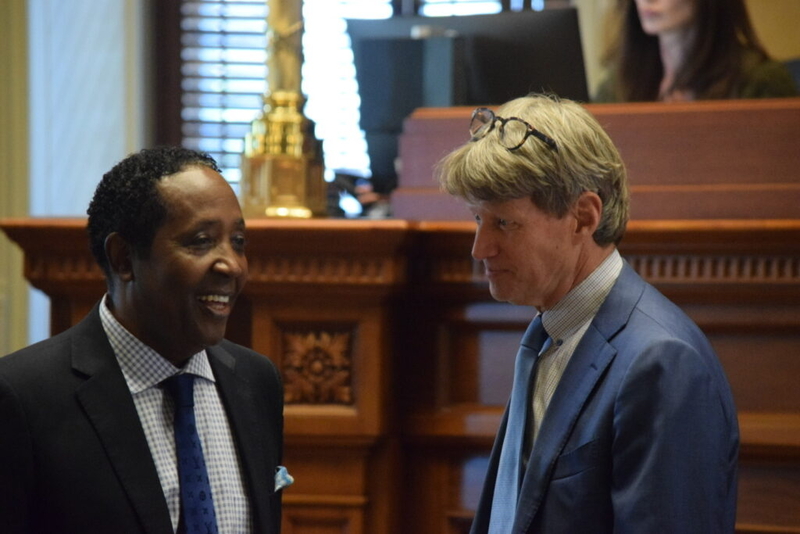
Sen. Darrell Jackson, D-Hopkins, and Sen. Luke Rankin, R- Myrtle Beach, pictured on Tuesday, Jan. 13, 2026. (File photo by Jessica Holdman/SC Daily Gazette)
Editor’s note: This article was updated after the Senate voted Saturday afternoon.
COLUMBIA — The Senate on Saturday tentatively approved a White House-backed congressional map aimed at flipping the state’s only blue seat, but a final vote is still days away.
The 27-17 vote put the overhauled map on a potential path to becoming law sometime after early voting for the June 9 primaries begins Tuesday morning.
Senators’ decision Saturday afternoon avoided needing to continue debates over Sunday and Memorial Day. Another vote Tuesday to limit debate again could enable the bill to reach the governor’s desk by mid-week.
Senate Minority Leader Brad Hutto said a “yes” vote will be “to disenfranchise voters standing in line at the polls at the very time that vote will be taken.”
GOP leaders who oppose rushing through the map contend it won’t survive a guaranteed legal challenge even if it does become law.
Sen. Chip Campsen, who helped draw the state’s existing map, asked his fellow senators not to throw away what’s been upheld by the U.S. and state supreme courts for a map that will put 2 million South Carolinians in a new congressional district with no input from South Carolinians.
Senate vote shows a new SC congressional map can’t become law before early voting starts
He read from the opinion last September from South Carolina’s chief justice, warning about “excessive partisan gerrymandering” in the future.
“Why am I convinced the state Supreme Court will strike this down? It will be the process,” said Campsen, R-Isle of Palms, who is among five Republicans who’ve consistently opposed the push.
“We have signed, sealed, delivered, unassailable congressional districts and we’re about to pass something the most assailable, most egregious because there’s nothing to it. I don’t even know who drew these maps,” he said, noting he spent six months working on the existing map. “We’re going to throw it away, and we’re going to lose.
“This will blow up in our face,” he added.
Saturday’s session began with a 28-15 vote setting 2 p.m. Sunday for the next day of debate.
Sen. Darrell Jackson, pastor of Bible Way Church in Columbia, chastised his colleagues — who often cite their Christian faith in debates — for choosing to do something that hasn’t happened in his 33 years in the chamber: disrespecting the Lord’s Day.
“I need someone to help me understand why such a hyper-partisan situation” is worthy of disrupting worship and family time, said Jackson, noting he’s scheduled to preach three services Sunday. His third service as a visiting pastor at a church celebrating a 72-year anniversary coincided with the scheduled 2 p.m. start in the chamber.
He rattled off emergencies that didn’t bring the Senate in on a Sunday, including the Great Recession, historic flooding and drought, and the 2015 massacre of nine people, including a senator, at a Charleston church.
“I hope you guys can live with yourself,” said Jackson, D-Hopkins.
Sen. Richard Cash, who has consistently voted for redistricting, agreed with him.
“We’re not in a state of emergency,” said the Anderson County Republican, who asked for Jackson’s words to be printed in the official Senate journal for the day. “I certainly agree with you Sunday is a day set apart for the worship of God.”
Sen. Deon Tedder, D-North Charleston, noted the special session doesn’t just disrupt senators’ plans, but also keeps legislative staff in chambers over the Memorial Day weekend.
Senators acknowledged it’s not possible for a new map to become law before the start of early voting. As of Friday, thousands of mailed absentee ballots had already been returned.
After a lengthy break for senators to huddle on what to do, they took the vote that allowed them to skip meeting Sunday and Monday. But the next vote basically is on the same schedule it would’ve been.
The legislation would delay congressional primaries until August. The other primaries, including statewide contests and state House seats, would continue under the existing calendar regardless. Ballots for June 9 primaries still list congressional candidates. But the legislation would void those contests.
Democrats urged people to go vote as soon as they can starting Tuesday. The expectation is that the more people who vote ahead of the map becoming law diminishes its chances of taking effect for this year.
“These votes on Tuesday matter more than they ever have before,” said Sen. Jeffrey Graham, D-Camden. “Everyone needs to use their right to vote.”
The effort to redraw South Carolina’s lines to create seven Republican seats followed a U.S. Supreme Court ruling that threw out Louisiana’s congressional map. Justices struck down a majority-Black congressional district as an unconstitutional racial gerrymander.
Supporters say it’s now necessary to “un-gerrymander” the 6th District, held by Democrat U.S. Rep. Jim Clyburn since voters first elected him in 1992.
But opponents contend the Louisiana ruling doesn’t apply to South Carolina’s map.
The U.S. Supreme Court upheld South Carolina’s voting lines in 2024, ruling the gerrymandering between the 1st and 6th districts was done for partisan, not racial, reasons.
Basically, justices ruled it was OK for the GOP-ruled Legislature to draw lines that gave Republicans the advantage in the coastal 1st District. They did that by moving Democrat-heavy precincts into the 6th District, keeping that seat reliably blue.
Senate Majority Leader Shane Massey has repeatedly warned that the attempt to create an all-Republican congressional delegation will actually make several districts competitive for Democrats.
Columbia