‘Protect the water, the air, the land’: Hundreds demand halt on Box Elder data center plan
May 23, 2026 | 11:06 pm ET
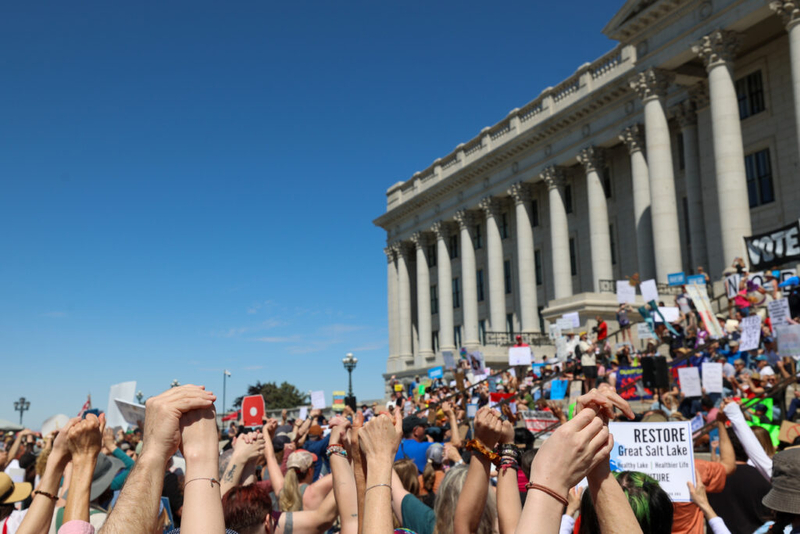
Description
Protesters demonstrate against a proposed Box Elder County data center at the Utah Capitol on Saturday, May 23, 2026. (Georgia Metcalf for Utah News Dispatch)
Hundreds of Utahns gathered on the Capitol steps Saturday afternoon, demanding a halt to the development of the Stratos Project, a controversial 40,000 acre data center campus set to be built in Box Elder County along the north shore of the Great Salt Lake.
The demonstration follows Box Elder County commissioners’ decision to allow the project to move forward, despite backlash from citizens and environmental groups. Speakers warned that the project could negatively impact air quality, increase greenhouse gas emissions and exacerbate the state’s water supply struggles.
Chants like “data center dollars don’t trickle down, Kevin O’Leary get out of our town,” a reference to the project’s billionaire investor, and “Air, water and land, we’ll keep on fighting and take a stand,” echoed through the crowd.
“These data centers carry consequences that extend far beyond even their enormous footprints,” Patrick Belmont, a professor in the Watershed Sciences department at Utah State University, told protesters.
He said technical issues like the size of the project — with the land set aside for it adding up to twice the size of Manhattan — are a major concern, but deeper problems “aren’t just technical.”
“When decisions this large move forward without transparency and independent review and when communities are handed the risks,” he added, “that is not progress, it’s a warning sign.”
Belmont emphasized tech companies “build AI infrastructure in ways that compound the very harms we need to reduce.”
Rep. John Arthur, D-Holladay, echoed Belmont’s sentiment.
“We have all agreed that we’re in a state of emergency when it comes to water. A data center like this exacts a terrible toll in our air, our water and our landscape,” he said in an interview with Utah News Dispatch.
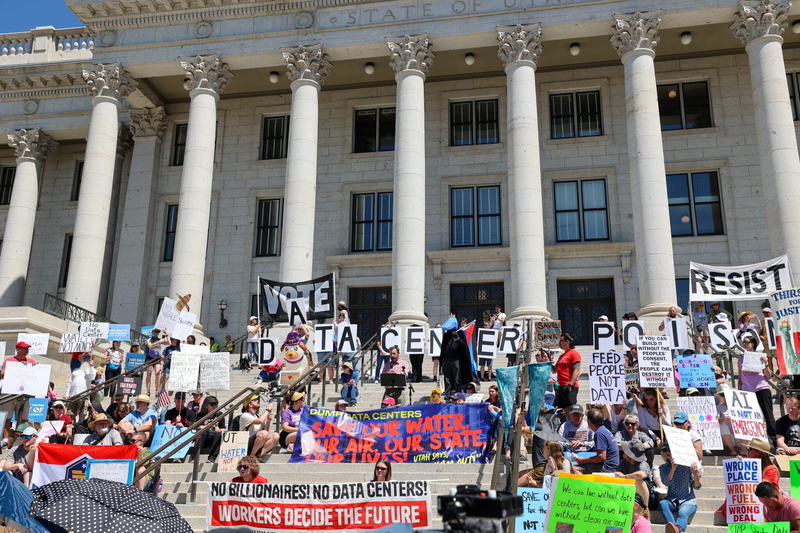
The rally
Speakers at the rally, a mix of activists and Democratic legislators, urged protesters to take environmental action.
Speaker Shannon Barton, a resident of Brigham City in Box Elder County, formed BEAR, or the Box Elder Accountability Referendum, an organization aiming to put the project’s fate in the hands of voters. The decision to form the organization came after commissioners denied public comment when the large crowd grew unruly at the meeting where they cast the final vote to greenlight the project.
Barton said she left the meeting “devastated.”
Renderings show vision for massive data center proposed in Utah, but permits could take years
“I sat next to hundreds of Box Elder residents concerned about having the ‘largest data center in the world’ right in our backyard,” she said, pointing to O’Leary’s claims about the project’s size.
“I do not need to make arguments about why a data center is bad,” she said. “We have action things to do.”
Bains continued Barton’s call to action.
“We’re tired of being treated like afterthoughts. This is a democracy. We have national tension marking this moment in history. We’re going to keep momentum, and we’re going to defend the protection of clean air, water, and a livable Utah,” she said.
Research on data center impact a key issue
A key theme for speakers was a lack of research on the impact of data centers. House Minority Leader Angela Romero, D-Salt Lake City, addressed protesters carrying signs with slogans reading “you can’t drink data” and “people over profit.”
In her speech, she referenced a recently proposed bill that would open up a study on the environmental impacts of data centers in Utah. Sponsored by Rep. Doug Owens, D-Millcreek, the bill would examine these centers’ potential consequences.
Romero, a self-described “action representative,” said a study alone “isn’t good enough.”
Belmont is also worried by the research gap.
“As a water scientist myself, show me the data. I’m not just going to take your word for it,” he told Utah News Dispatch.
Belmont urged lawmakers to enact policy change “deliberately,” referencing Gov. Spencer Cox’s comments at a news conference last month, where he said that taking time on ambitious projects does not “make things better or safer.”
He said “this notion that we can’t build anything anymore, that’s the governor panicking, and that’s not what we need right now. We need somebody looking at things thoughtfully.”
Arthur further echoed concerns about lack of scientific study. A sixth grade teacher, he said a piece of advice he gives his students is to “think before you move.”
“We need to find out before we commit ourselves to spending our precious air, water, land, and our children’s future on this development project,” Arthur said.
“We need to study (the environmental effects) further, but until we do, we need to put a halt on any big projects that can have a lasting impact on Utah.”
Correction: An earlier version misidentified Rep. Doug Owens, D-Millcreek, as a state senator.
Salt Lake City, UT