Visiting EPA administrator throws support behind Great Salt Lake, punts on controversial data center
May 24, 2026 | 7:05 am ET
Description
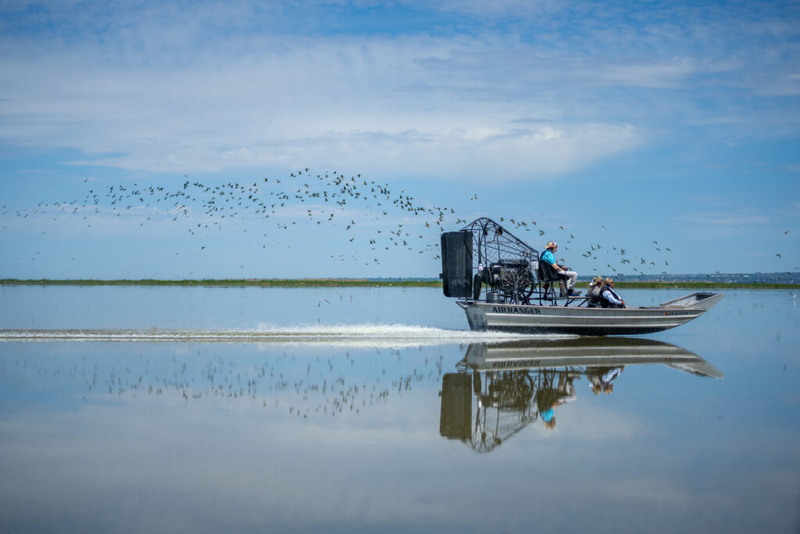
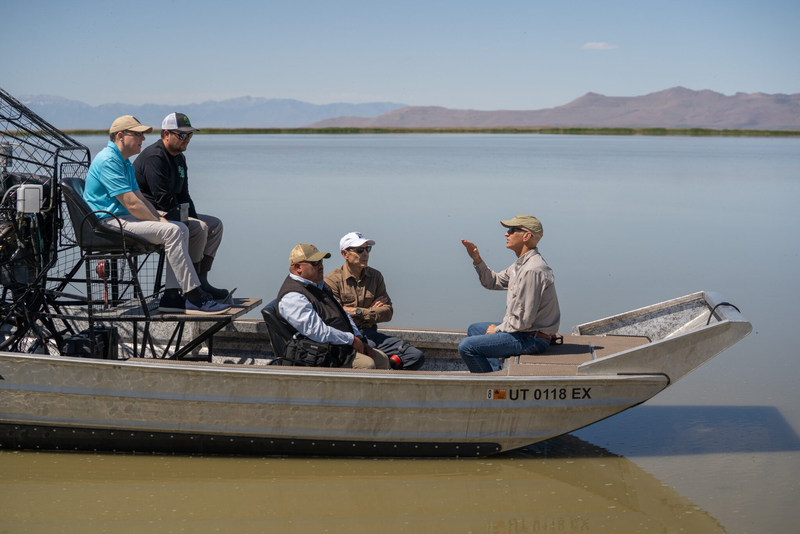
Environmental Protection Agency Administrator Lee Zeldin, in blue, tours the Great Salt Lake at Farmington Bay on Saturday, May 23, 2026. (Pool photo by Trent Nelson/The Salt Lake Tribune)
Before discussing the $1 billion allotment in President Donald Trump’s proposed federal budget to help save Utah’s ailing Great Salt Lake, the head of the Environmental Protection Agency took a tour on an airboat.
This article is published through the Great Salt Lake Collaborative, a solutions journalism initiative that partners news, education and media organizations to help inform people about the plight of the Great Salt Lake — and what can be done to make a difference before it is too late.
Saturday’s event at Farmington Bay was just one stop during EPA Administrator Lee Zeldin’s time in the Beehive State, where he was joined by members of Utah’s congressional delegation, state lawmakers and local environmental officials.
Zeldin said the tour added “many new dimensions” to his understanding of the Great Salt Lake’s plight, emphasizing “we must tackle this very important issue with the local community, the region, the state, and the country.”
Massive data center proposal raises lake concerns
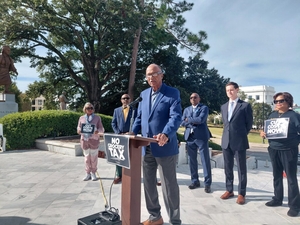
At the same time as Zeldin’s tour, hundreds of Utahns flocked to the state’s Capitol Hill in protest of the Stratos Project, a 40,000 acre proposal to build one of the world’s largest data centers along the north shores of the Great Salt Lake.
Backed by celebrity investor Kevin O’Leary, the proposal has garnered nationwide attention, sparking controversy over its massive footprint and plans for large-scale energy production — twice as much energy as the entire state uses annually.
When reporters asked Zeldin about the proposed hyperscale data center in Box Elder County, the EPA administrator deferred to state regulators.
“As far as our role with these data centers, EPA isn’t stepping all over the toes of that process,” Zeldin said. “In many cases, with states and local municipalities, the state has primacy for the air permitting. They are the ones doing the permitting, they have the oversight.”
Over the past year, the EPA has loosened restrictions on building new data center projects, making it easier for developers to expedite construction. A new EPA proposal would allow data center projects to begin construction on the non-emitting parts of their development without first receiving air quality permits.
‘Protect the water, the air, the land’: Hundreds demand halt on Box Elder data center plan
Zeldin said the EPA offers guidance, not oversight, pointing to the Water Reuse Action Plan 2.0, an EPA initiative for advancing water reuse.
“We respect the state and local leadership as knowing what is best for Utah’s land, air, and water,” Zeldin said.
Local regulation and licensure
In January, Salt Lake City had the worst air quality in the nation — and the proposed data center could increase Utah’s carbon emissions by over 50%.
“We can’t issue a permit if (a project) causes or contributes to a violation of the national air quality standard,” said Bryce Bird, director of the Utah Department of Environmental Quality’s Division of Air Quality, the body responsible for reviewing air quality permit applications.
Bird told Utah News Dispatch he guarantees the Stratos Data Center in Box Elder County will not worsen the airshed along the Wasatch Front, but he also said “carbon (dioxide) is not regulated” in the state.
“In the state of Utah, we don’t have a carbon emission regulatory process; we do encourage it, we track it over time, but we don’t directly regulate those emissions,” he added.
Bird said carbon emissions won’t play into the division’s decision on whether to grant the data center in Box Elder County an air quality permit. Instead, he emphasized they will look at the “direct health impact of these ozone, carbon monoxide, oxides of nitrogen, volatile organic compounds,” and other air pollutants included in the Clean Air Act.
Tim Davis, commissioner of Utah DEQ, said they “haven’t even received an air quality permit yet, or even had the pre-application meeting,”
“There’ll be plenty of process, there will be opportunities for public comment, engagement, once we begin those reviews.” Davis said. “We welcome sitting down and going through — figuring out — how a data center can move forward in a way that doesn’t undermine our air quality, consume our airsheds, and complies with the Clean Air Act.”
Joel Ferry, the executive director of Utah’s Department of Natural Resources, oversees Utah’s Division of Water Rights. He referenced “a historic use of water on that ranch” where the data center is planned to be built
“We can ensure that it will not take any additional water than has historically (been) taken from that ranch site,” Ferry said. “The law is, it cannot have an increased detrimental impact on a downstream user, on the Great Salt Lake, on the environment, on anything else.”
Federal Great Salt Lake assistance
In April, President Donald Trump requested $1 billion from Congress to aid the Great Salt Lake. The proposal must pass a divided Congress before Utah receives any assistance, but Zeldin said “there’s a whole lot of momentum,” emphasizing he is “confident that we will be able to put on far more than a dent at tackling what requires an urgent solution.”
Zeldin broke down the president’s $1 billion request from Congress:
- $300 million “for agricultural water leasing and acquisition to increase flows to the lake.”
- $100 million “for ecosystem restoration and removal of non-native invasive plant species.”
- $244 million “for municipal water conservation.”
- $66 million “for settling the Bear River migratory bird refuge land dispute.”
- $100 million “for habitat management to protect migratory birds and other potentially imperiled species.”
- $190 million “for major engineering solutions.”
“It’s hard to be hundreds of miles away, inside of an office, talking about a $1 billion ask and how agencies need to do their part if Congress finalizes it,” Zeldin said, emphasizing the importance of his hands-on visit to the Great Salt Lake.
Utah Republicans chime in
Prominent Utah officials spoke during the event, including Republican congressional representatives running for reelection and Utah’s Senate president.
Rep. Blake Moore, a Republican representing Utah’s 1st Congressional District, described the state and federal partnership as “crucial.”
“Every federal dollar that comes to Utah is handled with absolute respect, transparency and effectiveness … the resources and money can make a material impact on what we’re doing out here to improve the Great Salt Lake,” Moore said. “This will be managed extremely well and properly, and there will be no waste. I can guarantee you from our state leaders to be able to implement it in the right way, because money can have a material effect.”Utah Senate President Stuart Adams also chimed in, emphasizing that saving the Great Salt Lake “doesn’t happen just by Utah.”
“I’ve been told it’s impossible to save the Great Salt Lake, I don’t believe that,” said Adams, R-Layton. “The Northwest needs a lot of energy, we can trade electrons for water, and we can try to work with the other states around the region to be able to do some great kind of innovative things.
“It’s become an international issue, people ask about the Great Salt Lake everywhere I go,” said Utah Republican Sen. John Curtis. “We’re grateful for everybody’s help, but the answers to this lie with the astute men and women here in Utah.”
Rep. Celeste Maloy, who represents Utah’s 2nd District, expressed gratitude for the Trump administration, saying “we need federal help to solve the problems bigger than what the state can handle alone.”
“My mission is to protect and improve Utah’s air, land and water while supporting communities and growth statewide, we couldn’t do that alone,” Davis said. “We have to do that together, and getting the lake back to a healthy level by 2034 will take all of us.”
Correction: An earlier version of this story misidentified Rep. Blake Moore’s congressional district. He represents District 1, not District 4.
Salt Lake City, UT