Cumberland at a crossroads: A tipping point for Coastal Georgia
May 14, 2026 | 7:22 pm ET
Description
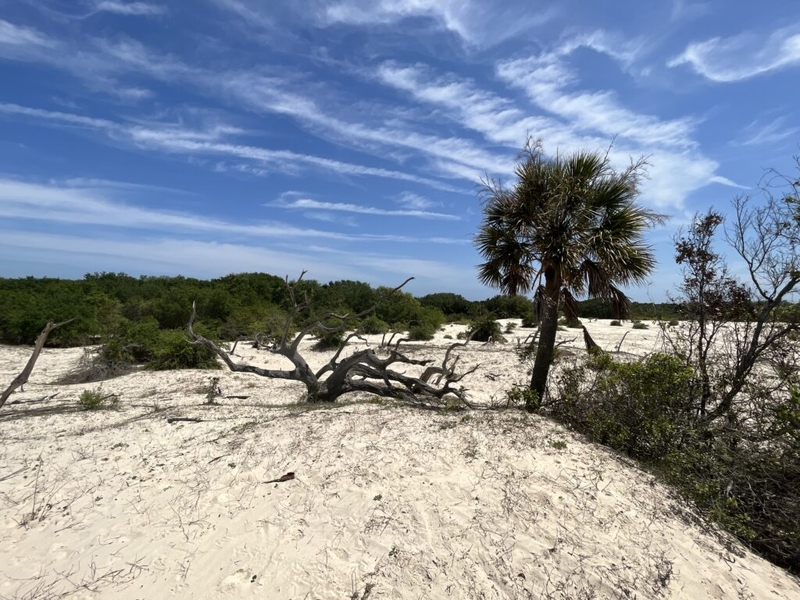
Cumberland Island National Seashore is Georgia's largest barrier island. Jill Nolin/Georgia Recorder
Cumberland Island is one of Georgia’s last truly wild places. For generations, its appeal has rested in its remoteness and isolation, not its tourist amenities.
That was no accident. When Congress created Cumberland Island National Seashore, it demanded that the island be “permanently preserved in its primitive state.”
Today, that promise to the public is nearly out of reach, with Cumberland at a pivotal crossroads. Unfortunately, the people of Georgia have little information about what is happening.
Through a recent Freedom of Information Act request, Defenders of Wildlife obtained records on proposed land exchanges with private landowners at Cumberland Island. The National Park Service, in its own public planning materials, previously identified four planned exchanges for the Seashore. Yet the agency produced documents for only two. The other two are seemingly lost in a bureaucratic black box.
The information Defenders did receive, however, is quite telling. These exchanges are not in early proposal stages. They include signed agreements and draft deeds that would privatize public land for residential development, allowing landowners to build luxury estates up to 15,000 square feet in size — an essential detail the NPS has otherwise failed to disclose to the public.
The Camden County Commission was recently asked to support the exchanges without the benefit of having seen these critical details. NPS moved the proposal forward behind closed doors and failed to release key information, leaving the county and the public scrambling to evaluate a complex decision in short order. The commissioners thankfully rejected the proposal, sending a clear signal to NPS that this activity is unacceptable. Nonetheless, this is not the level of disclosure the public deserves. The law requires public input to be provided before decisions are made, not after.
The proposed land exchanges are just the latest in NPS’s mismanagement of Cumberland Island. For decades, non-native, feral horses have damaged dunes, wetlands and wildlife habitat. In some areas, they have stripped up to 98% of native vegetation and trampled nesting sites for sea turtles and roosting shorebirds. Despite years of acknowledging the gravity of these problems, NPS has refused to develop a sustainable horse management plan for the island, which is the only national seashore on the East Coast with an unmanaged population. Likewise, the development of a wilderness management plan is decades overdue.
Meanwhile, the Seashore’s recent proposed Visitor Use Management Plan would more than double visitation on the island, expand use into some of its most sensitive areas and allow for increased development and foot traffic, grossly exceeding carrying capacity of the island.
More visitors, more infrastructure, more access, more development. It is a trend that is causing a downward spiral that has become impossible to ignore. But this trend does not have to continue; there is still time to get this right.
Cumberland Island is not just a pretty beach. Its undeveloped character supports local tourism, economies and fisheries. It protects habitat for rare species like red knots and piping plovers and represents something increasingly rare — a stretch of coastline that has not been built out or overused. It is also public land — it belongs to all of us and should not be sold to the highest bidder.
Once it is transferred, developed or degraded, the damage is done and is not easily reversible. That is why it is so important to abide by science-driven processes before decisions to change the landscape are locked in and impacts become permanent.
Cumberland has always balanced access and preservation. But that balance only works when decisions are made transparently and guided by law. Right now, that system is out of order.
At a crossroads, the direction chosen matters. And on Cumberland Island, the moment to choose the correct path is now.
Atlanta, GA