Continental Resources to resume oil drilling in North Dakota this year
May 21, 2026 | 4:21 pm ET
Description
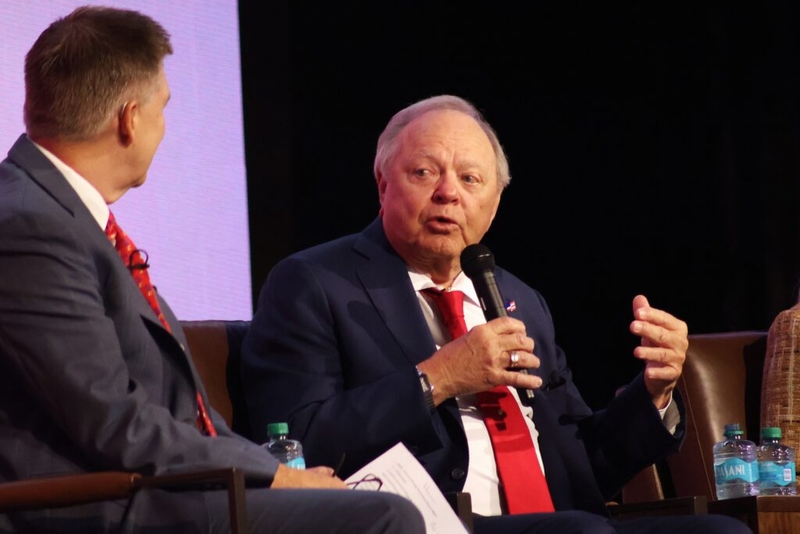
Harold Hamm, right, founder of Continental Resources, speaks to Ron Ness, president of the North Dakota Petroleum Council, during the 2026 Williston Basin Petroleum Conference in Bismarck on May 21, 2026. (Photo by Michael Achterling/North Dakota Monitor)
A leading North Dakota oil producer plans to resume drilling in the state after taking a pause from adding new wells because of low oil prices.
Continental Resources founder Harold Hamm announced Thursday at the Williston Basin Petroleum Conference in Bismarck the company’s plans to put drilling crews back to work in North Dakota.
In January, the company announced a temporary pause in new drilling, marking the first time in 30 years that Continental Resources didn’t have a rig operating in the state.
Since then, “a great deal has changed,” Hamm said, referring to higher oil prices amid the war with Iran.
“We’ll be back to work,” Hamm told attendees. “But we’re not giving it away now.”
Burgum touts AI data centers, calls Iran war ‘gift to the world’ in speech to oil industry
Hamm said in an interview the company didn’t yet have a firm number of rigs planned for the state, but said it would be “meaningful.” The company plans to resume drilling before the end of the year.
Hamm said some have predicted that once the Strait of Hormuz reopens to shipping oil through the Persian Gulf, oil prices will drop back to where they were before the Iran war.
“I don’t believe that, at all,” Hamm told the North Dakota Monitor. “I think that we’ll get back to realistic values of oil and natural gas.”
The breakeven price for oil companies operating in North Dakota ranges from $50 per barrel to $65 per barrel in West Texas Intermediate prices, depending on the geographic location, Department of Mineral Resources Director Nathan Anderson has said. The WTI price was around $60 around the time the company announced its pause. On Thursday, it was around $100 per barrel.
Hamm said that a minimum oil price in the high $70s or low $80s is a “healthy range” for the industry.
“If you get much lower than that, people curtail their activity,” Hamm said.
Continental Resources, North Dakota’s No. 2 oil producer, is seen as a leader in the Bakken and credited with advancing horizontal drilling that set off the Bakken oil boom.
North Dakota officials welcomed Hamm’s announcement as good news for the state, which relies on oil taxes as a major source of revenue.
“The conflict could end tomorrow, but what it tells me is it signals that there’s some certainty around a little higher price for a little bit longer,” said Anderson, the state’s top oil regulator. “I’ve heard not only Continental, I’ve heard another company that’s going to pick up another rig.”
The state has been averaging around 25 active rigs. North Dakota, the country’s No. 3 oil-producing state, produced an average of 1.1 million barrels of oil per day in February, the most recent figures available.
Army Corps grants final approval for Dakota Access Pipeline, 9 years after oil began flowing
Lynn Helms, who recently retired as the longtime director of the Department of Mineral Resources, said Continental has “a long runway” of drilling opportunities in North Dakota.
“It’s a reinforcement of how good the resource is here and how long he expects it to last, so it’s great news to hear that from Harold and from his company,” Helms said.
Helms said finding labor for the increased activity could be an issue, but Shelly Lambertz, executive chair of Continental Resources, expressed confidence that the company will have the workforce it needs.
Hamm predicted that North Dakota’s oil production will remain stable and touted the importance of advancing enhanced oil recovery, using a gas such as carbon dioxide to make wells more productive.
“I think the work that our team is doing toward enhanced oil recovery and how to recover more of the original oil in place, I think that’s really, really important work,” Hamm said. “And it’s going to take things like CO2 and other mediums to produce additional amounts.”
Hamm also emphasized that people shouldn’t overlook other areas besides the Bakken. When asked if the company is actively exploring other formations in North Dakota, Hamm said, “We never quit looking.”
Bismarck, ND