‘It was time.’ Infante-Green says she’s ready to hand back keys to Providence schools
May 21, 2026 | 4:30 pm ET
Description
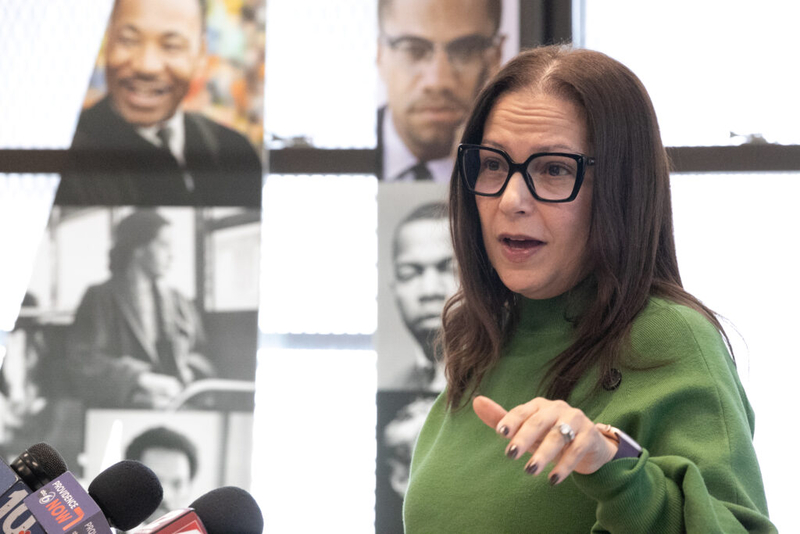
Rhode Island Education Commissioner Angélica Infante-Green speaks at an event in Providence in February 2025. (Photo by Alexander Castro/Rhode Island Current)
In a surprise move, Rhode Island Education Commissioner Angélica Infante-Green is recommending that Providence regain control of its public schools this summer after nearly seven years of being subject to a state turnaround plan.
“It didn’t make sense to keep having the same conversation over and over,” Infante-Green told Rhode Island Current in a phone interview Thursday, the day after a draft order arrived in an agenda item for a K-12 council meeting.
The agenda and its revelation — posted shortly before 5 p.m. Wednesday — was shortly followed by a letter from the commissioner to the Providence schools community announcing the news.
That recurring conversation, Infante-Green, said, involved how the Providence Public School District (PPSD) superintendent should be overseen. The Rhode Island Department of Education (RIDE) and municipal officials could not agree, Infante-Green said.
Now, Infante-Green is set to ask the Rhode Island Council on Elementary and Secondary Education at its May 26 meeting to OK the transition back to local control. The commissioner recommends that a full return to local control start on July 1, a year earlier than the more gradual return to local control in 2027 as she previously suggested in a memo leaked by the Providence School Board’s president earlier in the week.
The July 1 timeline marked an endpoint that local stakeholders have repeatedly insisted on when discussing the transition with RIDE. Infante-Green said her office has been working with the Providence School Board and the Mayor’s Office, “in teams for the last two years, monthly” on reaching that July 1, 2026, deadline.
“We were all looking towards July 1,” she said. “That’s what we have been working towards.”
Her preference was for “a more transitional return,” Infante-Green said. But ultimately, RIDE and local leaders “reached an impasse” over who would supervise the superintendent during the handoff.
“I was very adamant that only one person can supervise the superintendent,” Infante-Green said. “I didn’t want to create confusion. It’s not good management to have that. So I thought that it was, it was time, it was time, it was time.”
During a roughly 20-minute press conference at his office Thursday morning, Providence Mayor Brett Smiley proclaimed it an “exciting day” in the city and “a win for Providence students, families, and teachers.”
“After years of ongoing advocacy to give our students the high-quality education that they deserve, the city is ready to begin this next chapter,” Smiley said.
The mayor said Gov. Dan McKee gave him the heads up that Infante-Green “was going to be making an announcement soon” on Wednesday at 3:54 p.m. — shortly before a state Senate committee met to consider legislation that would annul the state takeover of Providence’s schools. Smiley was testifying at the State House when the announcement was made.
“Those details were a little bit vague on when ‘soon’ was, but I appreciate the governor’s outreach,” Smiley told reporters.
A McKee spokesperson said the governor’s office and RIDE are in agreement that a transition back to local control is now appropriate because significant progress has been made.
“A July 1st return date allows for a month-long transition period, after which the city will have the summer months to prepare for an excellent 26-27 school year,” spokesperson Laura Hart said.
Infante-Green, over the phone and in her letter Wednesday to the school community, cited improvements across academic outcomes, chronic absenteeism, and student access to Advanced Placement courses and career and technical education (CTE) offerings. The district has also seen record-high graduation rates, she said.
“Providence is a different place,” Infante-Green said. “It is a very strong district right now. … There’s work to be done, but it is a better place today than when we started, and it has a very strong foundation.”

Shift for the Providence School Board
A takeover clause in the state’s Crowley Act — little used before the Providence takeover — empowered the education commissioner to assume control of the district’s budget, personnel and administrative direction.
“When the intervention started, the buildings were falling apart,” Infante Green said. “There was a school that had a net with bats. The solution was to put a net and contain the bats.”
The takeover essentially made the Providence School Board a public body which acted in a virtually symbolic realm. The 10-member panel — even after it reformed into a half-elected, half-appointed body via the November 2024 election — could not make budgetary or personnel decisions. Those powers remained vested with the commissioner.
School Board President Ty’Relle Stephens said in an email Thursday that he was reviewing the draft order ahead of its formal debut at next week’s K-12 council meeting. The board was originally scheduled to discuss the 2027 turnover date at its meeting Wednesday but tabled the matter.
For Infante-Green, her chief concern going forward is that the school board understands the difference between governance and daily operations.
“The day to day is really the responsibility of the superintendent, not the school board,” she said. “I wanted everybody to understand what their role is as we move forward.”
The draft order mirrors this concern in a direction to the school board that asks its members to focus on “core work” and “refrain from encroaching on the Superintendent’s operational authority.” The board will also need to assess learning outcomes and identify goals in its public meetings, and dedicate 40% of its board time to that evaluation, with publication of progress reports also specified.
Smiley said the city has also done its fair share of work over what it was able to control since the state’s takeover noting expansions to after school programming, renovations of existing schools buildings and recreational spaces, and his administration’s ongoing push for universal pre-K.
Infante-Green’s draft order calls for city leaders to pledge future school funding via ordinance and keep any PPSD funds remaining at fiscal year’s end within the district.
Smiley told reporters his administration is committed to funding the schools, but declined to state how much.
“We pass a budget on an annual basis, we don’t pass a 10-year budget,” he said.
Additionally, the city needs to collaborate with the school board and city solicitor to decide on a single chief legal counsel for the district. The education department, meanwhile, will monitor the city’s $1 billion school facilities plan.

Expectations
Infante-Green outlined a list of measures she said the school district must take to avoid slipping backward. Those measures include creating a new Coordinator of Board Services position to support the Providence School Board, enlisting an independent review of governance policies the board adopted in the past year, and ethics training for the school board and senior district leaders.
Her draft order noted her “firm conviction that the progress made by PPSD while it was under state control will not continue, and in fact student achievement in the District will regress, if the following measures, or substantially similar measures, are not undertaken by the responsible.”
The commissioner would retain the power to rescind or modify the order before the transfer is complete.
What could RIDE do if the draft order’s expectations are not fulfilled by local officials? Infante-Green said she hopes the state does not need to intervene again.
“I hope we don’t get there,” she said. “But there is something in the order that talks about if we have to intervene in some sort of way, we will.”
The order also does not create any financial obligation for the state, RIDE or the commissioner, and would maintain “all such obligations…[as] the sole legal responsibility of the PPSD.”
I was very adamant that only one person can supervise the superintendent. I didn’t want to create confusion. It’s not good management to have that. So I thought that it was, it was time, it was time, it was time.
A big question mark over the transition is the future for Superintendent Javier Montañez, who took over the day-to-day administration of PPSD on an interim basis in 2021 after his predecessor resigned in scandal.
Montañez’s contract wraps up in 2027. Smiley declined to comment on whether the school board should select a new superintendent.
“Javier has worked really hard to build trust with the teachers, with the administration, with the administrators in school buildings,” Smiley said. “He’s got a contract, and I think he’s going to work with us closely through this transition.”
The bill heard Wednesday at the same time Infante-Green’s letter was distributed was sponsored by Sen. Sam Zurier, a Providence Democrat, who serves as secretary of the Senate Committee on Education. S2934 would return the district to local control while also changing state laws around unionized teachers’ compensation, layoffs and dismissal procedures.
“It shouldn’t happen by itself, it should be combined with reforms,” Zurier said of a takeover at Wednesday’s hearing. “Because if we just return the local schools to Providence without having done anything to improve them, why should we expect the outcomes to be any better than they were before the takeover occurred?”
Zurier could not be reached for comment Thursday.
Another bill heard earlier in April — S2526 by Sen. Sam Bell, a Providence Democrat — would formally deactivate the takeover at the legislative level. It would also prevent the commissioner from possibly rescinding the return to local control, and cease the takeover at the statutory level.
Bell said Thursday in a phone interview that the draft order is “meaningful concession and real progress,” but he still believes the General Assembly needs to pass his legislation.
“I’m glad that the commissioner — I think — started to read the room here,” Bell said. “But I don’t think it changes the fact that we need to pass the legislation.”
Bell acknowledged the draft order is not final, but he argued it leaves a corridor by which the commissioner might still retain some control. The draft order, Bell said, is ambiguous enough in his reading that it may simply be delegating authority back to Providence while keeping the commissioner’s overarching powers intact.
“The commissioner said a full return in her letter,” Bell said. “This order, as drafted, does not accomplish that.”
If the commissioner decided to modify or rescind the order before June 30, Bell said, that could leave the School Board preparing for local control with the possibility that the state could still “pull the rug out from underneath it.”
Infante-Green acknowledged on the phone that the district’s control “can’t stay in perpetuity with the state.”
“It just — it does not make sense,” she said.
Yes, she and RIDE are “still regulators,” she said. “We’re still going to be there, and I am very invested in this district. I’m very invested. I mean, it’s the capital city.”
Mayoral candidates weigh in
Providence State Rep. David Morales, who is challenging Smiley in the Democratic mayoral primary, said in a statement Thursday that he was grateful that the city’s public schools are returning to local control.
“Our schools transitioning back to local control represents a meaningful opportunity to improve family engagement and support for our 19,000-plus students in the Providence Public School Department,” Morales said.
He added that the future of Providence’s schools should not be treated as some sort of political prize for a mayor and governor “who are both facing stiff primary challenges.”
The mayoral race’s sole independent contender, Allen Waters, said in a statement to Rhode Island Current Thursday, “Bringing our schools home is the right thing.”
But he had concerns about the district’s leadership going forward: “What put Providence schools where they are today is weak leadership, failed policy, and a culture that has abandoned accountability and responsibility,” Waters said. “Seven years of failure had a cost, and our children paid it. Black children, brown children, the children of working families, and the disaffected young men this city gave up on.”
Providence, RI