Child advocacy group launches ‘living resource’ for childhood well-being data
Aug 27, 2026 | 5:59 am ET
Description
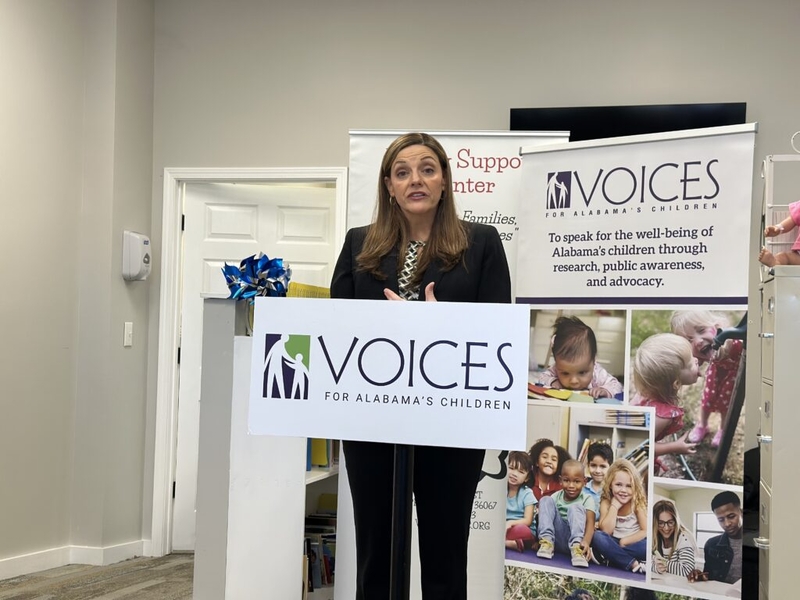
Apreill Hartsfield, Kids Count director for VOICES for Alabama Children, speaks at the 2025 Kids Count Data Book press conference at the Autauga County Family Resource Center in Prattville, Alabama on Feb. 17, 2025. The group announced an online dashboard for the data that can be updated as new data becomes available on Wednesday, which is meant to increase accessibility. (Anna Barrett/Alabama Reflector)
Alabama’s leading source of children’s well-being data and research plans to launch a new online data center to increase access to up-to-date information, the group announced Wednesday.
VOICES for Alabama’s Children, a nonprofit organization, is moving its annual research project to an online dashboard that can be updated as new data becomes available, becoming a “living resource.”
“We’re not changing the integrity of the work. What we are changing is how people can use it,” said Trayce Strichik, VOICES’ executive director, during a virtual preview of the website.
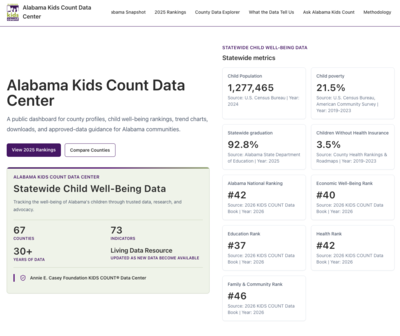
The website will be available to the public on Tuesday. During the preview, Apreill Hartsfield, the director of policy, advocacy and research, demonstrated the website’s features: a statewide snapshot, county-by-county comparisons, 2025 rankings and data explainers.
“Like the weather forecast, good data helps us understand current conditions, see patterns developing, and prepare before challenges become crises,” Hartsfield said. “Alabama Kids Count gives us the evidence to see conditions clearly. The data center makes that evidence even easier to put into the hands of people who can act.”
Strichik said the data helps “data users” like state lawmakers, local leaders and teachers make informed policy decisions to improve the lives of Alabama’s children.
“We wanted parents, community leaders, advocates, researchers, state agencies and policymakers to be able to ask better questions about how Alabama’s children are performing,” she said.
The Alabama Kids Count Data Book is typically released in January and includes 73 indicators of child well-being, ranging from mental health – the group’s focus this year – to education, economic security, safety and overall well-being.
The website allows users to compare any county to another, or to the state, on any indicator, or to sort by legislative district.
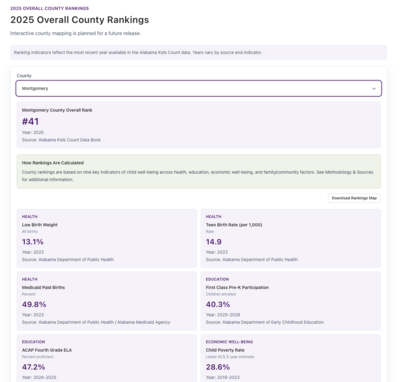
“I think it’s important for lawmakers for policymakers at the state level to take a look at the data and be aware of what the data says about their districts, and then figure out where there are things that districts have in common, whether it’s challenges or whether they’re improving,” Hartsfield said in an interview after the preview.
VOICES operates through funding from the Annie E. Casey Foundation, another nonprofit that conducts similar research to VOICES on the national level. Alabama improved one rank to 42nd in the national Kids Count data book, which was released this summer. It has 16 indicators, and often uses older data.
“Overall we have made improvements in certain areas that have helped that score improve, but ultimately we’re still seeing the effects in other states from the pandemic. Their score is not as high as it once was, and they haven’t bounced back as quickly as we have in those areas where we’ve improved,” Hartsfield said.
She said in a phone interview that the purpose of the data is to move Alabama towards action.
“Whatever that catalyst is, that will improve not only the data that we see for child well-being, but the lives of the children,” she said. “Behind every number in our data book, there is a life and a family.”
She said Alabama has made some steps in the right direction, especially in education, but it takes time to see the impact. The 2019 Literacy Act and 2022 Numeracy Act have been implemented for seven and four years, respectively.
According to data from the Alabama State Department of Education, about 77.7% of third grade students read at grade level in the 2021-2022 school year, according to the Alabama Comprehensive Assessment Program (ACAP) standardized test.
The test has changed, and now students must score above a certain number to move on to the next grade. In the 2025-2026 school year, about 88.2% of third grade students scored above the cut score.
“Not just that they’re doing better on tests, but they’re actually improving their skills in the classroom and they’re creating a better foundation on which to build the rest of their education journey,” Hartsfield said.
Math scores were mixed across grade levels this year, and about 34.3% of all public and charter school students were proficient in math. About 29.9% of students were proficient in math in the 2022-2023 school year, according to ALSDE data.
Hartsfield said the dashboard will change over time, and will allow VOICES to be more flexible and improve access to data as it is released.
“It’s all been an effort to make the data more accessible to our data users. Those data users are everybody from our policymakers and lawmakers down to the local out-of-school time programs that are writing grants,” she said. “We just want to make data not just more accessible, but give more depth to the data, and really just support people who are the end users and who are on the front lines and working to improve children’s lives.”
Montgomery