Amid multiple court battles, a guide to the status of mail-in voting
Aug 27, 2026 | 5:00 am ET
Description
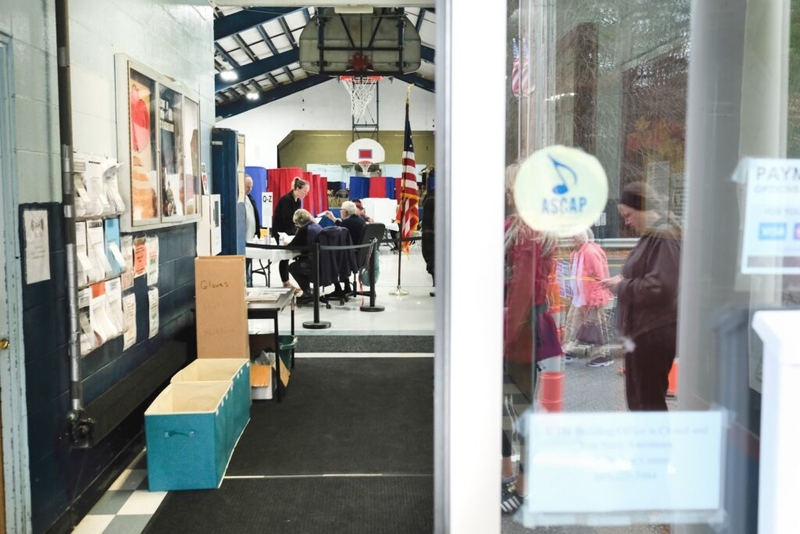
"Most observers expect the matter to return to the Supreme Court sometime before the Nov. 3 midterm election." Here, voters in Bow prepare to cast ballots in the Nov. 5, 2024, general election. (Photo by Will Steinfeld/For the New Hampshire Bulletin)
American voters could be forgiven for feeling blindsided this week.
On Monday, the U.S. Supreme Court lifted one of two injunctions against President Donald Trump’s executive order to restrict mail-in ballot use, citing the plaintiffs’ procedural timing errors.
On Wednesday, U.S. District Court Judge Indira Talwani of Massachusetts removed the second injunction against that executive order, pointing to the Supreme Court’s Monday decision.
The restrictions require election officials to mail ballots to absentee voters using specialized envelopes with barcodes and to submit absentee voter information into a federally run, digital portal. They require the U.S. Postal Service to match the envelopes to the database and refuse to send any envelopes to voters not in that portal.
Experts have stressed that the limits are not likely to affect the midterm elections, given the likelihood of a future court injunction and the difficulty of implementing the new rules in time. Both rulings this week were merely procedural; the courts have not yet weighed in on the merits.
That applies to New Hampshire, too. “The executive order is not going to affect the absentee ballots for the (Sept. 8) primary election,” Secretary of State Dave Scanlan said in an interview Tuesday. “And we’ll just wait and see what happens between now and November.”
Still, with five federal lawsuits against the executive order and a flurry of new arguments and court orders filed in the last several days, the legal situation is fluid, and most observers expect the matter to return to the Supreme Court sometime before the Nov. 3 midterm election.
Here is what New Hampshire voters should know about the pending restrictions.
Are the mail-in voting restrictions currently in effect?
No.
While Talwani’s ruling Wednesday technically removed the final remaining injunction against the president’s executive order and allowed it to take effect, the USPS does not yet have a system in place to implement it. The USPS issued a final agency rule to put in place Trump’s order on Aug. 21, but the rule was not officially published until Wednesday.
Meanwhile, plaintiffs are already attempting to stop the new rule before the USPS can implement it; lawyers in two separate federal lawsuits filed amended complaints on Wednesday that seek to block the new rule now that it has been formalized.
Those amended complaints are intended to address the issue raised by the Supreme Court in its Monday ruling: that the plaintiffs had sued the federal government too early — in April, before the USPS issued its final rule Aug. 21 — and that the case was not “ripe,” meaning the mail-in voting measures did not yet exist and could not yet harm the plaintiffs.
Now that the USPS has issued and published its final rule, the plaintiffs have returned with new motions to block it, both temporarily and permanently. Given the legal history, a new lower-court injunction could arrive within a week, though the Supreme Court will have the final say.
Aaron Blacksberg, federal policy counsel for the Institute for Responsible Government, a voting information organization tracking the lawsuits, said for now, people should vote the way that is most convenient for them — regardless of the confusing headlines.
“Nothing has changed right now as to how mail voting works, but it’s always best practice to request and return ballots early,” he said in an interview.

Scanlan noted that absentee ballots for the Sept. 8 primary have already been distributed to towns and voting is underway.
“In many cases, voters have requested and mailed them back to the clerks, and so to, you know, interrupt that process just is not practical or appropriate,” he said.
But Scanlan suggested the state is prepared to sue should the rule take effect in the coming weeks.
“That’s where we have our discussion with the (state Attorney General’s Office) to see if we need to go to federal court to address a situation that is just not manageable and workable,” he said.
What do the restrictions entail?
The final USPS rule that took effect Wednesday requires election officials to use new, standardized envelopes with an official logo and a unique “Intelligent Mail barcode” when sending out mail-in ballots.
Before sending those envelopes, election officials must have their ballot envelope designs approved by a USPS “Mailpiece Design Analyst.”
Then, election officials must input into a federal portal five details for each eligible mail-in voter: their name, their address, the barcode on their outbound mail envelope, the barcode on the inbound envelope, and the state.
When the election official mails out the ballots, a USPS employee will check the barcode and make sure that the voter’s data corresponding to that barcode is in the portal; if it isn’t, the postal service will not mail the ballot.
The rule clarifies that the portal will not collect voters’ sensitive information such as Social Security numbers, political party affiliations, or birthdates. And it states that USPS will not use the portal to assess voter eligibility itself — it will not compare portal data with state voter rolls, for instance. USPS workers are empowered only to verify that the barcode matches the portal.
In issuing the final rule last week, the USPS said the new system would make elections more secure, both by giving law enforcement “significantly enhanced visibility” into ballot mailing patterns ahead of an election and by allowing a better chain of custody to ensure ballots are delivered.
Critics see it differently. While Blacksberg agreed that tracking mail with barcodes is the best practice generally, he argued that requiring election officials to adopt the envelopes would be an unfunded mandate — and potentially an expensive one. And he said the data entry requirement could cause votes to be blocked because of human errors.
“That’s something that could hit rural counties harder and smaller counties that may not have easy access to envelope printers and design functions and features,” he said.
How would the restrictions affect New Hampshire?
Because of its decentralized election system, New Hampshire could be particularly affected by the mail-in ballot rule.
Unlike most states that administer their elections through counties, New Hampshire absentee ballots are approved and mailed out by individual towns and city wards. That means moderators in each New Hampshire town would need to separately submit absentee voter information into the USPS portal and administer the envelopes.
Additionally, New Hampshire is one of 13 states that require voters to provide a reason to vote absentee, such as a disability or illness, a planned absence from town on Election Day, or work or caregiving duties. Because each reason must be reviewed before the voter can be approved, New Hampshire’s mail-in ballots are approved in a “piecemeal” fashion, meaning town officials would need to be approving USPS entries up until the day before Election Day.
In July, the New Hampshire Secretary of State’s Office raised those concerns in a public comment to the USPS, arguing the state’s unique, local, and volunteer-dependent election system makes the ballot tracking system unworkable.
“It is not acceptable that New Hampshire voters could lose their right to vote because of clerical errors, which is the precise danger that the proposed rule creates,” wrote Scanlan in the July 1 comment.
What is the Trump administration’s broader goal?
Trump has long raised concerns about mail-in ballots, arguing the system is susceptible to fraud and claiming without evidence that it caused his loss in the 2020 presidential election, when the COVID-19 pandemic led to a record use of postal voting.
Research indicates that mail-in voter fraud is extremely rare; a 2025 Brookings Institution study of mail-in voting data in U.S. general elections between 2016 and 2022 found four cases of fraud per every 10 million votes, or 0.000043% of total ballots cast.
But Trump and Republicans argue the mail-in voting system should be tightened and standardized across the country. After the Senate failed to pass the president’s Safeguard American Voter Eligibility (SAVE) Act in March, Trump deployed his presidential pen, signing an executive order titled “Ensuring Citizenship Verification and Integrity in Federal Elections,” on March 31.
That order included the directive to the USPS to issue its now-final rule, as well directives to the Department of Homeland Security to create “citizenship lists” of confirmed American citizens who are eligible to vote and to the attorney general to prioritize prosecutions of election officials who mail ballots to ineligible voters.
“The right of American citizens to have their votes properly counted and tabulated, without illegal dilution, is vital to determining the rightful winner of an election,” the president wrote in his order.
Who are the plaintiffs and why have they sued?
Days after Trump’s executive order, multiple groups filed lawsuits to stop it. In one, California v. Trump, 23 states and the District of Columbia sued to stop the order; New Hampshire was not among them. In another, the League of Women Voters of Massachusetts partnered with other voter advocacy groups to sue to block the order on behalf of their members.
The plaintiffs argue the executive order is an unconstitutional use of presidential power, citing the Elections Clause in Article I, which states that elections “shall be prescribed in each State by the Legislature thereof.” The clause allows Congress to make laws governing such elections but does not mention the executive branch.
The plaintiffs say the Postal Clause in Article I, meanwhile, prohibits the president from creating new election security duties for the Postal Service without an act of Congress.
They also argue the president is violating states’ 10th Amendment rights to administer the time, place, and manner of their elections, that the USPS is acting outside of its statutory power by issuing the rule, that the ballot tracking system would pose an undue burden on the right to vote by risking disenfranchisement of eligible voters, and that it would violate voters’ privacy.
The U.S. Department of Justice, in defending the executive order, has countered that the order does not constitute a federal takeover of election administration because states still have control over the voting process. The executive order merely addresses Postal Service operations over which states do not have jurisdiction, the government argues.
And the DOJ has contended that the plaintiffs have no standing to sue because their stated injuries are speculative and premature.
What is the current status of the lawsuits?
After the plaintiffs in both League of Women Voters v. Trump and California v. Trump submitted amended motions Wednesday seeking to block the executive order now that the rule has taken effect, the Department of Justice is expected to file responses in the coming days and the lower courts can rule on the new complaints.
If a new injunction is coming, it could be soon; on Wednesday afternoon, Talwani gave the Department of Justice until noon Thursday to respond to the League of Women Voters’ request for a temporary restraining order against the law — the shortest form of relief — and until 11 p.m. Saturday to respond to the request for a preliminary injunction. Depending on the Supreme Court, that latter injunction could block the rule through the mid-term elections.
To Blacksberg, a bigger factor is looming: With some states’ mail-in general election ballots going out next week, the government may simply run out of time.
“There has to be a point at which the government stops trying for this year,” he said.
Concord, NH