Tom Tiffany’s long history of pro-extraction environmental policy
Aug 27, 2026 | 4:30 am ET
Description
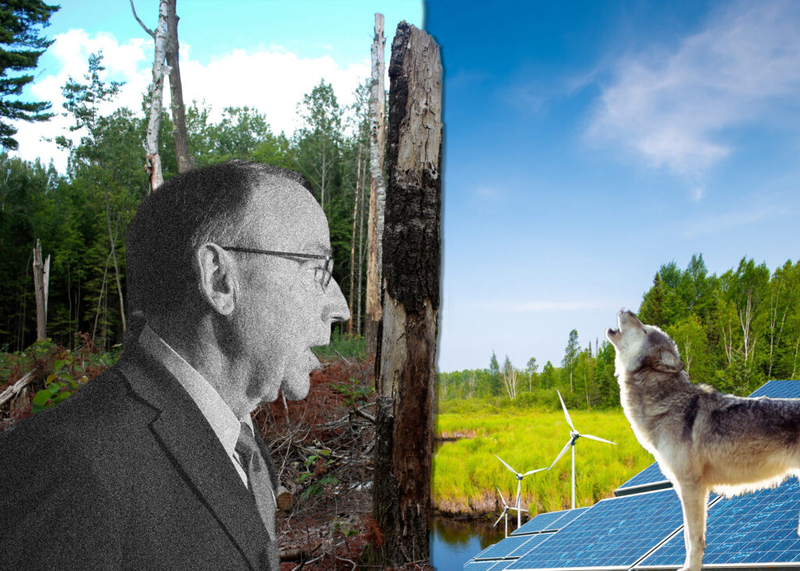
U.S. Rep. Tom Tiffany is running for Wisconsin governor with a long record of supporting extractive industries such as mining and logging in the Northwoods. (Photos Courtesy of Henry Redman, Baylor Spears, Jay Brittain, Getty Images, Illustration by Henry Redman/Wisconsin Examiner)
Since he was first elected, U.S. Rep. Tiffany has focused on issues related to the environment and natural resources more than any other topic — often pushing policy in directions to explicitly benefit the interests of extractive industries such as mining and logging.
In the Senate, he sat on the committees on Agriculture, Small Business, and Tourism; Workforce Development, Forestry, Mining, and Revenue; Natural Resources; and Sporting Heritage, Mining and Forestry. During his current congressional term, Tiffany sits on the Committee on Natural Resources and chairs the subcommittee on federal lands.
Now, Tiffany is the Republican nominee for governor with a campaign that has advocated for the state Department of Natural Resources to be divided into multiple departments in order to better support hunters. He’s also said he’d work with right-wing anti-conservation figures such as Luke Hilgemann to run the DNR.
“We are going to revamp the Department of Natural Resources,” he said at an event in Medford July 9, Civic Media reported. “I am open to splitting the agency. I’m open to splitting the agency so you separate fish, wildlife, hunting, fishing, trapping from the environmental permitting part of it.”
When he was in the Legislature, Tiffany helped lead Republican efforts to fire scientists at the DNR and prevent the agency from addressing climate change. In 2017, he supported the administration of Gov. Scott Walker’s efforts to scrub references to climate change from the DNR website.
When that decision was questioned, Tiffany said the criticism was “off-base” because “climate change is a theoretical construct.”
The Tiffany campaign did not respond to a request for comment or answer a detailed list of questions about his environmental policy plans.
Mining
In 2013, Wisconsin was two years into the Gov. Scott Walker era and Republicans, with the help of their newly installed legislative maps, had maintained majority control of the Legislature. To kick off the session, Tiffany was one of the lead authors on Senate Bill 1, which was meant to ease the regulations imposed on iron mines operating in the state.
At the time, the Florida-based Gogebic Taconite was hoping to build the largest open-pit iron mine in the world outside the Northwoods town of Hurley.
The company, known as GTAC, had given nearly $75,000 to Tiffany’s campaign. It was also involved in the dark money scandal that rocked Walker’s first term after secretly donating $700,000 to a pro-business advocacy group run by Walker’s campaign adviser during the 2011 and 2012 recall elections against him.
Throughout the legislative debate on the bill, in which Tiffany was criticized for stifling opposing viewpoints, Tiffany downplayed the environmental concerns raised by Democrats, environmental groups and the Native American tribes located close to the proposed mine site.
Drafting records from the effort to write the bill showed that GTAC played a key role in drafting the legislation — an arrangement Tiffany downplayed, saying legislators “go talk to farmers” before writing a bill on agricultural issues.
“He is really bought and paid for by mining companies, and really has no regard for the impact on the environment, local and tribal communities nearby, and you know he has a record a mile long to prove it,” Seth Hoffmeister, deputy director of Wisconsin Conservation Voters, said. The organization has on several occasions listed Tiffany on its “dishonor roll” in its legislative scorecards.
Within two months of its introduction, Walker signed the bill into law. Despite the promises from Tiffany and Republicans that the bill would spark an iron-based economic boom, the mine never opened. GTAC abandoned the project in 2015 after a drop in iron prices. The company also cited surprise at the number of protected wetlands near the mining site. Tiffany blamed the EPA for not being friendly enough to business interests.
A few months after the enactment of Tiffany’s first pro-mining bill, he authored a controversial proposal that would have prohibited local governments from regulating the operation of frac sand mining. The bill died after it failed to gain enough Republican support in the Senate.
In August of that year, Tiffany introduced legislation that would repeal Wisconsin’s Prove-it-first law, which since it was signed by Republican Gov. Tommy Thompson in 1998 had required that any companies planning to open a sulfide mine for metallic minerals in the state prove they can operate without polluting groundwater or surface water before receiving a permit.
For the 19 years it had been in effect, the law was effectively a moratorium on sulfide mining for copper and gold in the state.
“Our neighbors, Minnesota and Michigan, have placed their shovels in the dirt of America’s future. It is Wisconsin’s turn to do the same,” Tiffany said when the bill was introduced.
Aquila Resources, a Canadian mining company that owned claims on deposits in Marathon County and in a section of the Chequamegon-Nicolet National Forest in Taylor County, consulted with Tiffany as he wrote the bill.
Like the previous iron mining bill, opponents argued opening the state up to metallic mining would pollute the waters of the Northwoods in exchange for a limited number of jobs.
Walker signed the bill into law in December of 2017.
In 2021, Aquila’s Wisconsin claims were purchased by Green Light Metals, which last summer began an exploratory drilling project on the Taylor County site, the Examiner previously reported. No sulfide mines have been opened in the state since the passage of the bill.
But, environmental groups are concerned that if elected governor, Tiffany would encourage more mining projects in the state.
“The activism on the ground and the economics combined has been enough to stop any mines from moving forward. We lost that layer of protection that says you have to do it safely,” Elizabeth Ward, director of the Sierra Club’s Wisconsin chapter, told the Wisconsin Examiner. “Tom Tiffany, if he were to be governor, would for sure say extractive industries come in here because that’s what he’s been pushing for since he was in the Legislature, and so that could be the green light the industry needs to make the numbers work.”
In January of 2021, Tiffany co-sponsored H.R. 488, which would have prohibited the president, Department of the Interior or Department of Agriculture from declaring a moratorium on mining on federal land.
In September of 2022, Tiffany introduced H.R. 9024, the DRILL Act, which directed the U.S. Department of the Interior to issue permits for all pending applications to drill for oil and gas on public lands. The bill was referred to committee and failed to move any further.
Tiffany also voted for a bill that opened up Minnesota’s Boundary Waters to mining.
U.S. Rep. Jared Huffman (D-California), represents the northern coast of California from the Bay Area up to the Oregon border and sits on the Energy and Mineral Resources subcommittee with Tiffany. Huffman said that he personally gets along with the Republican, noting he has a good — although sometimes biting — sense of humor.
But, Huffman said, Tiffany is hyper focused on supporting extractive industries such as mining.
“Ideology is a poor substitute for reality. Nature always bats last,” Huffman said. “You can be as sarcastic and sanctimonious as you want in attacking climate action. You can dismiss it as a hoax and a conspiracy theory, but you’re going to have to reckon with it because it’s real and not going away, it’s actually getting worse. The problem is folks like Tom not only are deniers of that reality but are leaning in on things that are going to make it more destructive.”
Renewable Energy and Data Centers
Since officially earning the Republican nomination for governor in the state’s Aug. 11 primary elections, Tiffany’s campaign has been heavily focused on data centers. Both Democratic and Republican voters have been shown in polling to be opposed to the construction of massive hyperscale data centers across the state.
Tiffany’s focus on the issue is partially due to its salience during the Democratic primary election, in which state Rep. Francesca Hong’s nearly successful left-wing primary campaign for governor was built largely on her call for a statewide moratorium on data center construction until regulations on their energy use and cost to communities could be enacted.
David Crowley, the Democratic nominee for governor, has been less full-throated in his opposition to data centers, though he has said that all data centers should involve approval from local officials and be required to source their energy from renewable sources.
Tiffany has said on the campaign trail that he’s in favor of imposing additional regulations on data centers, but his opposition has largely followed the contours of his opposition to a different kind of development — large wind and solar energy projects.
“David Crowley wants to cover our farmland with industrial-scale wind, solar, and data centers,” Tiffany posted on X earlier this week.
Tiffany’s campaign has argued that data centers, along with renewable energy developments, are taking too much prime farmland in Wisconsin. In a news release earlier this month, the campaign said that if the state followed Crowley’s plan to power data centers with renewables, the three hyperscale data centers under construction in Beaver Dam, Mount Pleasant and Port Washington would require solar and wind power installations that “put more than 100,000 acres of Wisconsin land at risk.”
But Tiffany has been making the same argument for a long time. In each of his congressional terms, he has introduced a bill that would make wind and solar energy projects ineligible for federal tax benefits if the project was built on agricultural land.
At a town hall in Rice Lake shortly after the inauguration of President Donald Trump early last year, Tiffany was making the same anti-solar argument that he’s now combined with his data center position.
“I have real concerns about this. We are converting thousands of acres of farmland, prime farmland here in Wisconsin, to the solar and wind facilities,” he said. “And while it’s very important to produce energy, there’s one thing that’s certainly of higher priority, I believe, for us humans, and that is to produce food. And to be sidelining this productive farmland, I don’t think it’s good public policy.”
He has been making this argument despite little evidence that the state has been inundated with renewable projects.
A June analysis from the Solar Energy Industries Association found that about 41% of Wisconsin’s land is prime farmland — 22,499.9 square miles of the state’s total 54,382.1 square miles.
Currently, just 22 square miles in the state are taken up by solar. Meanwhile, 274 square miles in the state, 171 miles of which overlap with prime farmland, are taken up by golf courses and suburban sprawl, the SEIA analysis found.
Put into the Tiffany campaign’s unit of measurement, that’s 175,000 acres taken up by golf courses and sprawl and 14,000 acres by solar.
Meanwhile, Tiffany has received campaign contributions from the lobbyist for the Wisconsin Data Center Coalition and while in Congress voted for bills to support the development of artificial intelligence — the technology that is requiring the construction of such massive data centers.
“Tom Tiffany has two positions on data centers, and he’s counting on us not to notice,” former state legislative candidate LuAnn Bird said in a statement. “In the ads, he’s the guy protecting your farmland, but in front of his donors, he’s promising to grease the skids for the developers. He cast a deciding vote for the House bill that would have stripped our towns of any say over these projects, he voted to hand the corporations building them 100% tax write-offs, and he cashed a check from a data center lobbyist. It’s Wisconsin families who’ll see it on our utility bills. We can’t trust Tom Tiffany.”
Hoffmeister told the Examiner that Tiffany has spent his career supporting polluting energy industries such as coal and gas.
“His record is horrible on energy,” Hoffmeister said. “The choices he’s made in Congress are contributing to rising electric bills, to pollution, and they’re really not in the best interest of Wisconsinites. They’re in the best interest of his corporate utility and gas and oil company donors.”
Campaign finance records from Open Secrets show that since his first run for Congress, Tiffany has received more than $135,000 in campaign contributions from the energy and natural resources sector.
Wolves
One of the most divisive issues in Wisconsin’s conservation politics is the management of the state’s gray wolf population — which has successfully recovered after the animal was extirpated from the state in the 1960s.
Many residents of the Northwoods, who live closest to the wolves, have concerns about the risks posed to pets and livestock by a predator in the neighborhood. Longstanding societal fears about wolves and the desire from some people to hunt the animal also play a role in the opposition to the wolf’s presence.
But wolf supporters point to the importance of the animal’s role at the top of the food chain for the health of the state’s ecosystems as well as the importance of the wolf to the local Ojibwe tribes as reasons to support the wolf’s survival.
Under a controversial Wisconsin law, whenever the wolf is not on the federal endangered species list, the state must hold a wolf hunt.
Since his first election, Tiffany has been a prominent anti-wolf legislator.
“His big priority is wolves. He wants to hunt wolves. I’m not kidding. He’s talked to me about it many times on the House floor,” Michigan Democratic Rep. Haley Stevens said on CNN earlier this month.
The first piece of legislation that Tiffany introduced after his election to Congress in 2020 was H.R. 8180, the Managing Predators Act, which would have permanently removed the gray wolf from the federal endangered and threatened species list in Wisconsin, Michigan, Minnesota and Wyoming.
In recent years, with the state’s wolf population hovering around 1,200 animals, the Wisconsin DNR established an updated plan for managing the wolf population, including how it would hold a hunt when required. The plan has drawn the ire of Republicans because it doesn’t set a defined ceiling on the state’s wolf population. Instead, it divides the state into several regions in which DNR scientists would be able to determine if the wolf population in a given region should be decreased, maintained or allowed to grow.
Republicans have tried more than once to pass legislation that would return the wolf population goal to 350 — the number set when the wolf recovery efforts first began and what many anti-wolf activists see as their preferred limit.
Public lands and Knowles-Nelson
Prior to his election to the Legislature, Tiffany ran a company that operated boat tours on the Willow Flowage Dam in Oneida County — a property that exists because of state conservation money.
But as chair of the subcommittee on federal lands, Tiffany is part of a wing of congressional Republicans that have opposed the existence of public lands. He has allies in that cause in the Wisconsin Legislature, and the reauthorization of the state’s main tool for the acquisition of public lands is likely to be a major item on next year’s legislative agenda.
For decades, the program allowed the DNR to fund the acquisition of land and maintenance of its existing properties. Despite widespread popularity among voters for both parties, the program was allowed to expire earlier this summer because of Republican objections to its purpose and an inability to reach a bipartisan solution.
Tiffany has said he’d support reauthorizing the program if its funding was used only for maintaining the state’s current properties, but he’s long been skeptical of the program and land conservation in general. He also voted for the 2019 state budget, which included a four year re-authorization of the program.
In 2015, Tiffany introduced legislation that would have prevented the DNR from purchasing land through the grant program if the local governments adjacent to the property did not vote to approve the purchase. The bill follows a discredited right-wing legal theory about public land known as “coordination” that demands local governments get a final say when higher levels of government want to purchase land.
That demand for local approval emerged again when conservation groups began contemplating the development of the Pelican River State Forest, the largest conservation project in state history. A group of local officials were against the project, concerned that it would diminish local property tax rolls.
Tiffany connected those local officials with American Stewards of Liberty, a right-wing group dedicated to the end of land conservation in the country and a leading advocate for coordination, the Examiner previously reported.
Republicans in the Legislature were able to successfully prevent the use of Knowles-Nelson dollars to fund the Pelican River project, but it was ultimately still completed. ASL went on to exert a significant level of influence over the development of land use policies in a handful of Northwoods counties, with local officials acting to make their comprehensive planning documents more friendly to mining and logging interests.
Madison, WI