Censorship or accountability? Impact of law prompting Texas’ scrutiny of universities detailed
Jul 28, 2026 | 6:00 am ET
Description
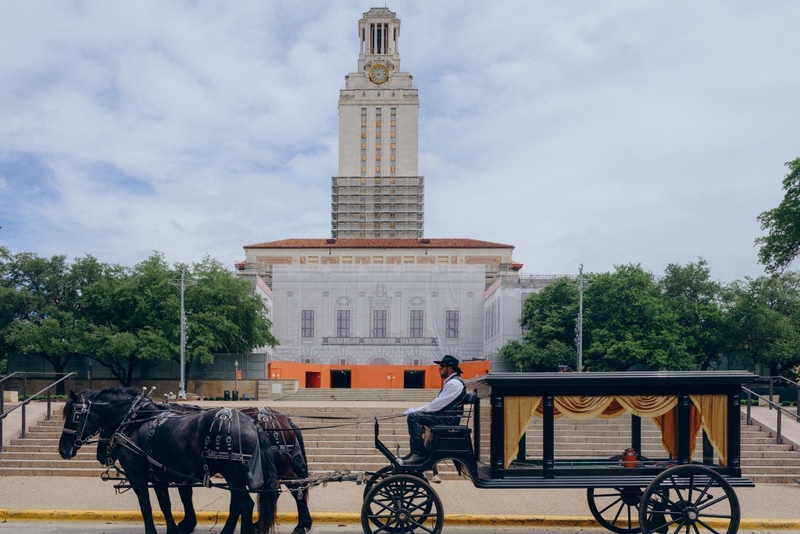
A horse-drawn hearse at the University of Texas at Austin Tower during the UT Funeral protest on May 20, 2026. (Manoo Sirivelu/The Texas Tribune)
Professors and students warned Tuesday that a new Texas law is leading to self-censorship, limiting what studies are allowed to learn and prompting some faculty and students to leave their universities.
But after hearing only from invited university administrators, Republican state senators on a seven-member committee praised how schools are carrying out the higher education law that’s shifted power on campuses. The legislators now want to strengthen it.
“There was a drumbeat that somehow the sky is falling,” Senate Higher Education Committee Chair Paul Bettencourt, R-Houston, said during the hearing on how Texas public colleges and universities are carrying out several new higher education laws. “Well, the answer is no. And more, importantly, we have record enrollment in higher education.”
The sharply different accounts emerged at separate Capitol events: professors, students and education advocates described Senate Bill 37 as causing widespread harm on campus during a news conference held just before university officials told senators they are carrying out the law with few problems.
The law gives governor-appointed regents greater authority over academics and university governance, including what courses students must take. They also now have more authority over the selection of campus leaders and faculty senates, groups that represent professors in university decisions.
The original bill would have barred required undergraduate courses from endorsing particular policies, ideologies or legislation, but lawmakers removed that language. The final law instead says those courses must prepare students for civic and professional life, the workforce and the “betterment of society.”
SB 37 came on the heels of a 2023 law that banned DEI-related efforts at public colleges and universities.
Around the same time SB 37 took effect in September, a secretly recorded video of a Texas A&M professor teaching about gender identity intensified scrutiny of college classrooms. Public university systems subsequently reviewed thousands of courses and adopted policies requiring professors to follow approved syllabi; to seek advanced approval for certain lessons about race, gender, and sexuality; or to present controversial topics in a “balanced” way.
During Tuesday’s news conference, student Valentina Rivas Labarca said she transferred from the University of Texas at San Antonio after that school consolidated its race, ethnicity and gender studies program, a decision she characterized as one of SB 37’s effects. She said she hoped to escape an approach that treated college as a “carefully managed career pipeline,” only to encounter similar program changes at the University of Houston.
UH is considering removing 101 courses, about 40% of its current core curriculum offerings, according to the Chronicle of Higher Education. Faculty members warned that losing core status could sharply reduce enrollment and lead the university to ultimately cut those courses.
“Censorship doesn’t always begin by banning ideas,” Rivas Labarca said. “Sometimes it begins by making those ideas impossible to study.”
The committee’s first witness had sat on the other side of the dais less than a year earlier. Texas Tech University System Chancellor Brandon Creighton authored SB 37 and previously chaired the Senate Higher Education Committee. He explained to his former colleagues how he puts the law into practice.
Creighton has described SB 37 as a “a floor,” not a limit on what university leaders may do. The chancellor ordered faculty to submit certain course content involving race, sex, gender identity and sexual orientation for review. He then barred sexual orientation and gender identity content from core and most lower-level courses, restricted it in advanced courses and began phasing out academic programs centered on those subjects.
Creighton told senators that system administrators reviewed more than 14,000 courses, flagged 1,403 for closer scrutiny and presented 92 courses for the regents to review. Of those, the regents required changes to 60. He emphasized that fewer than 1% of the courses reviewed were changed.
But Sen. Royce West, D-Dallas, questioned Creighton about why a constitutional law course removed from lessons the Dred Scott case, the infamous 1857 Supreme Court decision that denied U.S. citizenship to Black people.
Creighton said teaching the ruling was “in no way inhibited” by the system’s policies and that its removal was not directed by the regents. He promised to contact the law school’s dean and work with faculty members who may have misunderstood the review process.
“Studying Black history, discussing the realities of racism and treating every student with respect are not prohibited,” Creighton said.
Faculty groups suing Creighton and the system’s regents cite that episode as evidence that the restrictions are so vague that professors omit material rather than risk discipline.
Before the hearing, biology professor Lisa B. Limeri, who resigned from Texas Tech University this summer, offered one explanation for why faculty might not submit material for review. She detailed how she and colleagues omitted material about the biology of sex from an introductory biology.
“We were actually quite terrified of going through the formal process at the risk of bringing my name to the attention of the chancellor, who has to approve tenure, and so we opted to self-censor to protect our careers and our jobs,” she said.
Limeri has since accepted an untenured job outside of Texas because Tech’s restrictions prevented her from teaching complete and scientifically accurate material, she said.
Other university leaders said SB 37 spurred overdue scrutiny of their academic offerings.
University of North Texas System Chancellor Michael Williams, for example, called such reviews “a very healthy thing.” He noted that the flagship campus in Denton plans to cut or consolidate as many as 70 majors, minors and certificate programs with low enrollment.
“Much like Chancellor Creighton said, there’s always those people who disagree,” Williams said. “But our job is to do the work the Legislature gives us, and that’s what we have done. I would say overall, from my perspective, it’s been a positive experience.”
Brandon Simmons, the state’s first higher education ombudsman, testified publicly for the first time on his progress investigating colleges.
SB 37, which created the position, empowers him to examine whether universities are complying with the law and the state’s ban on diversity, equity and inclusion programs. He can compel schools’ cooperation and recommend that lawmakers block them from spending state funds if administrators do not correct violations.
Simmons’ office has received 73 complaints and opened investigations into two, he told the senators. One is a review into a student’s allegations that Stephen F. Austin State University operated a prohibited DEI program and discriminated against conservatives. Stephen F. Austin officials told KTRE that the university “complies with all state and federal laws. If there is a governmental investigation, the university will fully cooperate.”
Simmons expects his office to open a third investigation once the complaint is properly submitted. The new investigations also involve alleged DEI-ban violations.
Students and university employees may hesitate to report potential violations because they fear retaliation, Simmons said. His office plans to establish a text-based complaint line and publicize its work so more people know how to come forward.
Senators are considering whether there needs to be any changes to college oversight.
When Sen. Brent Hagenbuch, R-Denton, asked whether the ombudsman office should refer substantiated violations to the attorney general, rather than this committee as prescribed in SB 37, Bettencourt noted that Simmons hired three former attorney general’s office lawyers.
“The AG is the (ombudsman’s) office at this point,” he joked.
Simmons said it’s too early to recommend changes because his office is only beginning its first investigations.
Meanwhile, Higher Education Commissioner Wynn Rosser updated senators on another component of SB 37: a 14-member committee examining what Texas students should learn through core curriculum and whether its current required credit hours should be reduced.
The committee will not decide which individual courses universities should keep in their core curricula. SB 37 assigned those reviews to university systems and their regents.
Rosser said recommendations will go to the coordinating board in October with a final report sent to lawmakers by Dec. 1.
Sens. West and Carol Alvarado, D-Houston, also questioned whether Black and Hispanic students are sharing in the state’s enrollment growth after Texas banned DEI programs.
Rosser said enrollment at public colleges and universities increased across four racial and ethnic groups tracked by the state from 2024 to 2025: by slightly more than 9% among Black students, about 5.3% among Hispanic students, nearly 4% among Asian students and 1.5% among white students.
West cautioned that the statewide increases did not show how individual universities are performing or whether the growth will continue. He asked university officials to explain what recruitment efforts produced the increases and how enrollment of those groups compared with figures before the state’s DEI ban.
When Alvarado later asked representatives of UH, Texas State, UT and Texas A&M systems for their Black and Hispanic enrollment figures, they were not able to provide them during the hearing.
The Texas Tribune partners with Open Campus on higher education coverage.
Disclosure: MD Anderson Cancer Center, Open Campus, Rice University, Texas Tech University System and The Texas A&M University System have been financial supporters of The Texas Tribune, a nonprofit, nonpartisan news organization that is funded in part by donations from members, foundations and corporate sponsors. Financial supporters play no role in The Texas Tribune’s journalism. Find a complete list of them here.
Austin, TX