Bucknell coach charged with hazing in freshman football recruit’s 2024 death
Jul 06, 2026 | 6:19 pm ET

Description
A gavel in a courtroom. (Getty Images)
A Bucknell University football strength and conditioning coach is charged in the 2024 death of a freshman recruit who died of stress-induced sickle cell disease after being ordered to do exercises as punishment.
The Pennsylvania Attorney General’s Office announced Monday that Mark Kulbis is charged with felony aggravated hazing and misdemeanor counts of involuntary manslaughter, reckless endangerment and hazing.
Calvin “C.J.” Dickey Jr., 18, died July 12, 2024, two days after he collapsed during a workout on the first day of practice in which Kulbis ordered the freshman players to do dozens of “up-downs” because they “came up short,” according to court documents.
The attorney general’s office said an investigation showed Bucknell had provided training for its coaches on working with student-athletes with sickle cell trait, advising them to gradually work such students up to intense exercise rather than forcing them, which can result in death.
Sickle cell disease causes red blood cells to change shape from round to crescent shaped. The condition can lead to sickled-shaped blood cells clogging arteries during strenuous exercise.
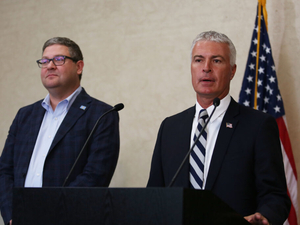
“The facts show this was an intentional, deliberate hazing perpetrated by a coach who knew C.J.’s health condition made him vulnerable to extreme workouts,” Attorney General Dave Sunday said in a news release. “The facts show this defendant received information about C.J.’s health condition, along with training about NCAA anti-hazing standards, and disregarded that information. This is an extraordinary tragedy, worsened by the fact that C.J.’s death was preventable.”
The Union County District Attorney referred the case to the attorney general’s office last year, citing a lack of resources, Sunday’s office said.
Kulbis of New Columbia, Union County, was arraigned in district court Monday and was free on $10,000 unsecured bail awaiting a preliminary hearing July 28. His attorney Barbara Zemlock of Camp Hill did not immediately respond to a message from the Capital-Star.
According to charging documents, Dickey, of Land O’Lakes, Florida, arrived at Bucknell with his parents two days before pre-season training was to begin. Although he had tested positive for sickle cell trait, a sports medicine doctor cleared Dickey to practice July 10, 2024, with advice to let his coaches know if he experienced shortness of breath or chest pain.
The football coaching staff was made aware of Dickey’s condition in a document prepared by the university’s athletic department, the team’s offensive coordinator John Bear told investigators. Records indicated Kulbis had downloaded the spreadsheet with athletes’ medical conditions and viewed it three times, including the morning before Dickey collapsed.
Dickey’s condition was also mentioned during a review of injuries and medical restrictions in a coaches meeting Kulbis attended before the workout session where Dickey was stricken, the attorney general’s office alleges.
“At one point, according to Bear, Coach Kulbis asked if he could ‘smoke’ the kids in his workout,” according to the affidavit in support of the charges. “Defensive Coordinator Chris Bowers, Coach McNeil Parker and Coach Bear all said ‘no’ and said that it was [the players] first time back. Head Coach Dave Ceccini told Kulbis not to make it hard.”
During the start of the workout session, Offensive Line Coach Sean Pearson noticed Dickey was away from his teammates talking on the phone in a meeting room, he told investigators. Pearson asked why and Dickey told him that despite previous assurances, he was not cleared to practice from “a compliance standpoint.”
About a half hour later, Dickey received word that he was cleared by the university’s compliance officer and that he was “good to go.” According to student-athletes who were interviewed after Dickey’s death, the workout was supposed to be instructional with no exertion.
Pearson, however, said the athletes were made to do core work or up-downs, similar to burpees, if they “messed anything up.”
Toward the end of the workout, Kulbis told the athletes “You guys came up short today … Finish with 30 up-downs … We’ll be better tomorrow,” Pearson told investigators. Dickey appeared exhausted by the time the students counted 10 up-downs and Pearson said he could tell that Dickey was out of shape.
By the time the group completed 20 up-downs, Dickey didn’t get up again, Pearson told investigators.
Dickey was taken by ambulance to Evangelical Hospital in Lewisburg and later transferred to Geisinger Medical Center in Danville, Montour County, where he died two days later.
According to the affidavit, in a recorded interview Kulbis described the workout as a warm-up, and that nothing about the conditioning session that day was “high volume” or “maximum intensity.” Kulbis said the athletes were made to do five up-downs if there were “mess-ups,” and these were scattered throughout the session. He said the workout ended with up-downs, but Dickey appeared “gassed” and he didn’t make Dickey do the exercises.
Police interviewed 28 student witnesses, 18 of whom described the exercises as a form of punishment and discipline for not performing to Kulbis’ satisfaction.
“Several players indicated that, in addition to doing a 2-minute ab circuit 6-7 times, they had to do approximately 100 up-downs throughout Coach Kulbis’ workout,” the charging document says.
Students said Dickey had been complaining about trouble breathing and could not get off the ground. Kublis witnessed this but did not summon help from the training staff. While he told Dickey to stay down, the teenager struggled to finish and Kublis did not stop him, the students told investigators.
In a recorded 911 call, Kublis described a student having trouble breathing but did not mention that Dickey had preexisting medical conditions, the charging document says
An autopsy by Montour County Coroner Scott Lynn concluded that Dickey died as a result of an enlarged heart and the breakdown of muscle tissue and that sickle cell trait and elevated body mass contributed. The manner of death was natural, Lynn said.
A second private autopsy concluded that the conditions that caused Dickey’s death were triggered by sickle cell crisis.
Investigators spoke with Lynn and the head of the forensic pathology practice that performed the second autopsy to share information gathered during the attorney general’s investigation and clarify the degree to which Dickey’s sickle cell condition contributed to his death. During the discussions, the coroner and pathologist explained the sickle cell trait, forced exertion and muscle breakdown were all significant factors in Dickey’s death.
Last month, Lynn issued an amended death certificate indicating Dickey died as a result of “forced exercise induced sickle cell crisis” and declaring the manner of death as “homicide,” the affidavit says.
The state Legislature passed the aggravated hazing law in response to the hazing death of Penn State University student Tim Piazza in 2017. Piazza was a 19-year-old engineering student who died after a fraternity event where he was forced to drink excessive amounts of alcohol, leading to multiple falls down a flight of basement stairs. Members of the fraternity didn’t summon help for more than 12 hours and Piazza died of his injuries.
The case led to one of the largest criminal prosecutions for hazing in United States history, leading to multiple convictions. It also served as a turning point against hazing.
“This law exists because it recognizes what hazing is: criminal conduct that, in the best possible scenario, humiliates and dehumanizes an individual — and at its worst, takes lives and leaves families and friends forever devastated,” Sunday said.

Harrisburg, PA