BPA abruptly pulls funding from Columbia River fisheries program
Jul 01, 2026 | 5:09 pm ET
Description
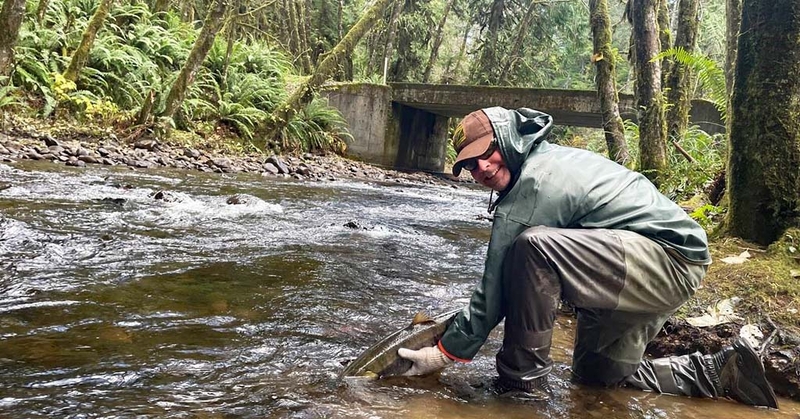
A worker releases a chum salmon in Oregon’s Gnat Creek. The Gnat Creek Hatchery is part of the Blind Slough Select Area Fishery, where an annual average of 560,000 spring chinook have historically been released as part of a program whose funding is being slashed. (Oregon Department of Fish and Wildlife)
This story was originally published by Columbia Insight, a nonprofit environmental news website covering the Pacific Northwest based in Hood River.
The Bonneville Power Administration isn’t going to put any more money into a fisheries program operated by state wildlife management agencies of Oregon and Washington and Clatsop County Fisheries in Oregon.
The decision, which comes a few months after BPA completed an updated environmental assessment of the program, seems to have left several jaws on the floor. BPA has provided funding for the program for decades.
“This decision by BPA caught us by surprise,” Debbie Colbert, director of the Oregon Department of Fish and Wildlife, said in a statement. “It puts decades of fishery reform work at risk and goes against the recommendation of the regional fish and wildlife managers and the Northwest Power and Conservation Council to fund this work.”
The Select Area Fisheries Enhancement program is part of ongoing, federally mandated wildlife conservation efforts funded by BPA aimed at mitigating the impacts of dams on the Lower Columbia River that make up the Federal Columbia River Power System.
The SAFE program was started by the Northwest Power and Conservation Council in 1993. The program attempts to reduce some of the harvest pressure on native salmon stocks in the main stem of the Columbia River by creating more recreational and commercial fishing opportunities in off-stem areas using hatchery fish.
SAFE is supposed to operate as a closed-loop system. Hatchery-born juvenile salmon are trucked to specific fisheries in Oregon and Washington, and are reared in net pens. Then, the fish are released to make their trek downstream to the ocean.
When the salmon are ready to return to freshwater, the hope is that the fish return to their net pens, where they can be harvested by recreational and commercial fishers.
Costs of the program are shared between BPA, ODFW, Washington Department of Fish and Wildlife and Clatsop County Fisheries, with the National Marine Fisheries Service and U.S. Fish and Wildlife Service also chipping in.
BPA has historically funded a majority portion of the program.
According to a BPA 2024 report supportive of the program, the total annual cost of operating and maintaining the SAFE Program is approximately $2.4 million. “Bonneville’s annual funding contribution has typically amounted to roughly $1.6 million, or two-thirds of annual O&M costs and half of smolt production costs,” according to the report.
BPA has historically paid for things like transporting juveniles to their net pens and operations at the net pens.
BPA money provides funding for 100% of one hatchery in the program, about 40-45% of another hatchery and all of the funding for the net pens used for final rearing of spring chinook and coho.
Unexpected decision
In a letter dated June 18, Jason Sweet, BPA’s fish and wildlife program executive director, alerted ODFW to the decision to pull funding for the next fiscal year.
Sweet argued that SAFE isn’t really helping native salmon stock.
“Although the off-channel fisheries supported by the SAFE program have clearly increased commercial and recreational harvest opportunities in those areas, there is no direct evidence that such increased off-channel harvest has resulted in reduced harvest impacts on weak and ESA-listed stocks in the mixed-stock fisheries on the mainstem,” wrote Sweet.
ODFW says the funding loss leaves the program in a lurch, placing more than 7 million hatchery salmon currently in production at immediate risk and leaving an estimated $2.4 million funding gap across the three partners responsible for SAFE operations.
“SAFE is a cornerstone program that provides terminal, ocean, and mainstem harvest opportunities, supports living-wage jobs in coastal communities, provides forage for critically endangered southern resident killer whales and reduces pressure on vulnerable Columbia River stocks,” said Tucker Jones, ODFW’s ocean salmon and Columbia River program manager, in a statement. “Pulling funding with almost no notice undermines stability for both fishery managers and commercial and recreational fishers.”
But Sweet said in his letter that the program’s management, which is focused on commercial and recreational harvest, doesn’t match BPA’s mitigation efforts.
“Due to the absence of a demonstrable mitigation benefit for weak and ESA-listed mainstem stocks, the SAFE program does not align with the statutory purpose of BPA’s Fish and Wildlife Program—to mitigate impacts of the Federal Columbia River Power System (FCRPS) on fish and wildlife,” wrote Sweet.
A BPA spokesperson provided Columbia Insight with a copy of Sweet’s letter but declined to comment further on the issue.
A spokesperson for ODFW told Columbia Insight the department disagrees with BPA’s assertions.
“BPA makes many claims in their letter to justify their decision to stop funding the SAFE program,” the spokesperson said via email. “SAFE restores some of the harvest opportunities lost due to hydrosystem impacts. But it also contributes to reduced commercial interceptions of listed upriver stocks, provides an important outlet for conservation efforts related to hatchery and harvest reforms in the Lower Columbia, and contributes valuable forage for critically endangered killer whales. It has been repeatedly reviewed by regional Fish & Wildlife Managers and the Northwest Power and Conservation Council and has always been recommended for continued funding.
“BPA has been actively narrowing its fish and wildlife mitigation funding obligations. Just because they have been attempting to tell the region that they’d like to transition away from this program doesn’t mean that it isn’t still a valuable part of the mitigation package.”
The program has drawn criticism from environmental groups such as Wild Fish Conservancy, which sued both Washington and Oregon for their management of hatcheries and net pens, and is pursuing further litigation against the program.
Conrad Gowell, legal director at Wild Fish Conservancy, told Columbia Insight that SAFE fisheries and hatcheries are rife with problems.
“The programs were originally intended to reduce interceptions in the main stem of the Columbia,” said Gowell. “What ended up happening is those programs then impacted those localized populations in those terminal areas to such an extent that they have, in some cases, reached the quasi-extinction threshold.”
According to Gowell, the hatchery fish don’t always return to their net pens, and are often found in tributaries throughout the Lower Columbia River. The terminal fisheries in the SAFE program can also displace other ESA-listed species, like chum, from reaching streams.
“I think there are better ways to spend funds on the recovery of ESA-listed fish,” said Gowell.
With the unexpected BPA announcement, the operational future of SAFE is uncertain. ODFW and WDFW have said they’re working together, along with Clatsop County, to assess impacts of the eliminated funding.
“We are closely coordinating with the Oregon Department of Fish and Wildlife and Clatsop County to better understand the implications of this decision,” WDFW spokesperson Kelly Hall told Columbia Insight. “Additional information will be shared as those discussions continue.”
Salem, OR