Birth centers appeal to Alabama Supreme Court in battle with Department of Public Health
Mar 24, 2026 | 7:01 am ET
Description
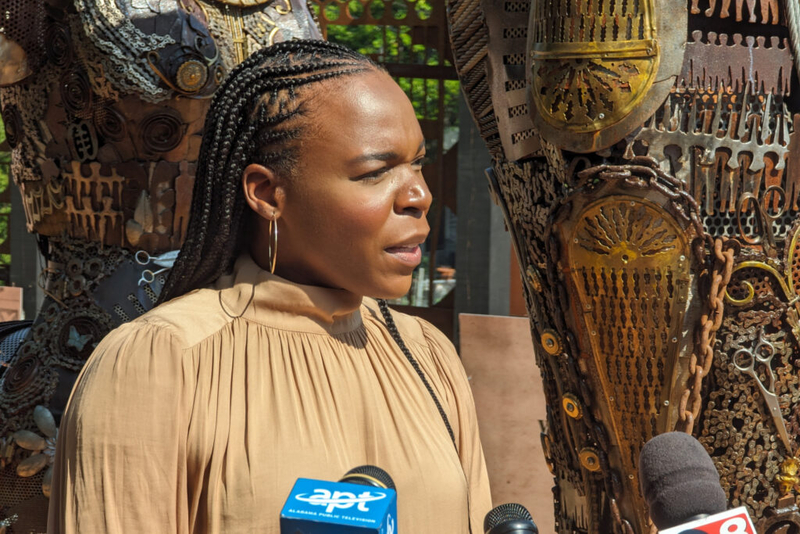
Dr. Yashica Robinson, OBGYN and owner of Alabama Birth Center in Huntsville, discusses ACLU's lawsuit against the Alabama Public Health Department on Aug. 8, 2023 in front of the Mothers of Gynecology Monument in Montgomery. Alabama Birth Center and the other plaintiffs in the case appealed a lower court's ruling that defined freestanding birth centers as hospitals and subjected them to state regulations on Friday to the Alabama Supreme Court. (Alander Rocha/Alabama Reflector)
A group of plaintiffs that include two Alabama birth centers Friday appealed a lower court’s ruling in January that birth centers are hospitals and subject to regulation by the Alabama Department of Public Health (ADPH).
Whitney White, staff attorney for the American Civil Liberties Union Reproductive Freedom Project, which represented the plaintiffs, said in an interview Monday afternoon that the case is about government overreach.
“The Department of Public Health has, for years now, been trying to subject birth centers to this requirement that they be licensed as hospitals, and has been trying to impose medically unnecessary and incredibly burdensome licensing rules that would make it difficult, if not flat out impossible, for birth centers to keep operating in the state,” White said. “That’s why we’ve sought further review of the decision, because it’s so important that Alabama families continue to have access to this model of care.”
The Alabama Attorney General’s Office is representing ADPH and State Health Officer Dr. Scott Harris, the defendants, in the case. Messages seeking comment from ADPH and the Attorney General’s Office were left Monday afternoon.
The plaintiffs on Friday requested an oral argument in front of the Alabama Supreme Court in hopes of overturning the Alabama Court of Civil Appeals January ruling.
Oasis Family Birthing Center in Birmingham and Alabama Birth Center in Huntsville filed suit against ADPH in 2023, a few months after the agency adopted new regulations requiring centers to be under the oversight of a physician or medical director and to be within 30 minutes of a hospital with OB-GYN services.
The centers, which provide an in-between option for individuals who do not feel comfortable with a home birth but prefer an out-of-hospital birth, said the regulations would make it difficult or impossible for them to provide services around the state, particularly in rural areas that lack hospitals.
The centers have been fully operational during the litigation due to a preliminary injunction granted early in the case, White said. She also said the centers are important given the state’s infant and maternal mortality rates.
“We know that many pregnant women in Alabama are struggling to access the pregnancy care that they need, and so birth centers offer a really critical access point for pregnancy related care,” White said. “The midwifery care that they provide is an evidence-based alternative for patients with low risk pregnancies.”
Infant mortality
According to state data released in November, the state’s infant mortality rate was 7.1 babies per 1,000 live births in 2024, reflecting the rate of infants who died within their first year of life. That was down from 7.8 deaths per 1,000 births in 2023, according to state data. There were 414 infant deaths in 2024. Of those, 222 of the deaths were white babies and 176 were Black babies, the lowest recorded number for Black infants.
But infant mortality rates for Black Alabamians remain disproportionately high. The infant mortality rate among white Alabamians was 5.4 deaths per 1,000 live births in 2024. For Black Alabamians, the rate was 11.8 per 1,000. In 2023, the rates were 5.7 and 13.1 deaths per 1,000 births, respectively.
The nation’s infant mortality average is 5.5 deaths per 1,000 live births, Harris said. However, the state matches the nation’s trend since 1970.
According to the data, the infant mortality rate is much higher in rural counties like Wilcox, Butler, Conecuh and Hale in the Black Belt, and Cherokee County in the northern part of the state. Those counties directly correlate with counties without hospitals that can deliver babies, according to the data.
According to the University of North Carolina’s Sheps Center, nine rural hospitals have closed in Alabama since 2009. Only 30% of the state’s rural hospitals have labor and delivery units, leaving many expectant parents to drive long distances for care.
“Being able to get pregnancy care in their own communities, in a home-like setting, makes a world of difference — especially for Black Alabamians, who are more likely to experience complications and be disempowered as the result of medical racism,” Dr. Yashica Robinson, founder of the Alabama Birth Center, said in a statement Monday afternoon. “With Alabama facing a serious maternal and infant health crisis that is disproportionately affecting Black Alabamians, those with low incomes, and rural communities, the support birth centers provide our communities is more important than ever.”
Oversight
The plaintiffs argue that the appeals court never determined whether freestanding birth centers are hospitals as defined by Alabama law. Should the lower court ruling stand, it would make it difficult, “if not impossible,” for birth centers to continue operating due to regulations enforced by ADPH. The filing also says that the lower court misunderstands the difference between midwifery and obstetrics.
“Obstetrics is a surgical specialty involving treatment of abnormality or pathology in pregnancy for patients with a range of risk levels, who may experience a range of complications or need more invasive, complex care than what birth centers provide,” the filing says. “By contrast, midwifery in birth centers is limited to low-risk patients with uncomplicated pregnancies, and involves only low-intervention care and physiological birth without surgical or operative interventions, labor induction or augmentation, or narcotic anesthesia.”
White said that without birth centers under the same regulations as hospitals, they would still have oversight from the Alabama Board of Midwifery, just like doctors who do not work in hospitals are under oversight from the Alabama board of Medical Examiners.
“The plaintiff birth centers are really just asking for the exact same midwifery care that they’re providing in birth centers, to be regulated in the same way that this care is provided elsewhere, like in home births,” White said.
As of Monday afternoon, the Alabama Supreme Court had not acted on the request.
Montgomery