‘Inspired by art’: Murals help unite and define Kansas towns, boosting pride, health and economy
Jul 27, 2026 | 10:25 am ET
Description
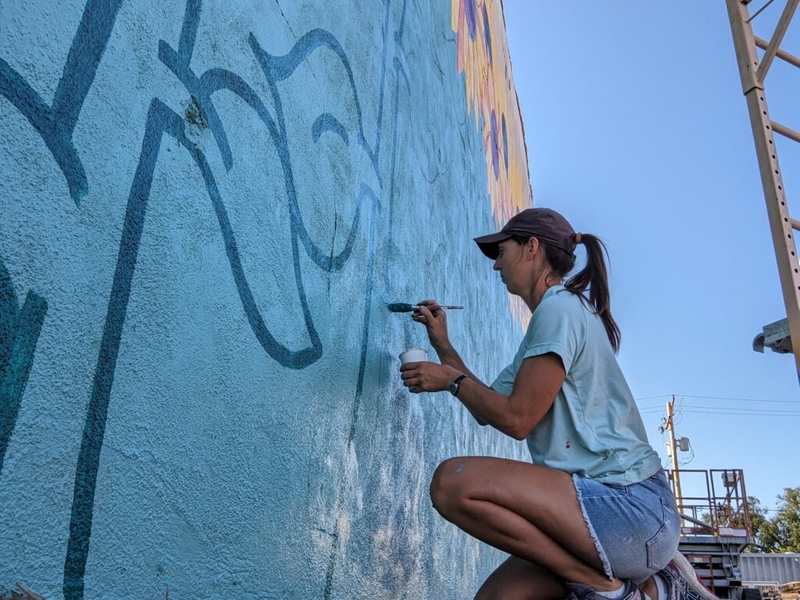
Artist Lissa Sexson works on a mural in St. Francis, Kansas. As economic development director for Wallace County, she sees the importance of showing community pride. (Photo submitted by Lissa Sexson)
TOPEKA — Artist Sarah Fizell doesn’t need convincing that public art affects neighborhood pride, community perceptions and even residents’ physical health.
But sometimes the real impact is conveyed in simple words from a little boy, who stopped by as she painted a mural on a Topeka bridge near Ripley Park.
“There was a kid who came and told us that before we painted the bridge, he just had to tell people he lived near where there had recently been a couple of murders that had been really high profile,” she said on the Kansas Reflector podcast. “Since we painted the bridge, he could tell people he lived by the bridge.
“That’s important for kids. That’s important for anybody to be able to be proud of where they live.”
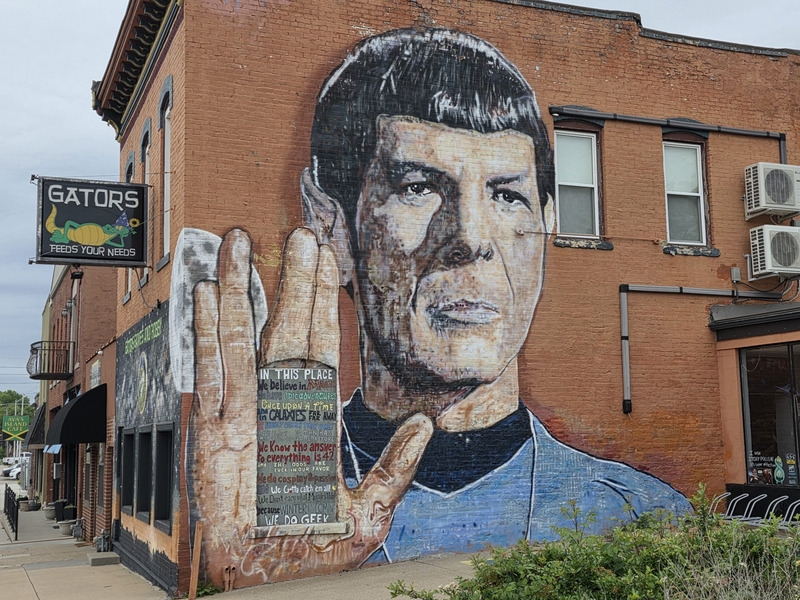
Hundreds of murals dot the Kansas landscape, lending a touch of outer space to downtown Leavenworth with a “Star Trek” Spock mural, or in numerous communities reminding people they’re visiting the Sunflower State with splashes of the golden flowers and meadowlarks.
Murals bring color and personality to small communities like Weskan, with a population of 158. The town wanted a way to welcome U.S. Highway 40 travelers as they enter Kansas from Colorado, said Lissa Sexson, an artist and director of community development in Wallace County.
Sexson painted the brightly colored wheat and stylistic sunflowers on the Weskan mural, and has done others in St. Francis, Leoti and Colby. She also was the lead designer for a project called “Pieces of Rice County,” designing eight murals for each community in Rice County and painting two of the eight.
Murals and other public art can bring a sense of optimism and hope to any space but can be especially important in rural areas like Wallace County, with a population of 1,800 people, she said.
“You go into each one of those communities, and each one of them has a little bit different story,” she said. “The unique piece of murals is that you can see all these places trying to talk about their identity.”
Bushton, for instance, is the central point of Kansas, Sexson said. Geneseo, a town of about 220 people, is known locally as the UFO Capital of Kansas, she said. Each has the chance to show its pride through the subjects chosen for public art.
Defining community
“Public art has been a really, really important definer of community historically,” said Curtis Young, director of the Kansas Arts Commission. “Especially when you think about public art that is supported by whatever the powers that be are in the society at the moment, whether that’s the king or the Legislature or a rich benefactor or the Medicis or whoever.”
The Medici family supported the Italian Renaissance period through funding artists like Michelangelo and Donatello.
The art pieces put in places for the public specifically to access are “infinitely democratic because they’re available to everybody,” he said.
“They help to bring a community together to help them define what it is that makes them, them,” Young said.
Whether funding for the public art comes from private donors, the government or is part of a business endeavor, the message is that the community is worth it, he said.
It is one of several reasons the Kansas Department of Commerce supports and encourages rural art projects through grant programs, he said.
Sarah Kephart, director of Envision Arts in Wichita, said public art makes art available to people who may never step into a gallery or museum, or who may not feel comfortable in those spaces.
“This gives them that opportunity to appreciate, learn about and be inspired by art,” she said. “Public art is so important in the way that it elevates a space. It also can turn a dismal location or space into something very lively.”
Health matters
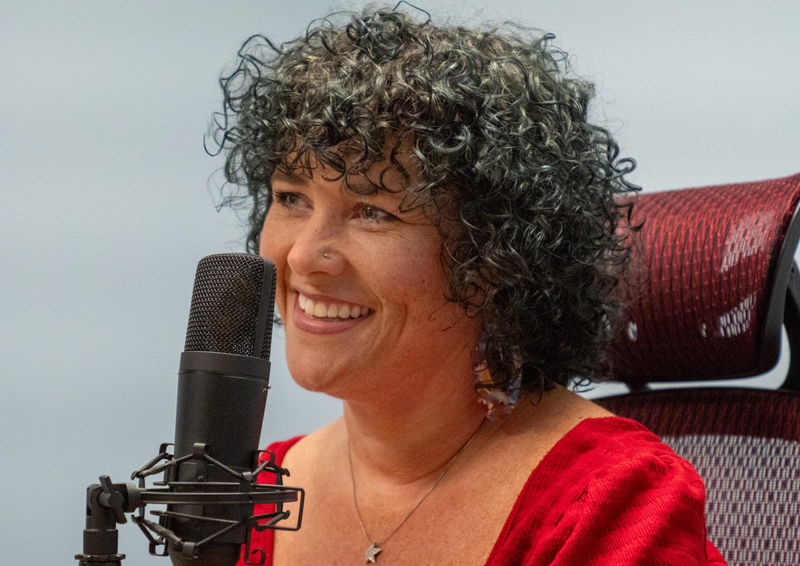
Public art beautifies spaces, starts conversations and helps people feel pride in their surroundings, Fizell said. Research, though, is showing that it also affects physical and mental health, she said.
“The medical industrial complex has figured out that loneliness and isolation are a huge reason that people get sick, like physically sick, and why they don’t recover from surgery,” Fizell said.
Research, much done by the University of Florida’s Center for Arts in Medicine, finds that placing and creating public art, as well as offering artistic activities, has far-reaching effects, Fizell said.
Public art encourages people to linger in spaces where they are more likely to connect to others in the community, she said.
And murals offer the chance for people to feel part of their community, and that connection can fight loneliness and isolation.
“When people who live in that community maybe don’t see themselves as part of it, if they can see something on a wall that represents them or makes them feel included, then it’s again doing those same things that make each person feel valuable, which changes behavior,” Fizell said.
Young said art and wellness are inextricably combined.
“The results that are coming back are just incredible,” he said, adding that he worked a few years ago on a project at the University of Florida to measure and quantify the relationship between community wellness and arts participation.
A result of that study was finding that where people can experience art — which can be anything from singing in a church choir to doing an artistic activity — were places where people tended to self-report better health, Young said.
“They tend to self-report liking their communities more. They tend to self-report that where they live is a good place to live, and when you live in a good place to live, you’re going to be healthier,” he said.
Some communities use public art, which by definition is accessible by anyone, to tackle tough issues. The National Endowment for the Arts supported “Ask the Question,” a project in Oregon that created art focused on encouraging people to ask others if they are OK as a response to a rise in suicides in the community.
The economics
Clay Center started a large mural project a few years ago, with the goal of being the mural capital of Kansas, he said.
“People are coming off the road to see it,” Young said. “While they’re there, they’re going to lunch. They’re buying gas. They’re stopping at the store.”
Public arts projects are economic drivers, and businesses near public arts projects “almost universally” report more business, he said.
Young said research from the Americans for the Arts organization highlights that aesthetics is one of the top three characteristics that cause residents to attach themselves to a community.
“When I read ‘attach themselves to a community,’ that doesn’t mean move there or stay there,” he said. “It means why they develop an emotional connection to their community.”
In her Wallace County community development role, Sexson said she sees the effects of art on drawing people to small towns.
Wallace County is holding its third music series, which involves live music in the downtown areas and encourages tourism and spending in the community.
“We’re in a small place,” she said. “Outside of maybe the school or outside the churches, there’s not a lot of places for people to gather.”
Americans for the Arts has been studying economic impacts of arts for more than 30 years. It’s most recent report found that arts generated $151.7 billion in economic activity nationally in 2022.
Telling a story
Businesses and nonprofits often create public art that supports their mission or business focus.
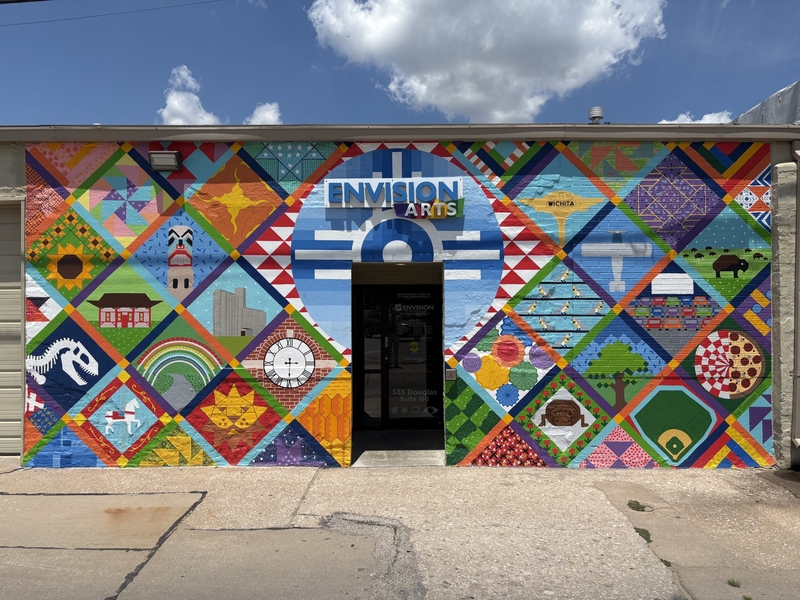
Kephart, the Wichita arts director, said her organization received a grant from the city to create a mural on a new building after it moved to a new neighborhood. Artist Eva Cummings, who is also the gallery coordinator for the Envision Arts Center, said the organization wanted a chance to “show who we are.”
“The back of this building, it’s a very long strip that is just all beige,” Cummings said, adding there was a mural there that represented the former ax-throwing business with Carrie Nation holding an ax.
It needed to change to reflect Envision’s work, which is an organization that supports people who are blind or visually impaired, she said.
“Envision Our City was really built upon the idea of stitching community together,” Cummings said. “Now it’s this very bright, colorful, welcoming and inviting entryway.”
The mural is designed to look like a quilt, with pieces highlighting favorite places around Wichita drawn from input of artists and others at Envision, she said.
It also has stimulated surrounding businesses to think about murals and putting art in their spaces, Cummings said.
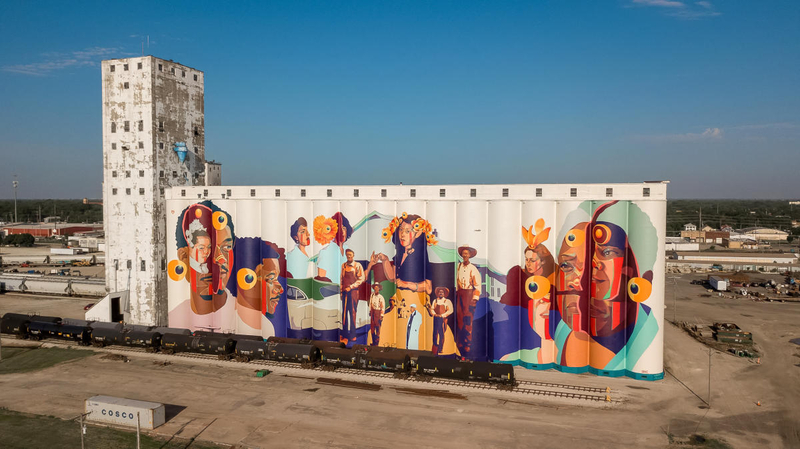
One of her favorite Wichita murals is the Beachner Grain Elevator north of the city, which is the largest mural done by a single artist in the world, Cummings said. According to the Travel Kansas website, the mural is part of the Horizontes Project, an artist-driven project designed to connect two underrepresented neighborhoods, the Latino NorthEnd and African-American Northeast.
“It represents the different faces of the communities that really built Wichita, with the agricultural industry in that district, and to me, just the sheer scale of that project really shows me what Wichita supports,” Cummings said.
Public art beyond murals
Murals can be the easiest way to put public art in place, Fizell said, and people engage with them easily, including taking photos.Sculptures tend to be more expensive and they also tend not to engage people as actively or build community as much, she said.
“So there to me is a real drop-off in effectiveness as community building between those two,” Fizell said. “However, there is not a drop in effectiveness between music in community with your neighbors and friends. I really think that as we move forward in trying to establish art policies in Topeka, I really feel strongly that those have to include public performance as public art.”
Even the simplest art can be controversial because someone is going to think it is beautiful while someone else thinks it is ugly, Young, with the Kansas Arts Commission, said.
“Art is always an experiment,” he said. “There are acceptable levels of (controversy), of course. You know, you don’t want a piece of art that is going to divide the community, but good public art can help people look at areas that would be controversial to them and find ways to agree.”
Topeka, KS