Bill to enshrine $35,000 teacher signing bonuses into Oklahoma law advances
Feb 17, 2025 | 3:44 pm ET
Description
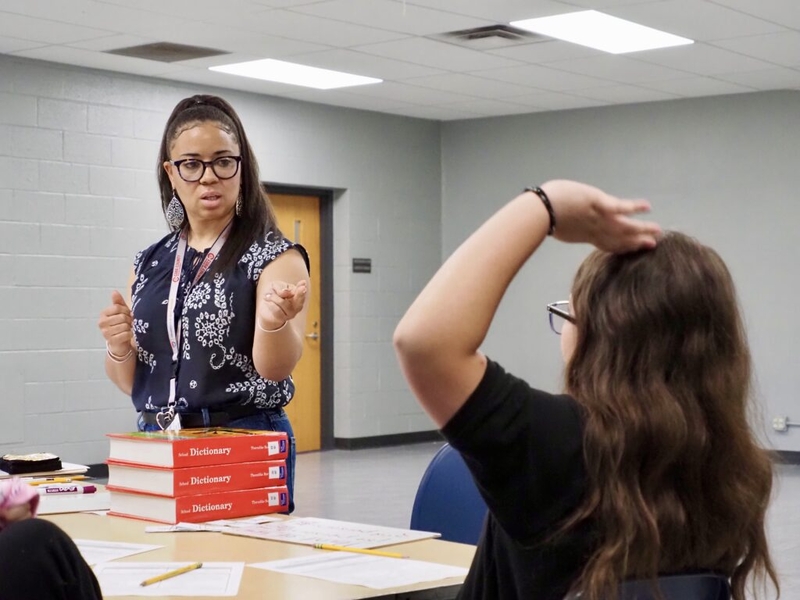
Skelly Elementary teacher Charity Hargrave leads a reading exercise with a small group of fifth graders in Tulsa on April 9. House Bill 1281 would offer signing bonuses to draw more qualified teachers back to the classroom. (Photo by Nuria Martinez-Keel/Oklahoma Voice)
OKLAHOMA CITY — House lawmakers on Monday advanced a bill that would encode $35,000 teacher signing bonuses into state law, taking inspiration from a similar program state Superintendent Ryan Walters implemented.
House Bill 1281, also called the Return to Teach Signing Bonus Act, would offer $35,000 upfront to educators with at least three years of teaching experience but who have not been working in an Oklahoma public school for the previous year.
Recipients of the signing bonus would have to commit to work as a public school teacher in Oklahoma for at least five years. Those who fail to complete the minimum five years would have to return the money on a prorated basis.
The bill would take effect for the 2025-26 school year if passed into law. It has no fiscal impact estimate. The signing bonuses would be “subject to the availability of funding,” according to the bill’s text.
A House subcommittee focused on education funding passed HB 1281 with an 8-2 vote. The two Democrats on the panel cast the only votes in opposition.
Rep. Michelle McCane, D-Tulsa, said during the meeting she was “concerned about the effectiveness” of the concept, given how many candidates Walters attracted with even larger bonuses.
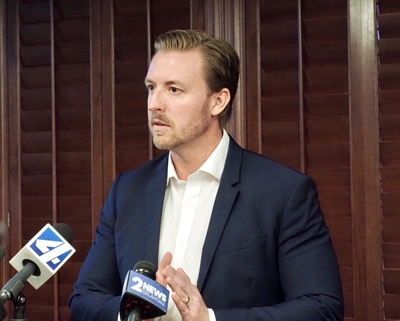
Walters’ program at the state Department of Education drew more than 500 teachers to Oklahoma public schools in the 2023-24 school year while offering signing bonuses up to $50,000. A second round of stipends up to $25,000 brought in 61 teachers to high-need positions in rural districts this school year.
The program, which relied on federal funds, was designed to entice teachers from out of state and to attract experienced educators in Oklahoma who had left the classroom.
Controversy erupted when the Education Department demanded repayments after discovering it had paid a few teachers who never actually met the program requirements. Walters blamed the mistaken payments on the teachers, accusing them of lying on their applications.
Two of the teachers sued Walters and the Education Department, contending they were honest on their applications and, if forced to repay their $50,000 bonuses, would suffer financially because of the state agency’s mistake. The lawsuit is still pending in Oklahoma County District Court.
With that clawback fiasco in mind, Rep. Dick Lowe, R-Amber, questioned whether it would be better to pay HB 1281’s signing bonuses in yearly installments rather than all $35,000 at once.
“That wasn’t a fun time for most of us when that clawback was being questioned,” Lowe said during Monday’s subcommittee meeting.
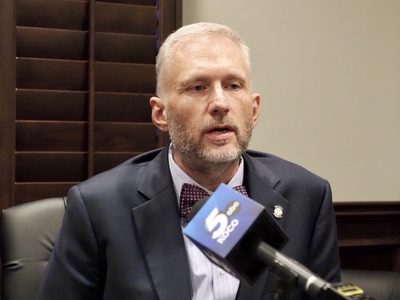
The bill’s author, Rep. Chad Caldwell, R-Enid, disagreed that he should change the bill.
Caldwell, who leads the subcommittee, said $35,000 upfront “would get people’s attention” better than the promise of yearly payments. The full amount could equate to a new car or a downpayment on a house.
“Candidly, I think it would be more effective if we just pay it all in a lump sum,” he said.
It shouldn’t be controversial to take funds back from teachers who are later found to be ineligible, Caldwell said.
He said the outcry over the Education Department’s attempted clawbacks were the result of “people wanting to garner headlines than actual policy conversation.”
“It’s something that happens in this country every day,” Caldwell said during the meeting. “When you lie on an application to gain financial resources, there are penalties for that, and the same would be true for this, too.”
HB 1281 now advances to the full House Appropriations and Budget Committee for consideration.
It’s not the only bill that would impact teacher pay.
Last week, the Senate Education Committee unanimously approved legislation to boost the minimum salary for first-year teachers to $50,000 and raise wages for public-school educators across the board. Currently, the state’s minimum required salary for first-year teachers is $39,601.
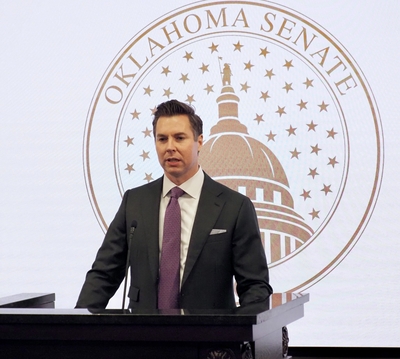
The bill’s author, Sen. Adam Pugh, R-Edmond, said bordering states are “cannibalizing” Oklahoma’s teacher workforce by offering more competitive wages. New Mexico hiked its minimum teacher salary to $50,000 in 2022, and Arkansas did so a year later.
Oklahoma last raised teacher salaries in 2023 by increasing the state-mandated minimum pay by $3,000 to $6,000, depending on years of experience.
“I think, just kind of holistically, $50,000 seems to be the north star that is the right signal to our teaching community and to teacher candidates that we’re serious about getting high-quality men and women into the classroom,” Pugh said during a committee meeting last week.
Pugh is also a co-author of HB 1281 with Caldwell.
Pugh’s pay raise bill, SB 201, would cost the state $640 million, according to the Senate’s fiscal impact estimate. The legislation is now in the hands of the Senate Appropriations Committee.
That’s a high price tag in a year when the state Legislature is projected to have less to spend than the year before. Meanwhile, Gov. Kevin Stitt is pushing to dedicate a similar amount, $600 million, to tax cuts.
Caldwell said House lawmakers are more focused on improving student outcomes than raising teacher pay or school funding.
“It’s not enough just to make a commitment to pay teachers more or to give our schools more,” Caldwell told reporters during a Thursday news conference. “While that sounds good and it looks really good in the newspapers and on television, what’s most important is about improving our students’ outcomes. And that’s what they deserve is that promise of a better future, not simply just a promise of better funding.”
Oklahoma City, OK