Senate vote shows a new SC congressional map can’t become law before early voting starts
May 22, 2026 | 3:05 pm ET
Description
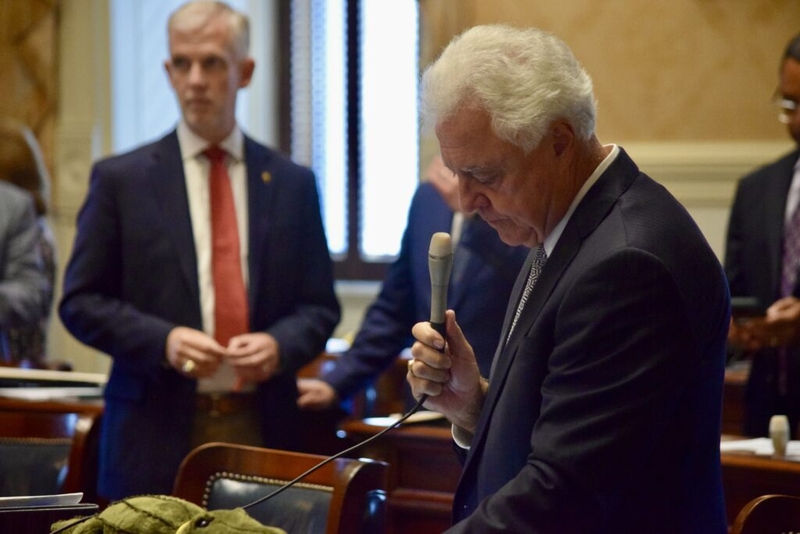
South Carolina Sen. Larry Grooms, R-Bonneau Beach, on the Senate floor Thursday, May 21, 2026, as the Senate debated legislation redrawing the state's congressional voting lines. (Photo by Jessica Holdman/SC Daily Gazette)
COLUMBIA — South Carolina senators failed Friday to muster the votes necessary for finalizing a new congressional map before early voting begins for party primaries, but debate on the White House-backed map continues.
Supporters needed two-thirds majority approval — at least 31 votes — to void their own redistricting rules and start voting on the bill.
After the attempt failed a second time Friday afternoon on a 26-15 vote, senators adjourned for the day.
Five Republicans joined Democrats in opposing the rushed process.
On Saturday, they’ll have the option of limiting debate through an existing rule. Even if they have the votes to push that through (with three-fifths approval), debate could continue for up to 46 hours before the Senate actually votes on the bill. Then the debate clock would start again for the necessary final vote.
“If you can’t suspend the rules, the earliest the Senate could pass something is when you have tens of thousands of people standing in line to vote already,” Senate Majority Leader Shane Massey, among the “no” votes, told reporters.
He contends it’s already too late to upend an election that’s already underway and void part of ballots already cast.
As of Friday, 12,695 absentee ballots had been mailed for the June 9 primary. The state Election Commission has received 320 ballots back from active military members overseas and 3,153 additional from other absentee voters.
“We’re trying to pull something off that we just never had time to do from the outset,” said Massey, R-Edgefield.
He was among five Republicans who helped kill a resolution to put redistricting on the agenda of a special session. That May 12 vote seemed to end the push.
But after the regular session ended two days later, Gov. Henry McMaster ordered legislators to keep working in a special session. A change in the House rules Monday allowed that chamber’s ruling Republicans to wrap up voting after midnight Tuesday.
House GOP passes new voting lines for SC ahead of court hearing on first lawsuit
Even some supporters of the effort expressed hesitancy to let debate bleed into the start of in-person early voting.
“Understand where we are right now,” Sen. Larry Grooms, who made the motion to suspend the rules, told his colleagues after the first failed vote.
He urged senators not to make any changes in the bill, no matter how long it takes to get through the process, since that would require the House to vote again.
“South Carolinians will go to their early voting places on Tuesday morning,” said the Berkeley County Republican. “They will push the buttons on a voting machine.”
But supporters ultimately weren’t willing to call it quits on mid-decade redistricting.
The legislation would push congressional primaries until August, while keeping the calendar in place for other contests, including statewide and state House races. Ballots will list congressional candidates regardless, but any votes cast for them wouldn’t count.
Following a Senate GOP huddle on what to do next, Grooms told reporters some Republicans thought it was important to continue to “show the folks back home” they were putting in the work and debating the issue.
Grooms said he will try again Saturday to suspend the rules.
“That was kind of a show,” Massey said of Republicans who refuse to give up despite the futility of the exercise.
“You have people who just want to show we’re fighting. You’re not really fighting. You’re not really doing anything other than wasting everybody’s time and money,” he said after the Senate adjourned Friday.
“Everybody knows where this is headed,” Massey said. “So, all we’re doing right now is causing more pain.”
Should the bill ultimately become law, a lawsuit on its timing is guaranteed, potentially blocking the law from taking effect this year anyway. Opponents say it’s not the U.S. Supreme Court that supporters need to worry about. It’s the state Supreme Court.
“If you’re looking for pitfalls, there’s plenty of arguments to make at the (state) Supreme Court already,” Massey said after the Senate’s first day of debate on the bill ended Thursday.
The effort to redraw South Carolina’s lines to create seven Republican seats followed a U.S. Supreme Court ruling that threw out Louisiana’s congressional map. Justices struck down a majority-Black congressional district as an unconstitutional racial gerrymander.
Supporters say it’s now necessary to “un-gerrymander” the 6th District, held by Democrat U.S. Rep. Jim Clyburn since voters first elected him in 1992.
But opponents contend the Louisiana ruling doesn’t apply to South Carolina’s map.
The U.S. Supreme Court upheld South Carolina’s voting lines in 2024, ruling the gerrymandering between the 1st and 6th districts was done for partisan, not racial, reasons. Basically, justices ruled it was OK for the GOP-ruled Legislature to draw lines that gave Republicans the advantage in the coastal 1st District. They did that by moving Democrat-heavy precincts into the 6th District, keeping that seat reliably blue.
After the ruling from the nation’s high court, the South Carolina chapters of the League of Women Voters and American Civil Liberties Union sued in state court, arguing that partisan gerrymandering violated the state constitution.
The justices ultimately disagreed in a unanimous ruling last September.
However, it came with a warning from Chief Justice John Kittredge.
“Future claims of excessive partisan gerrymandering” may warrant “judicial intervention,” he wrote in a separate opinion that made clear justices weren’t categorically condoning partisan gerrymandering.
He also wrote that the Legislature’s redistricting authority under the state constitution hinges on the action being “wise and proper.”
“They clearly were concerned about this exact scenario,” Massey told reporters, while holding a copy of the decision.
“The process has to matter,” he added. “If the process mattered three years ago and it’s going to matter three years from now it has to matter today, too.”
Columbia