Arkansas’ smoking ban just turned 20. Can the state find common ground on public health again?
Jul 26, 2026 | 6:00 am ET
Description
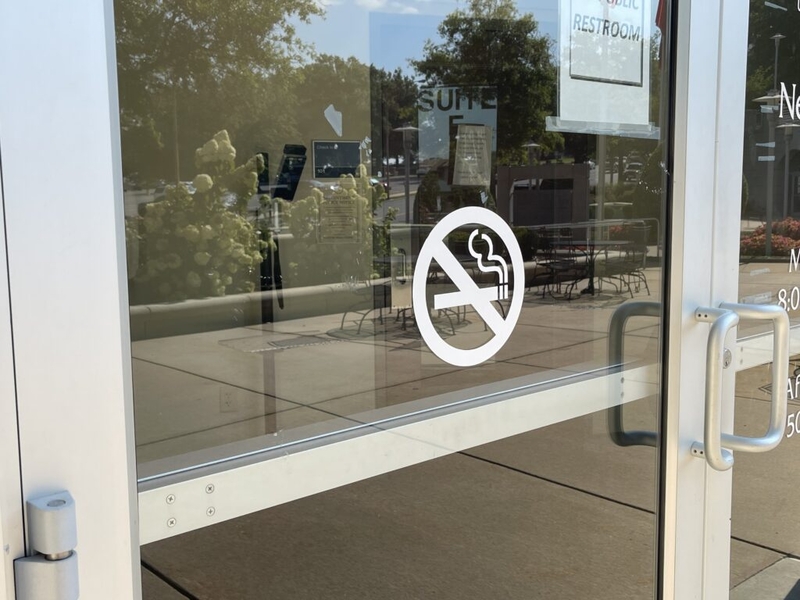
A no-smoking sign on a doorway in Little Rock, Arkansas on Wednesday, July 22, 2026 (Photo by Andrew DeMillo/Arkansas Advocate)
Just 20 years ago, trying to avoid smoke in Arkansas was an onerous task.
Going out to restaurants and bars often meant coming home reeking of cigarettes, even if you or your companions weren’t the ones smoking. Many employers had a smoke break room.
At my first newspaper job in Arkansas, that meant walking through a thick, noxious cloud to buy a can of Diet Coke from the vending machine.
It wasn’t just a hassle navigating this environment. It was a serious risk, especially for a state that has regularly placed at the bottom or near-bottom of most major health indicators.
Last week marked the 20th anniversary of the state’s indoor smoking ban taking effect. The law is a testament to bipartisanship and the work of Arkansas public health leaders. It’s also a model for how Arkansas policymakers can address the state’s public health concerns today.
Banning indoor smoking wasn’t the primary reason lawmakers were summoned to the Capitol in 2006. Republican Gov. Mike Huckabee, our current governor’s father, called the predominantly Democratic Legislature back into session to address a court ruling that Arkansas still hadn’t funded its schools adequately.
But the session gave Huckabee, who was term-limited and already laying the groundwork for a presidential bid, a chance to add policy wins to his resume. Trying to position himself as someone especially focused on health, reducing smoking became one of his signature causes.
To do so, he reversed course on his previous opposition to such a ban. The nonsmoking governor, who had received campaign contributions from tobacco companies, rejected a similar ban on smoking in restaurants in 2001.
But five years later, Huckabee argued forcefully for such a restriction and painted it as a matter of protecting workers’ health.
“I think people are going to find out that there is an overwhelming number of people who really prefer a nonsmoking environment,” Huckabee said in 2006. “There may be some businesses who think they can thrive that way, but I think more often than not, I think they not only limit their customer base but they also do encourage additional hazards.”
The wide vote margins in the House and the Senate for the ban don’t reflect just how much resistance there initially was to a ban that’s now a part of everyday life in the state. The idea faced opposition from some restaurant owners who said it would hurt their business and from some conservatives who portrayed it as a form of government overreach.
The ban even cleared the way for the passage of another measure banning smoking in cars with small children inside. Health advocates embraced that restriction, even though many suspected it was introduced as a joke or protest to the indoor ban.
The smoke-filled restaurants and other workplaces aren’t the only things that feel bizarre 20 years later. The idea of bipartisan support on public health issues, in an increasingly polarized environment, also feels like a different world.
The smoking ban passed during a weeklong session where a Republican governor and Democrats passed a raft of progressive measures. The agenda included a major boost in school funding and an increase in the state’s minimum wage.
But the smoking ban still provides a model. It showed what happens when people of different political backgrounds trust health experts and work together to make a pragmatic argument for change. It required leaders to be willing to change their minds and to accept compromises.
It’s a model that may be more difficult to replicate in an environment where so many policy discussions turn into fierce partisan battles. And it’s complicated further by the demonization public health officials have faced and the easy spread of medical disinformation.
But obstacles like that can be overcome, and environments can change. Every smoke-free workplace and restaurant in Arkansas is proof that consensus can be found.
Little Rock