Raising state revenues is essential to protecting vital services for Michiganders
Jul 27, 2026 | 7:00 am ET
Description
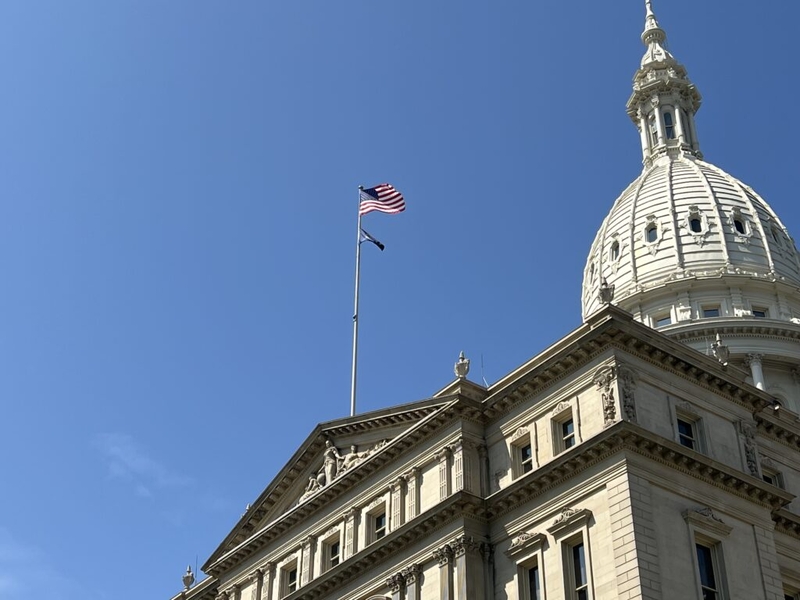
Flags atop Michigan State Capitol Building | Photo by Jon King/Michigan Advance
State policy and budget leaders have finalized the fiscal year (FY) 2026-2027 state budget, and, while it contains some important investments that are worth celebrating, it also leaves out something that is essential to protecting vital services for Michiganders: ways in which to raise revenue.
This is especially important in the wake of the passage of the so-called “One Big, Beautiful Bill Act” by Congress last year, which has left the state and those who live here bracing for significant federal funding cuts to essential social safety net programs like Medicaid and the Supplemental Nutrition Assistance Program (SNAP).
These cuts, which were made to give significant tax breaks to the wealthiest among us, will shift insurmountable costs to Michigan and cause harm to people living in every county across our state. This includes many of the estimated 40% of Michigan households already struggling to afford basic needs.
With SNAP benefits paused, Michigan recipients, advocates and lawmakers determine how to respond
Federal changes have already resulted in very real budget impacts in states like Michigan. For example, the state has had to invest more funding in SNAP for administrative costs as well as hiring costs for new staff who can work to make sure that new federal eligibility requirements are met. And the negative impact on the state’s budget will only continue to grow because changes are slated to be implemented over several years.
It’s important to recognize that raising revenues is critical to addressing Michigan’s present-day and future budget challenges; however, we here at the Michigan League for Public Policy understand it won’t be easy. One thing that is important to keep in mind when it comes to exploring revenue options is that, while Michigan was once considered a high-tax state, that is no longer the case.
Policy changes have reduced the so-called “tax burden” here. In fact, when you combine the total state and local taxes as a percent of personal income, Michigan currently ranks 38th in the nation, below any other state in the Great Lakes region.
The Headlee Amendment, which passed in 1978 with the approval of Michigan voters, also shows how Michigan’s revenues have room to grow. As a part of this constitutional change, Michigan’s total state tax collections are capped at 9.49% of personal income. However, this revenue limit was last met back in 2000.
If state tax collections would have simply kept pace with personal income since 2000, the state would have an additional $14 billion for the critical needs of Michiganders right now. These critical needs include things like healthcare, food assistance, education and childcare.
Options for raising state revenue include raising taxes on profitable corporations, ensuring flow-through businesses pay the same tax rate as traditional corporations and considering the various policy solutions that would increase taxes for the wealthiest Michiganders. Michigan currently doesn’t have any wealth taxes and they are seldom used in our country despite their revenue raising potential.
Raising the capital gains tax rate higher than the income tax rate, expanding the real estate tax, installing a progressive mansion tax rate, and decoupling from the federal estate tax and implementing either a state inheritance or estate tax are just a few ways Michigan can ensure that wealthy Michiganders are paying their fair share and reduce inequality in the state.
We at the League have also long advocated for the state to enact a graduated income tax, so those who earn the most pay a fairer share of their income in taxes. Right now that is not the case as Michigan has a flat income tax of 4.25%, meaning that everyone from all income groups pays the same tax rate. This is deeply unfair for Michiganders earning the least in our state — they pay the largest share of their income in taxes.
Tax increases on commodities like tobacco and gambling to increase funding for healthcare are also great examples of common sense ways in which the state could raise revenue while improving the health and well-being of Michiganders. We lauded Gov. Gretchen Whitmer for proposing this in her executive budget earlier this year and we were disappointed to see that it was not included in the state’s final budget agreement.
These are just a few of the avenues in which state lawmakers could address current and forecasted state budget challenges to ensure vital services for Michiganders do not need to be reduced or cut completely. It’s important for our legislators to understand that there are ways for the state to adequately and equitably raise revenues so the services that Michiganders depend upon do not continue to be placed in jeopardy.
Lansing, MI