Are we letting Oregon’s initiative process become a playground for political weirdness?
Jul 27, 2026 | 4:13 pm ET
Description
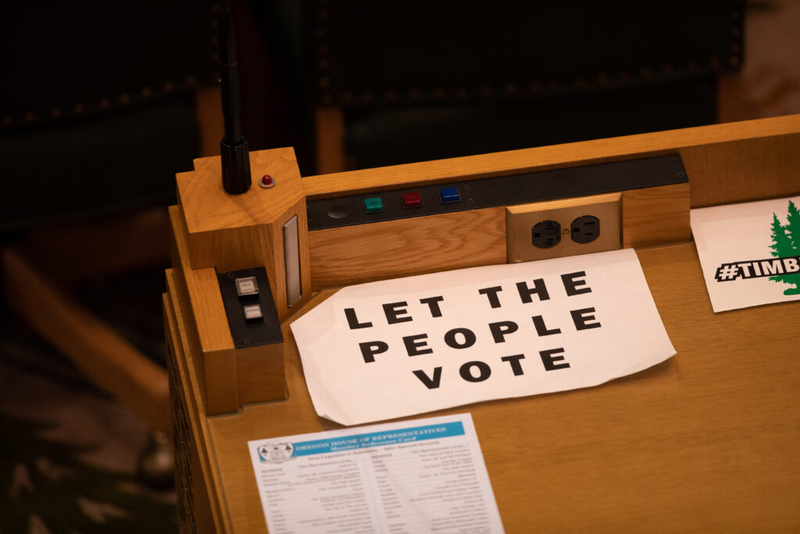
A sign on a desk in the House at the Oregon state Capitol on Monday, Sept. 20, 2021. (Photo by Amanda Loman/Oregon Capital Chronicle)
When Initiative Petition 28 failed to qualify for Oregon’s November ballot last week, my first reaction was relief.
IP 28 would have banned all hunting and fishing and most ranching and farming practices in the state. And, despite polls showing it would have faced overwhelming opposition from Oregon voters, its presence on the ballot would have sparked a silly debate about whether Oregonians should have to live like hunter-gatherers, without the hunting. I’m glad we avoided that.
Oregon initiative that would have banned most killing of animals won’t be on November ballots
But my second reaction was different. IP 28 was the only one of 88 potential initiatives filed with the Secretary of State that came close to qualifying for the 2026 general election. As a result, this will be the first time since 1966 — 60 years ago! — that Oregon voters will see not a single initiative measure on their ballots.
Is this the sign of a healthy state government, where our elected representative are taking care of the people’s business? Or a sign of fatalism in our democracy at a time when there seems no end of real problems to solve?
You’d think that, with confidence in our Legislature at an all-time low, we’d be using our vaunted initiative process to bring new solutions to the voters. After all, this was the process that, in the lifetimes of most of today’s voters, delivered vote by mail, legalized death with dignity, reset our property tax system, rebalanced our land use reforms and twice raised Oregon’s minimum wage — among other equally controversial but less enduring enactments of laws and constitutional amendments by the people.
There were hints of that energy in the list of wannabe initiatives this year: Open our closed primaries; raise, limit or eliminate certain taxes; audit our K-12 system; clear the backlog in our courtrooms; deal with the dysfunction of our mental health system. But they all fell by the wayside.
Meanwhile an animal rights crusader’s zeal to change the way of life in his home state risked not only derision and rejection but trivializing and setting back a cause that deserves a more thoughtful consideration of worst case practices.
Advocates for more serious ballot measures this year were far more cautious, stepping carefully through a process dominated by sophisticated legal battles over the wording of ballot titles and early posturing by proponents and opponents deploying patrons, polling and pledges.
This is how the process works now, for good reasons and bad. The days of “ballot measures gone wild” in the 1990s and early 2000s, when as many as 15 measures competed for our attention on a given ballot, are over.
The abuses that plagued those initiative campaigns three decades ago — paying bounties for signatures, allowing itinerant hustlers to trick unsuspecting voters into signing petitions and copying signatures from one petition to another — set the stage for a decade of reforms that followed.
In 2002, Oregon voters approved a constitutional amendment (Measure 26) banning payments per signature in initiative campaigns. (I was a chief petitioner for that measure and was pleased to see it put an end to the worst abuses of the prior era.)
In 2008, lawmakers strengthened enforcement of Measure 26 and established standards for signature collection appropriate to its importance in the election process. They also raised the threshold for securing ballot titles for proposed initiatives from 25 to 1,000 signatures, effectively curtailing the practice of “ballot title shopping.”
Finally, throughout that decade, campaigns for and against proposed initiatives began to pay more attention to the front end of the process. They lawyered up, launching legal battles to clarify or obscure the true purposes of an initiative when first presented to the voters — or, in the case of opponents, to simply delay initiative sponsors from collecting signatures.
As a result of these changes — some well warranted, others just manipulative — the process of collecting signatures became cleaner, but the effort to pursue an initiative to the ballot became more complicated and expensive. The numbers show what happened next.
In the 1990s and 2000s, Oregonians saw a total of 103 different initiatives on their general election ballots, an average of 10 in every election. In the 2010s, that average dropped below four. So far this decade, it’s been two, now headed to zero.
You might think that the cost and complexity that came with cleaning up the initiative process in Oregon is the reason leaders in our business, labor and civic sectors have disengaged from that process over the past several years. But that thought doesn’t hold up.
If anything, the leaders in those sectors have all the resources they need to engage the process to reset priorities and advance reforms that would help get our state back on track — unless they’re happy with the performance of our Legislature, pleased with the management of state government, OK with the uncompromising agendas of the major parties and unconcerned about the direction of our economy and civic life.
Perhaps, we’ll see a turnaround in the 2028 election cycle, if the proposals left on the cutting room floor this year find new sponsors and supporters. But, if that’s not the case, we may as well hand over the state’s initiative process to the follies of our political fringes.
Salem, OR