U.S. Senate candidates not addressing Michigan’s economic woes, political experts say
Jul 27, 2026 | 11:00 am ET
Description
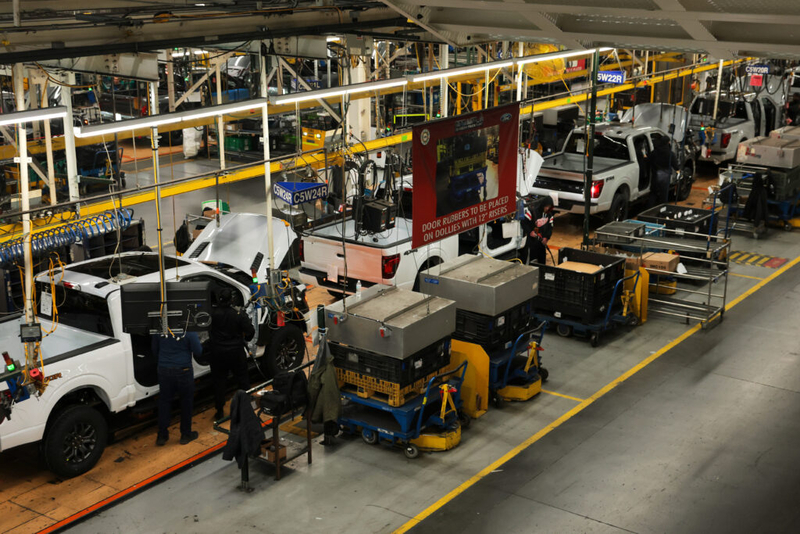
DEARBORN, MICHIGAN - JANUARY 13: Ford F-150 trucks are assembled at the Ford River Rouge Complex on January 13, 2026 in Dearborn, Michigan. U.S. President Donald Trump toured the Ford River Rouge complex prior to giving remarks to the Detroit Economic Club. (Photo by Anna Moneymaker/Getty Images)
The New York Times recently ran a fascinating piece on its opinion page featuring a panel of Michigan political experts who offered their insights into the state’s highly contentious U.S. Senate race.
The winner of the November election could determine which party will control the upper chamber next year. Should the Democrats recapture Congress, President Donald Trump’s extraordinary use of power over the past two years could be sharply curtailed.
What I found most interesting in this long opinion piece were some unusually harsh assessments of Michigan’s economy and the state’s auto industry by conservatives and liberals on the panel. Enacting policies at the federal level to recharge the state’s economy, and that of much of the manufacturing-dependent Midwest, will be a heavy lift for whoever wins the seat being occupied by Democratic Sen. Gary Peters.
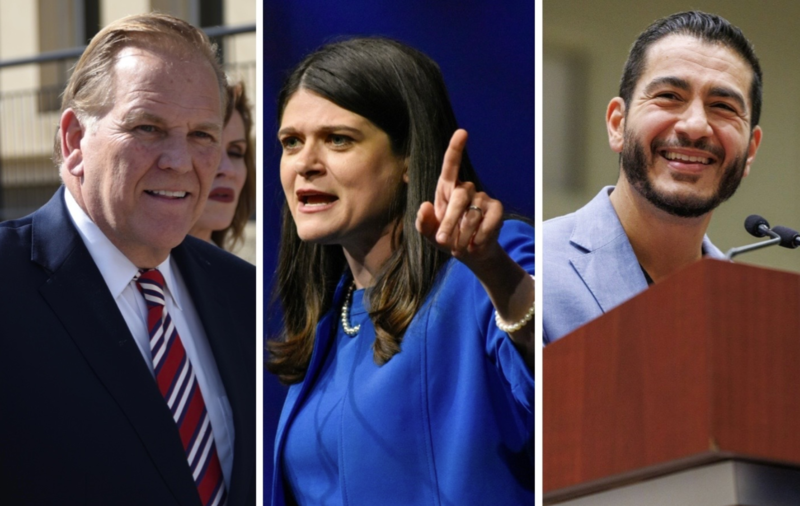
Unless you’ve completely tuned out of political news, you know that the Democratic primary for the U.S. Senate features Haley Stevens, an Oakland County centrist member of Congress, and Abdul El-Sayed, a progressive former public health official.
The winner of this hard-fought primary on August 4 will face Republican Mike Rogers, a staunch supporter of President Donald Trump.
The Times panel, which focused on the El-Sayed-Stevens race, outlined the various contentious issues in the contest: a “ferocious” backlash against data centers, Israel’s wars in Gaza and Lebanon, affordable housing and health care costs among them.
But many of the panelists expressed alarm over the steady decline of Michigan’s auto-based economy and what they see as the candidates’ lack of understanding about what policymakers need to do to reverse the slide.
“Michigan’s economy over the past 25 years has become calcified in its nostalgia for manufacturing,” said pollster Richard Czuba, who regularly surveys Michigan residents for the Detroit Regional Chamber. “And that is, at the very core, what has caused Michigan’s economy to just stagnate. We have got to change.”
Panelists expressed particular concern for the future of the state’s signature auto industry. Kaitlyn Buss, a conservative columnist at the Detroit News, said that foreign automakers have leapfrogged the Detroit 3 automakers in advanced technol
To be fair, Michigan remains the intellectual center of the auto industry, home to about half the nation’s automotive engineers. But it appears to be losing at least some of these jobs to growing auto manufacturing states in the South and to Silicon Valley.
Michigan has shed 4,000 business and professional service jobs over the past 12 months. Economists tell me that many, if not most, of those jobs are connected to the auto industry.
Some of the panelists said many young college students don’t see a future in Michigan, while working-class people are watching once-good-paying jobs in manufacturing dry up. Michigan has lost 7,000 manufacturing jobs in the past 12 months.
Saeed A. Kahn, a professor of Middle East studies at Wayne State University, said as many as 40% of his students annually tell him they plan to leave Michigan after graduating. And fewer each year say they plan to return to the state at some point to raise a family.
“They said there really is no future in Michigan. And it’s a bit surprising that the candidates aren’t picking up on this a bit more,” Kahn said.
All three Senate candidates say they are largely focused on lifting the economic prospects of the working class, mainly through rebuildi
Stevens touts her work on President Barack Obama’s 2009 bailouts of General Motors and Chrysler as making her the best candidate to restore manufacturing’s fortun
El-Sayed, who is endorsed by the United Auto Workers union, echoes the union’s opposition to free trade deals that he says “have rotted out our towns and destroyed communities.” El-Sayed also supports targete
Rogers, the lone Republican candidate seeking the Senate seat, has said he backs Trump’s broad range of tariffs to “reshore” manufacturing plants to the United States.
So far, Trump’s strategy hasn’t worked
Some of the Times’ panelists said the struggles of the working class, particularly for young men, are not being adequately addressed by the candidates.
Sarah Anthony, a Democratic lawmaker from Lansing and daughter of an autoworker, said there is little opportunity in Michigan for young men who might not be suited for spending four years at a university. She said Michigan is stuck in a “nostalgic view of Michigan” — a time decades ago when a person could walk out of high school and into a good job on an auto assembly line.
“Men and boys do not feel they have agency in this state anymore,” Anthony said. “They cannot see a prosperous future in which they belong anywhere.”
Adrian Hemond, CEO of the bipartisan advocacy firm Grass Roots, said his father-in-law at the age of 19 got a job on the line at General Motors, was able to raise a family on one income and was provided with good health care insurance and a pension.
Today, that 19-year-old would likely be working at Speedway or delivering packages at Amazon and “thinking that seems really bleak,” Hemond said. “And these candidates are not speaking to that young man.”
Lansing, MI