‘Alligator Alcatraz’ could be emitting hundreds of tons of toxic gases, new case claims
May 28, 2026 | 3:45 pm ET
Description
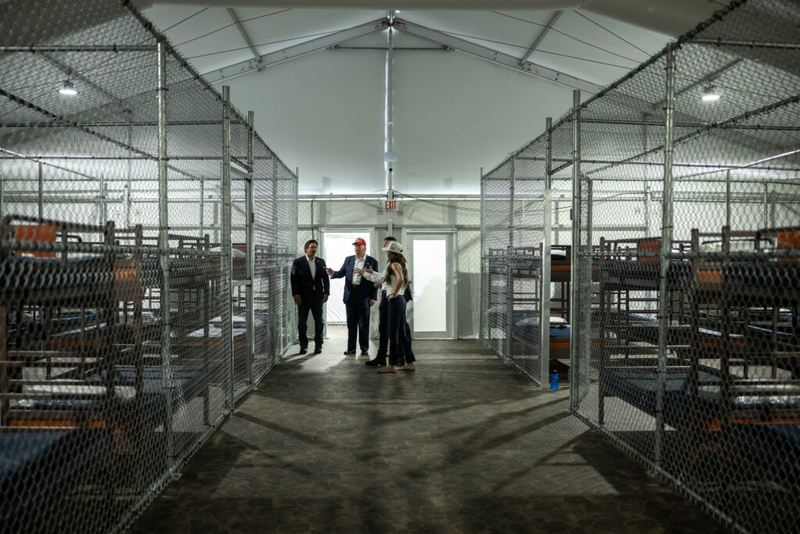
A new lawsuit claims Florida's ad hoc Everglades immigrant detention center could be emitting hundreds of tons of toxic gases without a permit. (Official White House Photo by Daniel Torok).
The so-called “Alligator Alcatraz” detention center could be pumping hundreds of tons of toxic gases into the atmosphere without a permit, Florida environmentalists suing the state claimed in a new court filing.
The federal lawsuit, brought by the Center for Biological Diversity, asks the Southern District of Florida to declare that Florida’s emergency managers have violated the Clean Air Act and to fine them more than $120K per environmental violation per day.
It’s the Center’s second lawsuit targeting the Everglades detention center’s operations over environmental concerns, and comes one month after its first case was kicked back to a lower court.
“Upon information and belief, and even using conservative estimates, collectively the generator sets and lighting towers have the potential to emit … no less than 509 tons of carbon monoxide per year [and] no less than 204 tons of [nitrogen oxides],” the suit reads.
The document points to an October environmental assessment commissioned by the Florida Division of Emergency Management, revealing that the facility requires more than 100 diesel-powered lighting towers and between 25 and 200 diesel-powered generators. These consume more than 7.6 million gallons of fuel annually, the report says.
The account was made public in March after the Center and other groups sued DEM — the agency in charge of the facility — for thousands of public records it said were being kept secret in violation of Florida law.
The assessment found that DEM needed to obtain a special air quality permit required for large facilities that emit “significant” levels of air pollution, called a Prevention of Significant Deterioration permit. It’s required under the Clean Air Act, generally if a facility can emit at least 100 tons of carbon monoxide or 40 tons of nitrogen oxides.
DEM did not respond to a request for comment.
The Center’s lawsuit is only the latest in a string of legal challenges brought against the state for “Alligator Alcatraz,” a potential billion-dollar enterprise hastily constructed atop a defunct airport deep within the environmentally fragile region.
Allegations of human rights abuses and breaking the law have swirled in federal courts across the Southern half of the state, but largely to no avail — the facility has remained open since July 1, 2025, processing more than 22,000 detainees.
Environmentalists have alleged dangers to protected wildlife and violations of federal laws, although the U.S. Court of Appeals for the Eleventh Circuit trashed their claim that the facility is subject to the National Environmental Protection Act. The court said the facility is state-run, so it doesn’t need to abide by federal environmental regulations.
A three-judge panel allowed Alligator Alcatraz to continue operation, sending the case back to a trial court for a final resolution.
The Clean Air Act, however, at issue in the Center’s case filed Wednesday, applies to both state and federal facilities. Specifically, PSD permits are dependent on a structure’s emissions, not its ownership.
Emptying out
The case comes amid reports that the facility is winding down operations. Although state authorities have insisted there’s been no “official” shutdown order, U.S. Rep. Maxwell Frost — after a tour through the center — detailed a drastic dip in detainees, emptied offices, and a skeleton crew of staff.
“Every day this facility continues to operate is another day of harm to people, endangered species and the delicate wetlands that sustain life in the Everglades,” Ryan Maher, a staff attorney at the Center, said in a written statement.
“We’re going to hold the state accountable until every dirty diesel generator is removed from the site.”
Update: An earlier version of this story incorrectly said that a previous lawsuit was tossed. Instead, it was sent to a lower court for final resolution.
Tallahassee, FL