Legislators move to support prison oversight
Sep 04, 2026 | 5:01 pm ET
Description
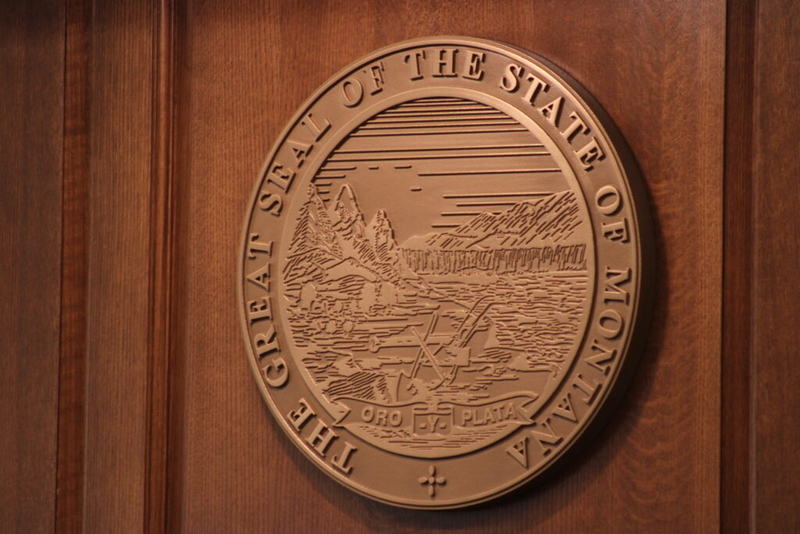
The state seal of Montana is pictured on Tuesday, Sept. 1, in the Montana Capitol in Helena, MT. (Jordan Hansen / Daily Montanan)
Legislators said increased oversight is likely coming to the Department of Corrections, potentially during the next session in 2027.
Prison rights advocates have pushed hard for independent oversight of the agency, asking legislators to demand increased transparency and accountability.
On Tuesday, the Law and Justice Interim Committee voted 5-4 to support legislation that would create a program providing independent oversight of the Department of Corrections housed in the Governor’s Office. The bill will be introduced by either Rep. Zooey Zephyr, D-Missoula, or Rep. Katie Fire Thunder, D-Bozeman.
The oversight would come in the form of an ombudsperson position, of which Montana already has several, including the Department of Justice’s Office of the Child and Family Ombudsman.
DOC Director Eric Strauss has previously said the department was “pretty agnostic” to the idea, but not inherently against the concept.
Fire Thunder introduced the legislation to the committee earlier this year. Catalyst Montana, an advocacy organization based in Missoula, has supported the idea, which was originally presented to legislators by Amanda McKnight, who began advocating for transparency after a severe water crisis at Montana State Prison a year ago.
People who have incarcerated family members, including McKnight, have been frustrated with what they say is poor communication from the agency, visits being canceled, slow medical care and inmate transfers to out-of-state facilities with little or no notice.
Some of those problems have been in part due to staffing and retention, a long-standing issue DOC has sought to address.
“This vote is a major victory for every family that has felt ignored, every correctional employee who has been afraid to speak out, and every Montana taxpayer demanding accountability from the system they fund,” McKnight said in a statement. “For too long, the Department of Corrections has largely been expected to police itself, and families have experienced the consequences when that oversight fails.”
She added that it “proves” grassroots voices can be heard by legislators and that she plans to keep fighting for the bill.
The legislation has not been a particularly partisan issue, and several of the “no” votes in the Law and Justice Committee were not because legislators thought it a bad idea, but because they said they didn’t think it went far enough. There were also slight concerns at the potential cost, which was estimated at $1 million to $1.5 million. This cost includes a similar model to a Child Protective Services ombudsperson, which includes an appointed investigator and an advisory council.
“Having operated a correctional institution, I worry about constitutional issues,” said Rep. Steven Kelly, a Flathead Republican. “Medical care falls directly under the Eighth Amendment. If they go in and find that we are failing to provide medical care, that’s a big red flag, and that will land us in federal court. Whoever finds these things should have the ability to report it and expect somebody to do something. There’s nothing here that does that, and so while this looks good on paper, it’s a paper tiger.”
Medical issues in the system are indeed a concern, Strauss said Tuesday, as he reported to legislators on a recent visit he took to Tallahatchie County Correctional Facility in Mississippi, which has been the source of complaints. The Montana DOC currently has 3,376 prisoners, with 587 of them — all men — held at the Mississippi prison. The state is contracting with that correctional facility due to overcrowding issues in Montana. The DOC moved all prisoners previously held in Arizona to the Mississippi facility earlier this year in an effort to have all of its out-of-state prisoners in one place. Both of those facilities are run by CoreCivic, a private company.
The Montana Department of Correction’s operational capacity is 3,450 prisoners, its data dashboard says. This includes men, women and juveniles.
Strauss said he found a deeply concerning problem involving inmates’ access to medical care, adding they’ve completed an audit and are in the process of finalizing a report about what happened.
“I heard repeatedly from many offenders down there that they had concerns about access to medications, access to appointments,” Strauss said.
Prisoners use tablets to communicate, and all Montana prisoners are issued one. It allows them to communicate, not only with their families, but within the prison itself, to address things like medical care.
Strauss said a feature prisoners in Mississippi were using to communicate medical issues was not being received by prison staff. It’s a feature that’s disabled on tablets in other Montana facilities, but was turned on in the Tallahatchie facility.
Prison rights advocates have also pointed to an increase in prison deaths as 17 inmates have died in DOC custody this year. That’s the highest number since the COVID-19 pandemic, when 25 inmates died in 2020 and 20 died in 2021. Prison death statistics includes illnesses, natural causes and suicide.
Four of those deaths have been at Tallahatchie County Correctional Facility in Mississippi. The other 13 have been in Montana. The Montana Department of Corrections has said their goal is to bring inmates back to the state, and Strauss again reiterated that on Tuesday.
“Our anticipated timeline, like I’ve communicated before, is aligned with the construction project at Montana State Prison,” Strauss said. “As soon as that’s done, sometime in early 2029, we would expect to return that full population back to Montana. So it is a short-term solution to short-term problem.”
Strauss said the facility is generally “quite nice” and air conditioned. He noted a lack of things for inmates at the prison to do, saying it was clear they were “bored.” As one example, inmates who had transferred from Arizona to Mississippi were not longer able to access music they’d purchased at the previous facility.
Transferring music has been complex, but is something DOC is working on facilitating, he said. Inmates previously denied certain employment based on offense now have more job opportunities in Mississippi as well. This was due to a “inconsistent application of policy” from a service provider, Strauss said.
Tallahatchie County Correctional Facility also has a different policy for inmates receiving books from family. Strauss said they were able to change that policy for Montana prisoners to be in-line with how the process would go to send a book to an inmate in the state.
He spent six hours talking with Montana inmates housed at the Mississippi facility, he added.
“There are many individual concerns that I encountered that we were able to resolve just by having a conversation,” Strauss said.
He added if state employees discover more systemic problems, they need to be noted and addressed with leadership of the Mississippi facility.
Helena, MT