Alabama immigration bill draws criticism at House committee meeting
Jan 22, 2026 | 7:59 am ET

Description
Members of immigrant rights groups gather outside the Alabama Statehouse on Wednesday, Jan. 21, 2026 following a public hearing on a bill allowing law enforcement to assist with federal immigration enforcement. Critics said the legislation could lead to harassment of immigrants and constitutional violations. (Ralph Chapoco/Alabama Reflector)
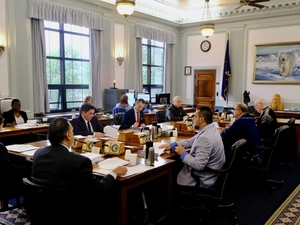
A bill that would further allow local law enforcement to assist in immigration enforcement drew criticism from immigrants’ rights groups during a public hearing hosted by the Alabama House Judiciary Committee on Wednesday.
HB 13, sponsored by Rep. Ernie Yarbrough, R-Trinity, would permit local law enforcement to enter into memorandum of understanding or agreements with federal agencies such as the Department of Homeland Security to help enforce the country’s immigration laws.
“This is to help with the flooding, particularly with criminal elements, into our country over the last several years,” Yarbrough told the committee about his bill. “We feel like that grass roots help to work together with the federal government on existing laws will help make our communities more safe.”
Several speakers expressed concerns that the bill could allow law enforcement to violate people’s constitutional rights, and said it could create fear among immigrants that they could be stopped, detained and eventually deported by law enforcement while out in public.
“We are concerned about it on a number of levels,” said Rev. Kevin Thomas, senior pastor at First Church Birmingham, in an interview with media after the meeting. “Number one; how do you determine probable cause? Number two; a law enforcement officer who gets it wrong is immune from prosecution under this bill. To allow officers to do what they do with impunity is concerning to us. As parents of a law enforcement officer, not in Alabama, we could imagine this affecting him at some point too.”
The bill comes as the deployment of Immigration and Customs Enforcement (ICE) agents in Minnesota has led to massive resistance. Allison Hamilton, executive director of the Alabama Coalition of Immigrant Justice, told the committee that ICE agents have used tear gas on individuals and families and arrested multiple people who are U.S. citizens even after they presented identification.
“One citizen in Alabama has been detained twice this year while working on construction sites and was accused of having a fake star ID both times,” Hamilton said. “We are in a very dangerous moment when a federal agency is being used to silence American people.”
Current statute only allows the Alabama Attorney General’s Office to enter into agreements with the federal government. The legislation allows law enforcement agencies to detain, remove and investigate individuals without the required paperwork to remain in the country.
It is unclear how the bill is different from the 287(g) program that also allows the federal government to obtain help from state and local law enforcement to enforce immigration. Some agencies in Alabama already have such agreements in place.
Yarbrough’s legislation requires state and local government employees to share and maintain information about the immigration status of individuals and transfer the custody of such individuals to the custody of the federal government. The legislation also allows state and local law enforcement to arrest people based on their immigration status.
HB 13 states that staff must try to determine the legal status of individuals who are arrested and contact the Law Enforcement Support Center of Immigration and Customs Enforcement to determine a person’s legal residency status if the individual is unable to provide paperwork to prove legal status.
The bill also states that people without the proper paperwork to reside in the U.S. cannot be detained without specific written instructions from ICE or LESC.
Yarbrough previously filed the bill in 2024 and 2025. Both the House Judiciary and the Public Safety and Homeland Security committees approved the legislation in 2025, but it did not come to a broader vote.
Lawmakers last year passed SB 53, sponsored by Wes Kitchens, R-Arab, that makes it a Class C felony, punishable by up to 10 years in prison and a $15,000 fine to transport individuals who do not have appropriate documentation into Alabama from another country or state.
That bill also required county and municipal jail staff to investigate the residency status of people in their custody, like HB 13.
Thomas was especially concerned with specific provisions in the legislation, such as allowing law enforcement to “arrest, with probable cause, any individual suspected of being an illegal alien.”
“It enables those officers to arrest and detain someone on probable cause of being an undocumented immigrant,” Thomas told the committee. “It doesn’t define what that probable cause looks like, and I am curious if my daughter’s skin color is probable cause for her detention, or if she is hanging out with the wrong group of people.”
Thomas said earlier that he and his spouse adopted their daughter from Guatemala who is afraid to drive and be out in public because of the scrutiny she may be subjected to by ICE and local and state law enforcement.
Several lawmakers with prior law enforcement experience praised the actions of sheriffs’ deputies and police officers charged with protecting the public.
“As a 34-year law enforcement officer, let me tell you what I see,” said Rep. Shane Stringer, R-Citronelle, during the committee meeting. “I have seen the cops take care of our community and care for people that have a love for people. Personally, I have allowed an immigrant from Honduras that was in our community with nowhere to go, to stay in a camper until he had somewhere to go.”
Other lawmakers on the committee said that people have a right to be concerned with the legislation.
“I don’t think it is unreasonable for people to think, or to be afraid, that their ethnicity can be weaponized, or used against them, by somebody who is untrained, who is unhinged, and who has absolutely no business being in law enforcement,” said Rep. Chris England, D-Tuscaloosa. “I don’t think it is unreasonable for people to have a certain level of fear if they have experienced some things in their past.”
Lawmakers will vote on the bill next week.
Montgomery